


The manufacturing sector continues to power ahead, boosted by a strong US economy. Other factors are supportive. There is a clear split in performance between fast-growing tech, pharma and transportation sectors versus more labour-intensive, commoditised sectors. Construction activity suggests interest-rate-sensitive sectors are struggling
ISM manufacturing production hits a five-year high
The October US ISM manufacturing index rose to 55.5 from 54.5 in September, where the market had expected it to remain. The production index rose to 59.0 from 56.7, indicating very robust activity, while healthy readings for new orders (55.5) and the backlog of orders (54.6) indicate that the outlook for the sector remains good – 50 is the break-even level and the further the index above 50, the greater the pace of expansion.
Employment slipped marginally to 52.4 from 52.7, but it means that the sector should continue contributing positively to Friday's payrolls figure. Prices paid remain hot though, running at 75.2, in line with their six-month average.
ISM manufacturing production versus official industrial output growth
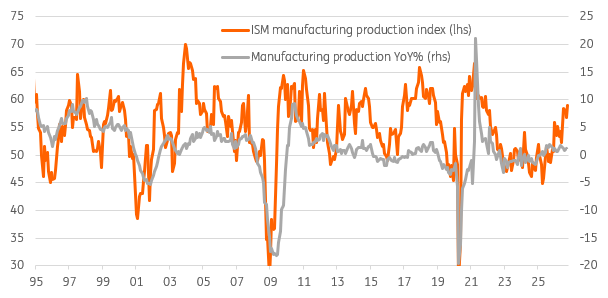
Tariffs and US energy security have boosted the attractiveness of manufacturing in the US. But so too has US economic growth, which continues to outperform other key markets. High value-added or advanced manufacturing, within which we group tech, electronics, transport and power-related sectors, has significantly outperformed other sectors. We expect this story to continue. As more countries increase military spending, US defence companies may benefit from strengthening order books.
Traditional, labour-intensive, commoditised manufacturing sectors will continue to shrink under pressure from foreign competitors. Here, tariffs are not enough to provide the competitiveness boost needed to offset the high cost of producing in the US. These US producers are also often adversely affected in foreign markets by retaliatory tariffs.
Construction contraction suggests pain in interest rate sensitive sectors
The story for the construction sector is far less rosy. Construction spending plunged 1.9% month-on-month in September, but this follows a 2% jump in August (initially reported as a 0.9% gain). There have been huge swings in residential construction recently (+3.6% MoM in August, followed by a 5.5% drop in September). As the chart below shows, the trend is clearly downwards for residential spending given the lack of affordability in a higher-mortgage-rate environment.
Residential and non-residential construction spending ($bn)
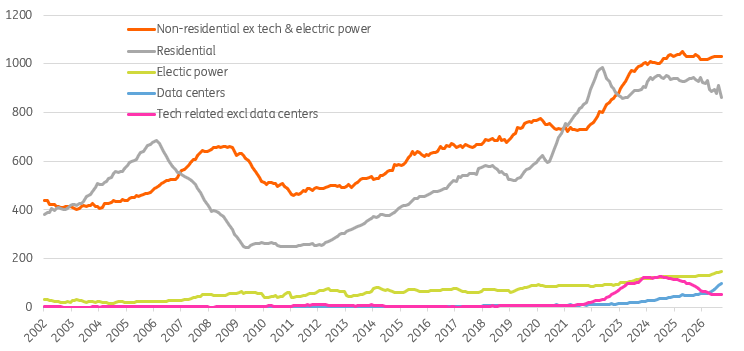
For non-residential construction, the growth is heavily skewed towards data centres, with construction spending up 8.6%MoM/90.3%YoY! All other non-residential construction outside of data centres and electric power is flat lining. This suggests that interest-rate-sensitive sectors are starting to struggle, but for tech and AI, where the appetite to spend appears insatiable, the pipeline remains strong.



Comments
Log in or sign up to join the conversation.