

|
|
|
|

We know this chart indicates a well known fact. Retail sales are diminishing in the United States. And over time the magnitude of this decline is astonishing. Xmas season is shown by the longer lines, and in 1999 reached a peak of 15875 million (15.875 billion) down to 7611 million (7.611 billion) in 2018.
As of 2018, consumer spending made up 68 percent of the economy. At 14.2 trillion dollars in 2018, two thirds of consumer spending is for services including housing and health care. Total GDP for 2018 was 20.9 trillion dollars.
Kimberly Amadeo reports that in late 2018, one quarter of workers in the United States made less than 10 dollars per hour. She cites income inequality for the decrease in spending at the retail level.
It is clear that while outsourcing jobs to emerging markets has been central to income inequality, Amadeo says that preventing companies from outsourcing jobs will not work:
Trying to prevent U.S. companies from outsourcing will not work. It is punishing them for responding to global redistribution of wealth. Neither will protectionist trade policies or walls to prevent immigrants from entering illegally.
She says that Trump tax cuts have made it worse for the bottom rungs and that:
This shift is about lessening global income inequality. The richest 1 percent of the world's population has 40 percent of its wealth. Americans hold 25 percent of that wealth. But China has 22 percent of the world's population and 8.8 percent of its wealth. India has 15 percent of its population and 4 percent of its wealth.
So, iIt is not as if China and India, for example, are wallowing in wealth. Most of the wealth remains in the USA, and developed nations. Yes wealth is shifting to EM's, but not that quickly.
A Strong Solution
As a solution, Amadeo says that taxes should be raised for the top fifth of US income earners to pay for education for the bottom two fifths. This would be an investment in future prosperity for the entire nation. It is clear from the Fred chart below that this investment is sorely needed:
|
|
|
Organization for Economic Co-operation and Development, Total Unfilled Job Vacancies for the United States [LMJVTTUVUSM647S], retrieved from FRED, Federal Reserve Bank of St. Louis; April 6, 2019. |
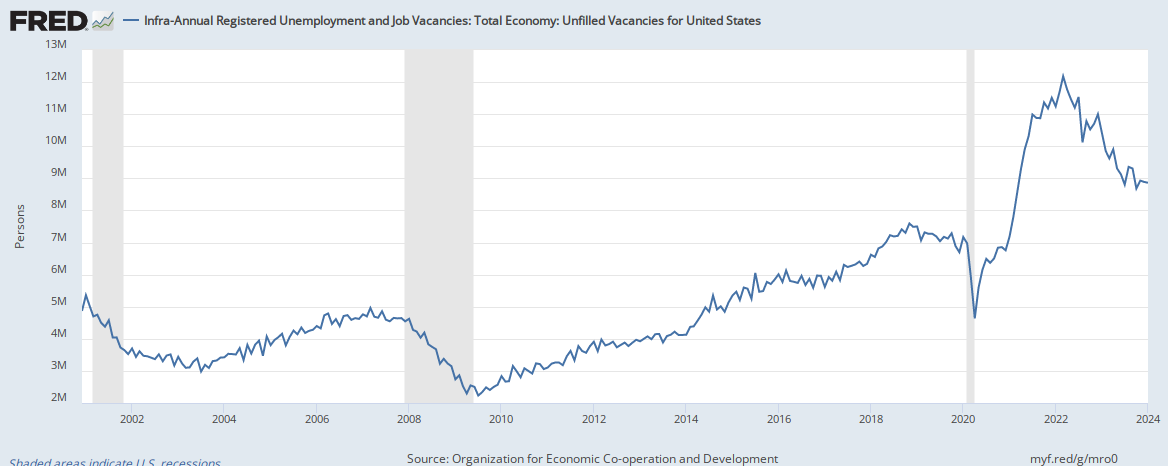
We can see that Amadeo's solution is not a solution in search of a problem. Education in the USA is becoming a real problem. Amadeo does not believe universal basic income is an answer. She did not comment on Milton Friedman's helicopter money, which could help Main Street, in addition to education.
As Dr. Dan Clinciu, founder of the HET forum has written:
Why is it that such a large number of Americans prefer to live abroad, could care less about the “American dream” and aren’t interested in filling available jobs even though quite a few are well qualified and get paid less abroad? Besides no longer believing in the American dream these days, their reasons are quite compelling!
While I believe that some of Dr. Clinciu's reasons for living outside the USA are exaggerated by him, certainly there are issues with safety, transportation and quality of life in many parts of the USA that do not exist elsewhere. Education and better job prospects are key.
And certainly, the amount of expats living abroad is difficult to measure. However, as we see from the chart above, there are 7,335,000 jobs going unfilled. Looking at the American Diaspora, it is difficult to count, but there could be close to 10 million expats living abroad. How many are of working age and have the correct skills are hard to measure.
Since Americans are double taxed in foreign lands, some have renounced citizenship.
Therefore, education for those that come to the USA, the children of immigrants, should be a priority in America. Yes, it is unlikely, as Dr. Clinciu says, that those immigrants will take the skilled jobs left behind, although perhaps some could. But their children certainly could learn to do so. There should also be a stepping up of immigration for skilled workers but the present president does not seem to understand this need for skilled workers.
And Trump's treatment of children of immigrants not born in the US is just a waste of education already instilled in many of these young people over many years. And children born here of immigrant parents should be targeted for extra educational efforts. They do not have the home environment that citizen parents provide their children.
But we have a Secretary of Education seeking to dumb down the American educational system with larger class sizes.These headwinds are difficult to overcome if America is truly going to show greatness.
The real concern for me is that almost everything that the government of the United States is doing is the exact opposite of what needs to be done to increase skilled employment. The tariff wars appear to be an effort to get other nations to buy more from the United States. Perhaps POTUS believes that skilled worker training isn't worth it and that we just need to make more stuff at a lower level of educational need.
I once thought that Trump's desire to make widgets and ignore high tech was just political music to his base. But I now think that he really means it. He really wants more widgets produced here. Yet he wants to rely on a nation (China) that has only 8.8 percent of the world's wealth. Yes, there are many high end customers who buy American and buy luxury, but widgets?
And the middle class Chinese are spending on education for their children, with not a lot of disposable income left over to buy American goods. According to HSBC, 93 percent of Chinese spend on private tuition in some form, while only 46 percent of Americans do likewise.
Seems like if they are going to buy a lot more product we are going to have to import way more from them so they can afford it. After all, China is a paradox, with many affluent, a growing middle class strapped with education needs, and a customer base that only purchases 40 percent of GDP. That number likely qualifies China keeping its Developing Country status through the WTO.
Conclusion
America has 25 percent of the world's wealth and 21.67 percent share of world GDP. We should be educating our lower rung people to do skilled jobs that go unfilled. We should be developing Latin and Asian nations. We are fearing that China, with 8.8 percent of the world's wealth and 10.3 percent share of world GDP, might dominate the world by investing in poorer nations. There is something very wrong with that picture. Our paranoia is pathological.
It is no wonder that the world and Dr. Clinciu and many others have no confidence in America. We will become great by making others great. We have the wealth. But we aren't doing the job. It is a failure, not just of Donald Trump, but of presidents past as well.
Consumer spending is a warning and a call to action for our nation to engage in the development of our people and investment in our world competitors/customers.



Comments
Log in or sign up to join the conversation.