

I wrote an article in 2016 comparing the current secular bull market that began in late 2013 to the bull markets of the 1950's and 1980's. I followed up with an update in February 2020 just as the coronavirus pandemic was unfolding. It seems time then to see how the market is progressing versus those earlier decades as the pandemic headwinds have somewhat subsided.
In the 2016 article, I noted that the 1950's and 1980's make a reasonable comparison to the 2013 bull market breakout for a number of reasons. The 1950's bull market followed World War II and economic activity was strong over the decade as consumers went on a consumption spree in an effort to satisfy pent up demand.
Infrastructure spending was also a focus in the 1950's and one area of interest was the building of the interstate highway system. Infrastructure is a focus today along with a pickup in demand following the pandemic restrictions. The 1980's growth was kick started with a lowering of government regulations, lower taxes, and more by President Ronald Reagan. President Donald Trump pursued some of these same type of policies.
As the below chart shows, the current bull market continues to track like the 1950's and 1980's markets.
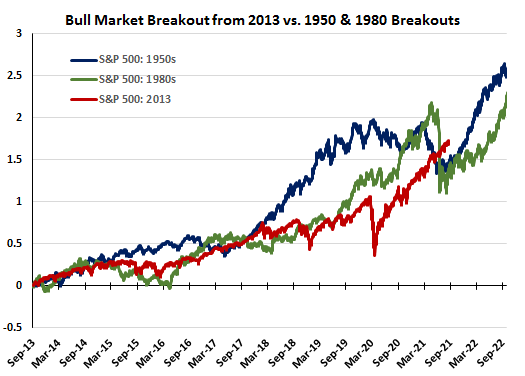
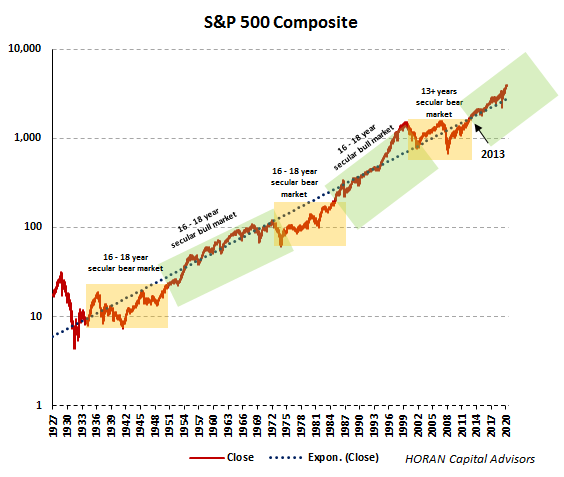
The above chart compared the 10-year periods that began in 1950 and 1980. With that being the case, the current secular bull market that began in September of 2013 would end September 2022. Note, though, that secular bull markets tend to run over a 16-18 year period. This is shown in the chart below.
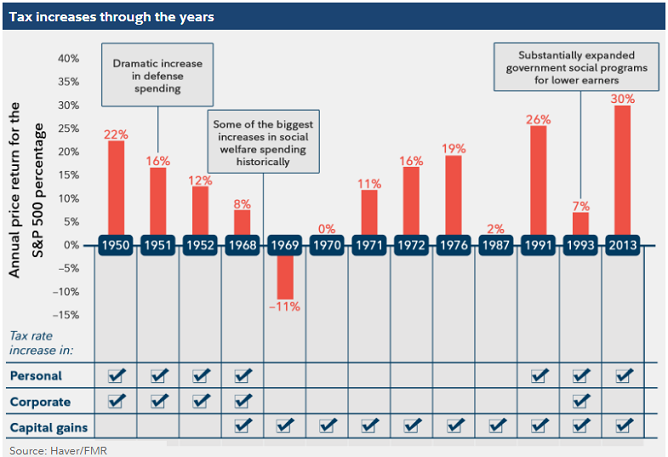
Higher taxes seem likely for the near-term based on activity in Congress, but higher taxes have not necessarily lead to lower stock prices. The below table from Fidelity highlights this fact. One reason this tends to be the case is the fact Congress and administrations in Washington, D.C. tend to raise taxes when the economy is expanding; thus, making it easier for companies to digest the increase.
What seems like an economy that is being partially driven by consumers satisfying pent-up demand and more unemployed individuals coming back into the labor force could experience continued growth over the next few years. I have said many times that the performance of the economy does not necessarily track the performance of the stock market, or vice versa.
However, company earnings continue to see strong growth and these earnings continue to exceed expectations. Yes, the stock market is not cheap; however, low interest rates tend to lead to stocks trading at higher P/E's or valuations.
The market is due for a pullback, as they are typical during bull markets. Given the decent economic backdrop and the strong earnings environment, a pullback probably does not lead into a recession, all else being equal.

Comments
Log in or sign up to join the conversation.