

Has the DNA of the global economy been gradually altered by endless injections of quantitative easing, morphing it into a freakish mutant? Are things that are not supposed to happen for centuries on end going to become common occurrences? The collapse of oil prices and jump in the Swiss franc have forced me to puzzle over these weighty questions. In isolation, these events and the direction of their moves did not worry me, but their magnitude, velocity and proximity to each other sent me on an intellectual quest.

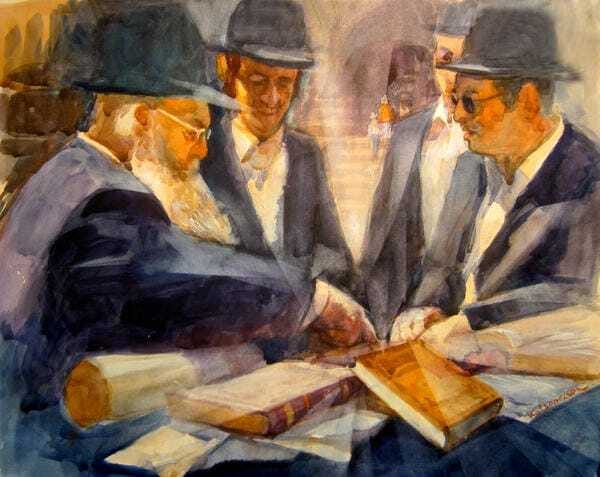
Watercolor (not named) is by my father Naum Katsenelson
I wanted to share with you music that you may have heard in the movie Godfather. No, not Godfather 1 (though you can listen to that here), but Godfather 3.
It is an opera by Pietro Mascagni called Cavalleria Rusticana (loosely translated: Peasant’s Honor). This was Mascagni’s first opera, which he wrote in two months in 1888 as an entry in competition for young Italian composers. He wrote fifteen operas during his life but this remained the most popular.
My two favorite parts of this opera are the intermezzo (overture in the middle of the opera) and the chorus of peasants. Movie buffs may recognize this intermezzo from another movie: it was used in the opening credits of Martin Scorsese’s Raging Bull(listen here). Here are several performances of it:
From Godfather 3: listen here
From a 1982 film directed by Franco Zeffirelli with Placido Domingo and Russian gem Elena Obraztsova. This link is to the full movie, but it starts at the chorus part.
For comparison purposes, here is a 1968 film of the opera (starting at the chorus part). Hopefully this comparison highlights the cinemagraphic genius of Franco Zeffirelli (he also wrote and directed one of my favorite movies, Callas Forever). My kids and I love to sit in front of the TV and watch different performances, and then we discuss them. We did this with Jonah (my 13-year-old) yesterday, and he actually preferred the soprano in this movie, while I am very partial to Elena Obraztsova. I’ll let you decide.
Finally, Ricardo Muti conducting the intermezzo: listen here
I want to preface my article with a short excerpt from one of my favorite books,Antifragile, by Nassim Taleb:
A turkey is fed for a thousand days by a butcher; every day confirms to its staff of analysts that butchers love turkeys “with increased statistical confidence.” The butcher will keep feeding the turkey until a few days before Thanksgiving. Then comes that day when it is really not a very good idea to be a turkey. So with the butcher surprising it, the turkey will have a revision of belief—right when its confidence in the statement that the butcher loves turkeys is maximal and “it is very quiet” and soothingly predictable in the life of the turkey.…The key here is that such a surprise will be a Black Swan event; but just for the turkey, not for the butcher….
“Not being a turkey”starts with figuring out the difference between true and manufactured stability.(emphasis mine).
Our global economy and thus stock markets have experienced manufactured (not true) stability, and this is what I am puzzling about in the following article that I wrote for Institutional Investor.
Unraveling the Mystery of Oil and the Swiss Franc
Has the DNA of the global economy been gradually altered by endless injections of quantitative easing, morphing it into a freakish mutant? Are things that are not supposed to happen for centuries on end going to become common occurrences? The collapse of oil prices and jump in the Swiss franc have forced me to puzzle over these weighty questions. In isolation, these events and the direction of their moves did not worry me, but their magnitude, velocity and proximity to each other sent me on an intellectual quest.
Let’s start with oil. Supply has been increasing due to growth in shale oil production in the U.S., and that increase along with a stronger dollar drove oil prices lower (since oil is priced in dollars). Additionally, demand for oil has weakened in the developed markets as vehicles have become more fuel-efficient. However, none of these things are new. You can also blame the fall in oil prices on OPEC and its unwillingness to lower production, but what is now an obvious decline was not obvious six months ago. Oil prices have sunk more than 50 percent in less than five months, and this happened not during a financial crisis but in a (supposedly) stable global economy where most economies are growing.
Continue reading on Institutional Investor…
Comments
Log in or sign up to join the conversation.