

USD/JPY rises as Middle East tensions boost dollar demand
USD/JPY is rising for a second straight session as renewed geopolitical tensions support the US dollar and keep inflation concerns elevated ahead of key US CPI data later today.
The dollar is strengthening after President Trump questioned the durability of the US-Iran ceasefire following his rejection of Tehran’s latest peace proposal. The developments have triggered renewed safe-haven flows into the dollar, while US equity futures traded modestly lower.
Markets are increasingly focused on the inflationary implications of higher oil prices. US CPI is expected to rise to 3.7% year-on-year in April from 3.3% previously, as the recent surge in crude prices begins feeding through into the data.
A stronger-than-expected inflation print would further reduce expectations for interest rate cuts from the Federal Reserve this year, reinforcing support for the dollar and Treasury yields.
Meanwhile, the yen remains under pressure from rising oil prices despite ongoing coordination between Washington and Tokyo on currency policy. Japanese Finance Minister Satsuki Katayama recently met with US Treasury Secretary Scott Bessent amid speculation Tokyo has spent more than $63 billion intervening in FX markets to stabilise the currency, although authorities have not confirmed intervention.
Separately, the summary of opinions from the Bank of Japan’s April meeting suggested policymakers are increasingly open to further tightening, potentially as early as the next meeting, as elevated oil prices continue to add to inflation pressures.
USD/JPY forecast – Technical analysis
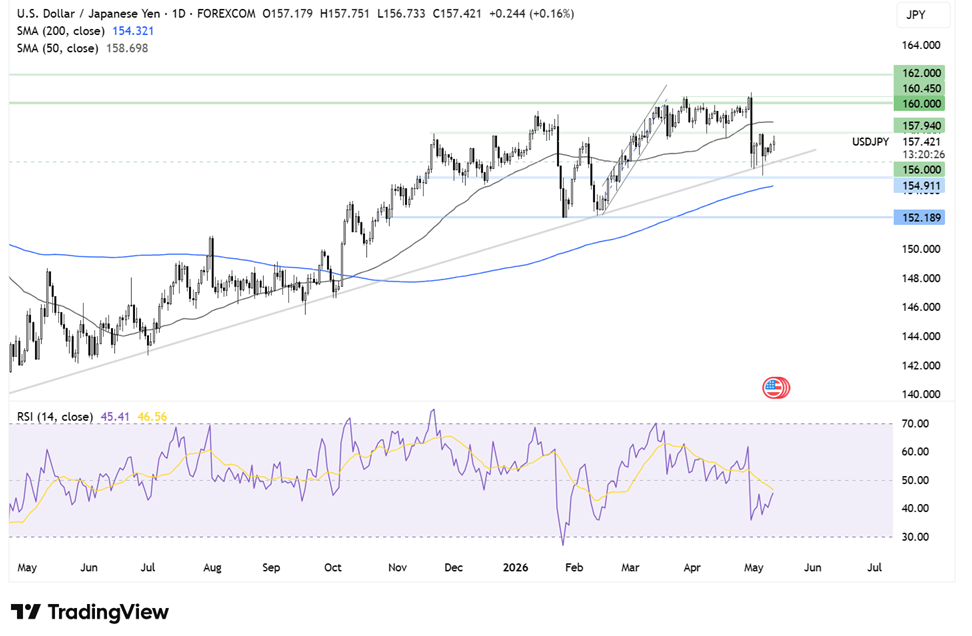
USD/JPY continues to trade above its longer-term rising trendline.
After consolidating between 157.90 and 160.50, the pair broke lower before finding support at the rising trendline dating back to April last year. The rebound from that support has so far stalled near 157.90 — a key level buyers need to reclaim to strengthen the near-term outlook and expose the 50-day SMA at 158.75. Above there, 160 comes back into focus.
On the downside, initial support is seen at 156 near the rising trendline, followed by 155, the May low. A break below these levels would expose the 200-day SMA near 154.30.
DAX falls as oil prices and inflation risks rise
European equities opened lower on Tuesday as investors monitored developments in the Middle East and awaited key US inflation data.
Trump’s comments over the fragile ceasefire between Washington and Tehran have renewed doubts about the likelihood of a lasting truce, pushing oil prices higher again. Brent crude is trading around $105 per barrel amid continued concerns over supply disruption.
Officials at Saudi Aramco warned that even if the Strait of Hormuz blockade ended immediately, global energy markets may not fully normalise until 2027, underlining the scale of the disruption.
Higher oil prices are reinforcing inflation concerns globally. In Europe, markets are now pricing in two 25 basis point rate hikes from the European Central Bank this year, with around a 75% probability of a third increase by year-end.
Attention later today will focus on US CPI data, while German ZEW economic sentiment figures are also due. Sentiment is expected to deteriorate further, with forecasts pointing to a decline to -19.8 from -17.2 previously. Weak German data could hurt sentiment and pull the DAX lower.
Investors are also watching Trump’s upcoming summit with Xi Jinping in Beijing, where discussions are expected to cover Iran, tariffs, AI, and Taiwan.
DAX forecast – Technical analysis
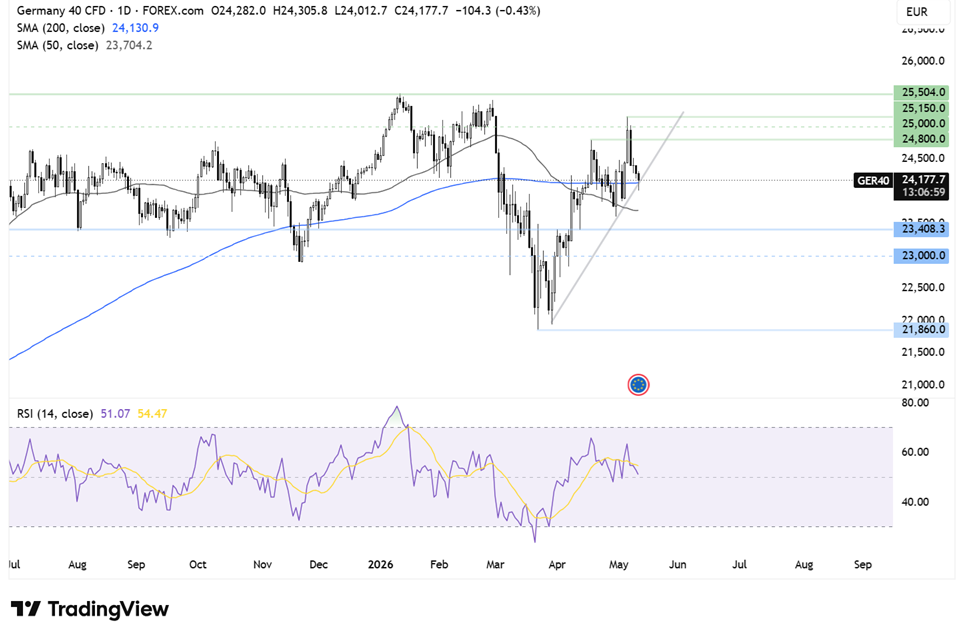
The DAX recovery from the 21,860 low stalled near 25,150 before easing back towards 24,170.
The index is now testing near-term rising trendline support alongside the 200-day SMA. Buyers will need to defend this zone to maintain the broader uptrend.
If support holds, attention will return to 24,800, the April 17 swing high, followed by 25,150, the May peak.
A break below 24,150 would expose the 50-day SMA near 23,700. Beneath that, focus shifts towards 23,450 — the April 13 swing low and April 1 breakout level.



Comments
Log in or sign up to join the conversation.