


DAX Rises as Oil Retreats on Diplomacy Hopes and Attention Turns to Earnings Season
The DAX, along with its European peers, is heading higher on Tuesday on reports of U.S.-Iran mediation attempts, which have pulled oil prices lower.
Oil prices have retreated from a monthly high amid reports of diplomatic efforts between Washington and Tehran. However, it's still early days, and concerns over energy supplies remain. Yemen's Iran-aligned Houthis announced a blockade of Saudi Arabia on Monday, highlighting that geopolitical risks haven't disappeared.
Earnings are also in focus this week, with Alphabet and Intel due to report. Investors will be looking for clues over the sustainability of AI-related spending and whether lofty valuations across the sector remain justified.
Attention is also turning to Thursday's ECB rate decision, where the central bank is expected to leave interest rates unchanged at 2.25%. However, ECB President Christine Lagarde could keep the door open to a September rate hike, particularly if higher oil prices threaten to lift inflation again.
Before then, German ZEW economic sentiment figures are due shortly, with sentiment expected to improve to 18.0 in July from 10.5 in June.
Friday's PMI data will also be watched closely for fresh clues on economic activity after recent weakness across the eurozone.
DAX forecast – technical analysis
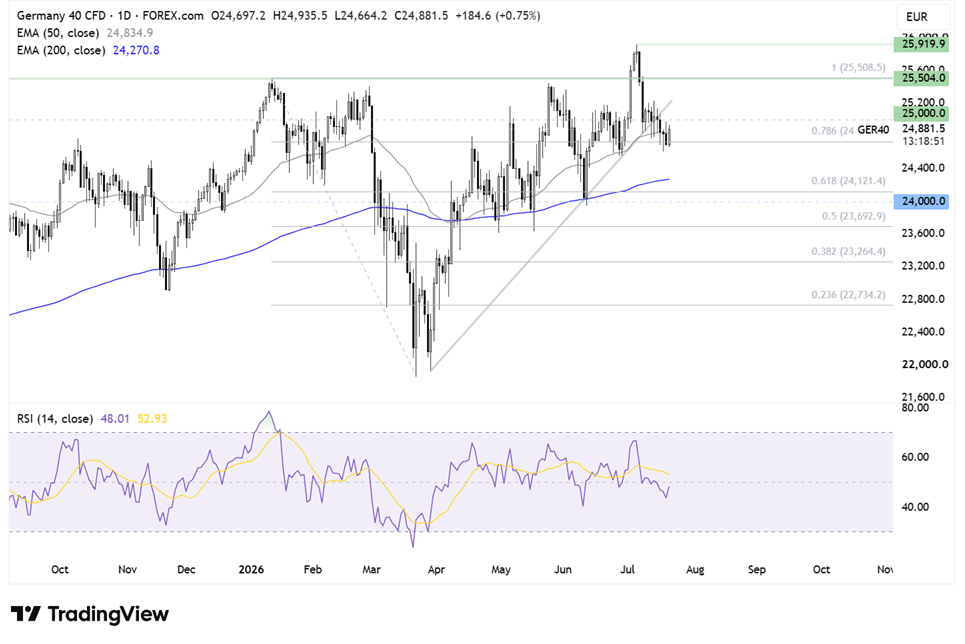
After running into resistance at the record high of 25,900, the DAX has eased lower, breaking below rising trendline support before finding support around 24,700, the 78.6% Fibonacci retracement of the 21,860–25,500 rally.
Sellers would need to break below 24,700 to create a lower low and expose the 200-day EMA at 24,260. A move below here could see selling pressure gather pace.
On the upside, buyers need to reclaim the 50-day EMA at 24,850 to bring 25,000 into focus. Above there, attention turns to 25,500 ahead of the 25,900 record high.
GBP/USD Holds Steady as Markets Weigh Fiscal Concerns, Higher Government Borrowing & Jobs Data
GBP/USD is holding steady below 1.3450 on Tuesday as investors digest the latest UK labour market data, Andy Burnham's policy pledges and a larger-than-expected government borrowing overshoot.
The new Prime Minister has pledged further support to help households with the cost of living. However, the growing list of spending commitments is raising questions over how they will be funded.
Calls for greater fiscal flexibility have unsettled the gilt market, pushing bond yields higher and could limit any upside in sterling.
Those concerns come as data showed Britain borrowed more than expected in the first three months of the fiscal year, underlining the challenges facing the new Chancellor, John Healey, as he looks to balance the public finances.
The budget deficit totalled £57.6 billion between April and June, £2.7 billion higher than the Office for Budget Responsibility forecast in March.
That said, June's figures were more encouraging, with the monthly deficit narrowing by almost £8 billion to £16 billion.
Meanwhile, the latest labour market data suggests conditions may be stabilising, although wage pressures continue to ease.
The number of employees on payrolls fell by 4,000 in June, a smaller decline than the 8,000 expected. Job vacancies were unchanged at 712,000, unemployment held steady at 4.9%, and regular wage growth remained at 3.4%.
Private sector wage growth slowed to 2.9%, the weakest reading since October 2020, suggesting the labour market is becoming less supportive of second-round inflation pressures.
The data comes ahead of next week's Bank of England meeting, where policymakers are expected to leave interest rates unchanged. Markets are pricing just a 14% chance of a 25bp rate hike next week, although investors still expect rates to rise again before the end of the year.
Meanwhile, the U.S. dollar is little changed as tensions between the U.S. and Iran ease slightly and oil prices retreat.
The U.S. economic calendar is relatively quiet this week, with Friday's PMI data the main scheduled release. Otherwise, developments in the Middle East are likely to remain the main driver of the dollar.
GBP/USD forecast – technical analysis
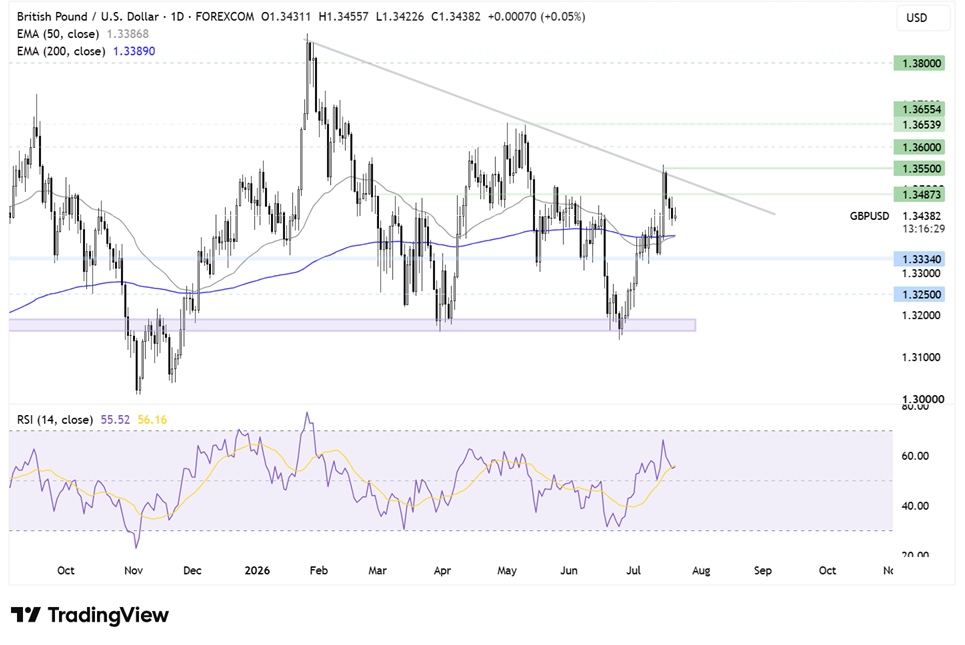
GBP/USD recovered from the 1.3200 support zone, rising above the 250-day EMA before running into resistance around 1.3550, where the falling trendline also comes into play.
The pair continues to trade above the 50-day and 200-day EMAs, but below the falling trendline resistance, leaving the near-term picture slightly mixed.
Buyers need to break above the trendline around 1.3525 and then clear 1.3550 to create a higher high and bring 1.3600 into focus, ahead of 1.3650.
On the downside, initial support can be seen at 1.3400. Below there, the 200-day SMA at 1.3340 comes into focus.

Comments
Log in or sign up to join the conversation.