

Oil rises as ceasefire optimism fades and supply risks remain elevated
Oil prices are rising more than 2% on Thursday, clawing back losses from the previous session as investors reassess conflicting signals from the US and Iran over ceasefire talks, de-escalation in the Middle East, and the broader outlook for global energy supply.
While the US continues to signal that it is pursuing a diplomatic route towards ending the conflict, Iran has so far rejected direct negotiations, despite reportedly reviewing a 15-point proposal from President Trump. At the same time, the Strait of Hormuz remains effectively closed, keeping supply concerns firmly in place.
Trump has also warned that the US could take more aggressive action if Tehran does not accept what he described as a “military defeat”, suggesting that hopes for a near-term ceasefire may be fading.
Any eventual agreement would likely need to allow both Washington and Tehran to present the outcome domestically as a strategic win — a challenge that could prolong negotiations and keep energy markets on edge.
Additional supply-side pressures are also adding to the bullish backdrop for oil.
Japan has reportedly released 80 million barrels from its strategic reserves to ease market tightness. However, this is being offset by fresh disruptions elsewhere. Around 40% of Russia’s oil export capacity is reportedly offline following Ukrainian drone strikes on a major pipeline, while Iraqi oil production has slowed amid rising storage constraints.
Taken together, these developments suggest that while some geopolitical risk premium may have faded from its recent extremes, the underlying supply picture remains fragile.
For oil prices to move meaningfully lower from here, markets will need to see more concrete evidence of de-escalation — particularly around the reopening of the Strait of Hormuz and a reduction in physical supply disruption across key producing regions.
Oil forecast -technical analysis
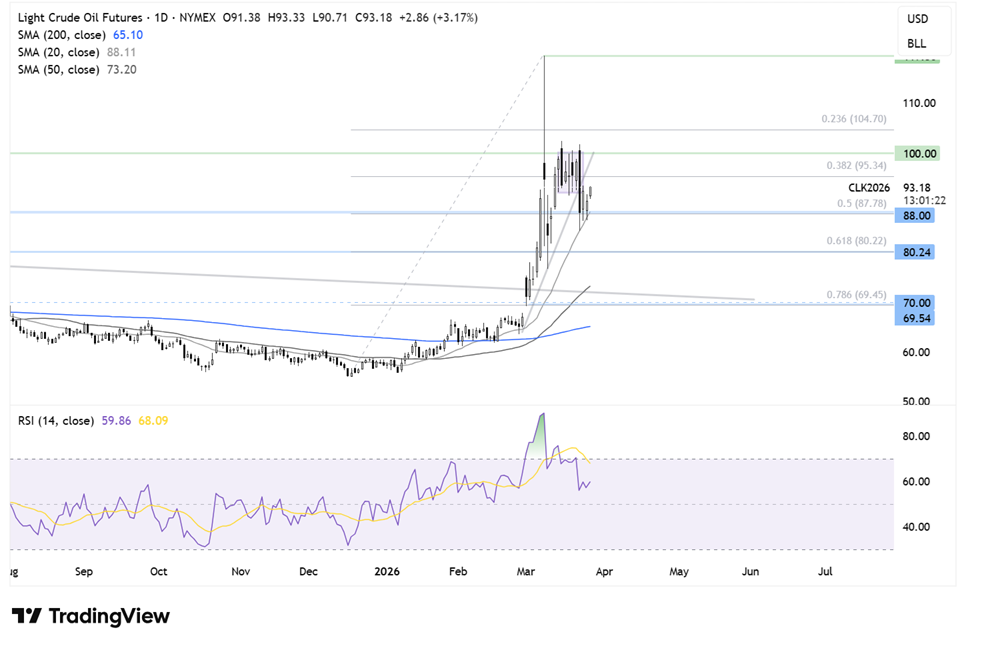
After several days in a holding pattern between 92.50 and 100.00, the price of oil broke lower, taking out of the falling trendline support, bringing the RSI out of overbought territory. However, the price found support and the 20 SMA before, recovering higher.
Buyers will look to extend the recovery to 95.00, the 38.2% Fib level of the 55.00 low and 120.00 high, before looking towards 100.00.
Support is seen at 88.00, the 50% Fib retracement level, with a break below it opening the door to 80.00.
FTSE and European markets fall as higher oil revives inflation fears
The FTSE 100, along with its European peers and bond markets, is trading lower as renewed uncertainty over the Middle East conflict pushes oil prices higher and revives concerns over inflation.
Conflicting statements from the US and Iran regarding peace talks have injected fresh uncertainty into markets, leading investors to reverse some of the relief rally seen earlier in the week.
Brent crude has moved back above $100 a barrel and is now on track for its largest monthly gain since 1990. This sharp rise in energy prices is once again fuelling inflation concerns and feeding directly into expectations for central bank policy.
UK gilt yields are moving higher as markets reassess the Bank of England outlook. While investors were pricing in around two rate hikes from the BoE as recently as yesterday, the latest repricing now points closer to three hikes, reflecting fears that elevated energy costs could prolong inflationary pressures.
This is becoming increasingly problematic for the UK economy, where growth is already fragile.
The British Retail Consortium’s measure of expectations for the economy over the next three months fell sharply to -53 in March from -30, marking the weakest reading since the series began in March 2024.
This suggests that households and businesses are becoming increasingly pessimistic about the outlook, with higher energy costs expected to reduce disposable income and weigh on discretionary spending.
From a sector perspective, the market reaction is consistent with a higher-for-longer rates and slower-growth environment.
Energy stocks are outperforming on the back of stronger oil prices, while miners are under pressure. Rate-sensitive and growth-linked sectors such as real estate are also lagging, reflecting the drag from higher yields and weaker macro expectations.
Overall, the market is once again confronting a stagflationary-style backdrop — where inflation risks are rising even as growth expectations deteriorate.
FTSE forecast -technical analysis
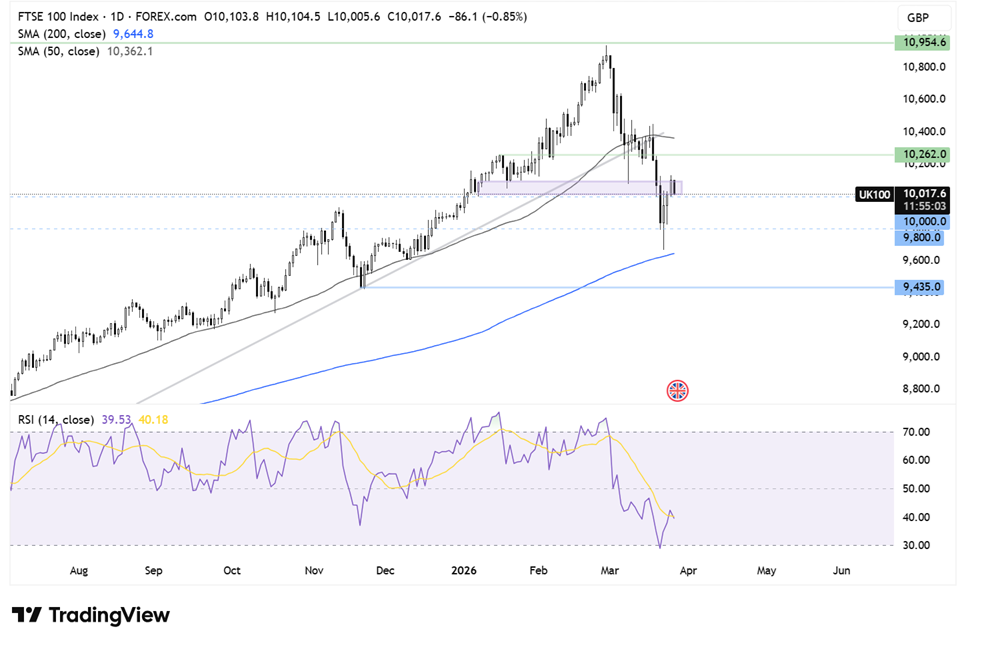
After running into resistance at 10,935, the record high, the FTSE rebounded lower, breaking below its rising trendline, the 50 SMA, before finding support at 9665, just above the 200 SMA. The price rebounded higher, with a hammer reversal candlestick bringing some optimism to the bulls. However, the recovery has run into resistance around the 10,000 resistance zone.
Rejection at this 10,000 resistance zone could see the price fall back to towards 9800 round number and 9650, the 200 SMA.



Comments
Log in or sign up to join the conversation.