


Oil falls further on diplomatic hopes for a Middle East resolution
Crude oil prices are falling for a third straight day as signs of diplomatic progress in the Middle East reduce some of the supply-risk premium built into prices.
Technical talks between Iran and Oman appear to be making progress towards a maritime corridor covering the future administration of the Strait of Hormuz, information sharing, traffic management and the provision of maritime and security services.
Other signs of progress include Pakistan's army chief travelling to Tehran to support diplomatic efforts, while Qatar said it was continuing its mediation.
The improving diplomatic outlook has overshadowed Washington's latest measures to increase economic pressure on Iran, which were less aggressive than the market had feared. Investors also appear to view economic sanctions as less of a threat to oil supply than further military escalation.
Meanwhile, U.S. crude inventories increased by 4.2 million barrels in the week ending August 21, well above expectations for a 1.2 million-barrel increase and reversing the 328,000-barrel drawdown seen the previous week.
For oil prices to extend their decline, the market will want to see clear evidence of improving supply flows, particularly an increase in vessels transiting the Strait of Hormuz. Conversely, any renewed escalation or disruption to shipping could quickly put a risk premium back into crude prices.
Oil forecast – technical analysis
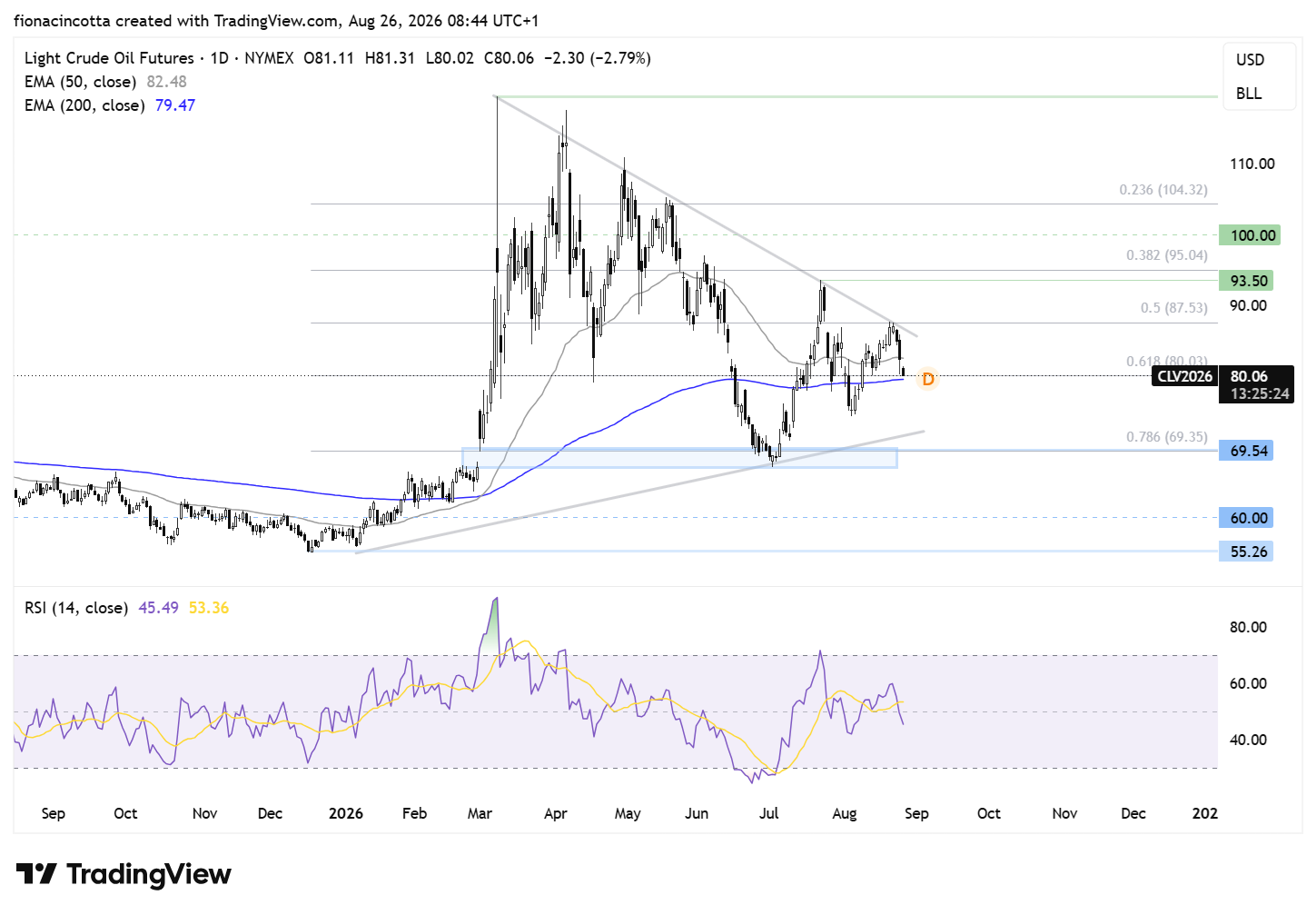
Oil remains within a symmetrical triangle pattern. The price recently ran into resistance around $88, where the falling trend line and 50% Fibonacci retracement of the $55 low to $120 high converge.
The subsequent decline has taken oil below the 50 EMA, with the price now testing the 200 EMA and the 61.8% Fibonacci retracement around $80. The RSI is below 50, keeping sellers in control of near-term momentum.
A break below $80 would strengthen the bearish outlook and bring $75, the August low, into focus, followed by the rising trend line around $70. A break below $70 would mark a more significant deterioration in the technical picture and expose $60.
However, if the 200 EMA holds, buyers will look to reclaim the 50 EMA around $82.50 before retesting $88. A break above $88 would create a higher high and shift attention towards $95 and then $100.
EUR/USD consolidates ahead of U.S. inflation and Jackson Hole
EUR/USD is consolidating around 1.1660 after easing back from its highest level since May 14, as traders await fresh clues on the Federal Reserve's interest-rate outlook.
Attention is firmly on today's U.S. core PCE inflation data and Federal Reserve Chair Kevin Warsh's speech at the Jackson Hole Symposium on Friday. Together, they could be pivotal for the next move in the U.S. dollar.
Core PCE is expected to remain unchanged at 3.3%, while headline inflation is forecast to ease to 3.6% in July from 3.7% in June.
The data comes as markets expect the Federal Reserve to leave interest rates unchanged at the September 15–16 FOMC meeting, following subdued CPI data and a weaker-than-expected labour market.
The outlook contrasts with that of the ECB, where policymakers are expected to raise interest rates in September in response to inflationary pressures following the Middle East conflict.
This divergence in expected Fed and ECB policy continues to provide a fundamental tailwind for EUR/USD.
At the same time, U.S. Treasury buybacks and falling oil prices have helped push Treasury yields lower. If yields continue to decline, while diplomatic optimism reduces safe-haven demand for the dollar, this could provide further support for EUR/USD.
The key risk is therefore the U.S. inflation and Fed outlook. A cooler-than-expected PCE reading or a cautious Warsh could weaken the dollar and give EUR/USD another push higher. Conversely, sticky inflation or a hawkish Fed message could send yields and the dollar higher, putting the recent euro rally under pressure.
EUR/USD forecast – technical analysis
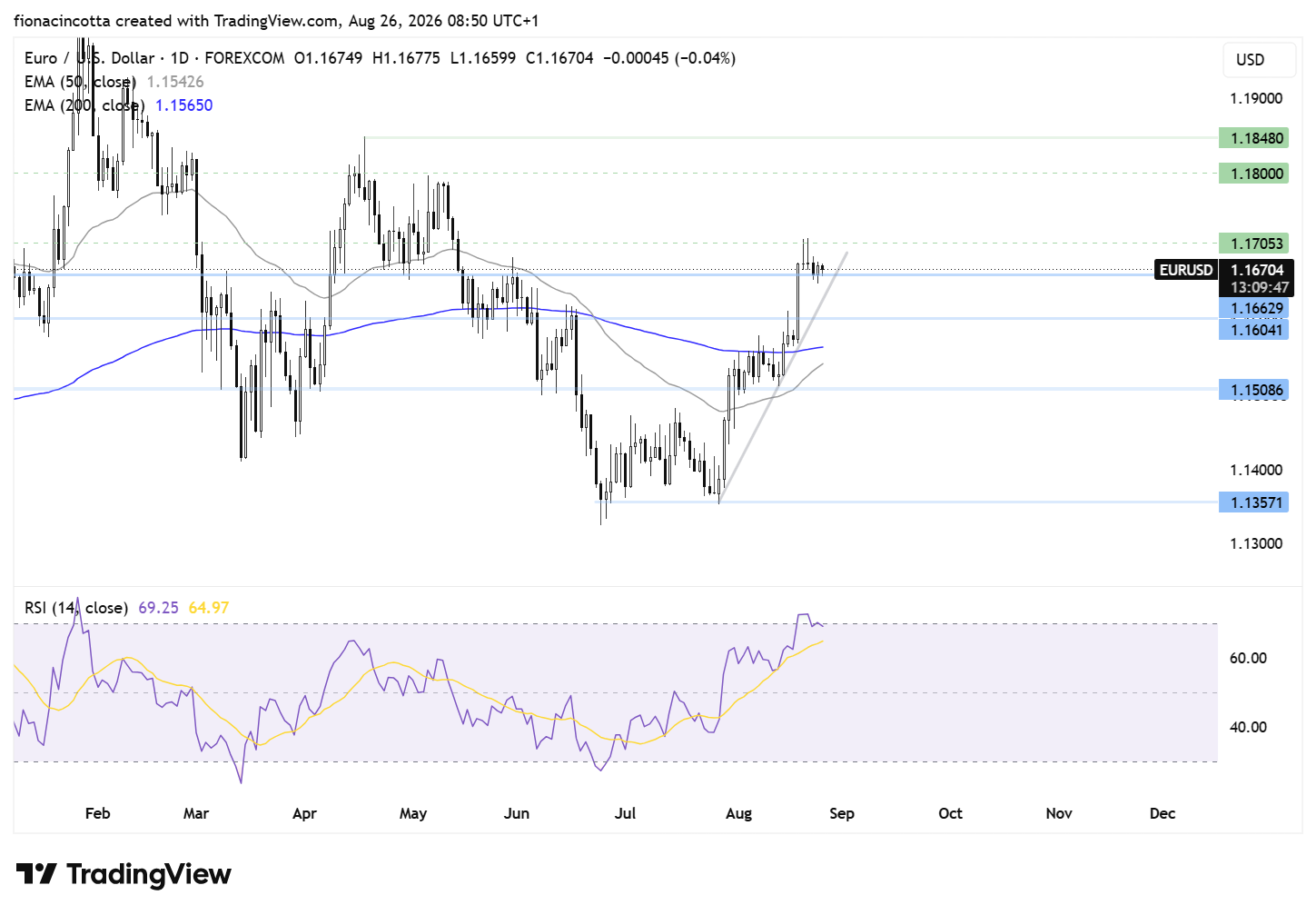
EUR/USD has recovered from the 1.1350 low, rising above its ascending trend line and the 50 and 200 EMAs on the daily chart.
The pair ran into resistance above 1.1700 and has eased back towards 1.1670, bringing the RSI out of overbought territory while the broader uptrend remains intact.
Buyers will look to break above 1.1700 to bring 1.1800 into focus, followed by 1.1840, the April 2026 high.
On the downside, sellers would need to break below 1.1600 to expose 1.1560, around the 200 EMA. Below here, 1.1500 becomes the next key support level.



Comments
Log in or sign up to join the conversation.