

Oil drops sharply as Trump sees the Middle East war ending soon
Oil prices are falling sharply on the prospect of the Middle East war coming to an end.
After rallying to an almost four-year high of $120.00 a barrel yesterday, oil retreated below the key $100 psychological level after Trump said the war in Iran could end soon, and that the Iran war is ahead of schedule.
Trump's comments have helped ease concerns about a prolonged conflict in the Middle East and fears over supply disruptions.
However, it's worth noting that events continue to move fast and unpredictably, driven by volatility, uncertainty, and headlines.
The Trump administration will be sensitive to persistently high energy prices and reluctant to see them persist over a longer period of time.
However, the markets will want to see a reconciliation between Trump's comments and actions on the ground or around the Strait of Hormuz to support this.
Oil forecast – technical analysis
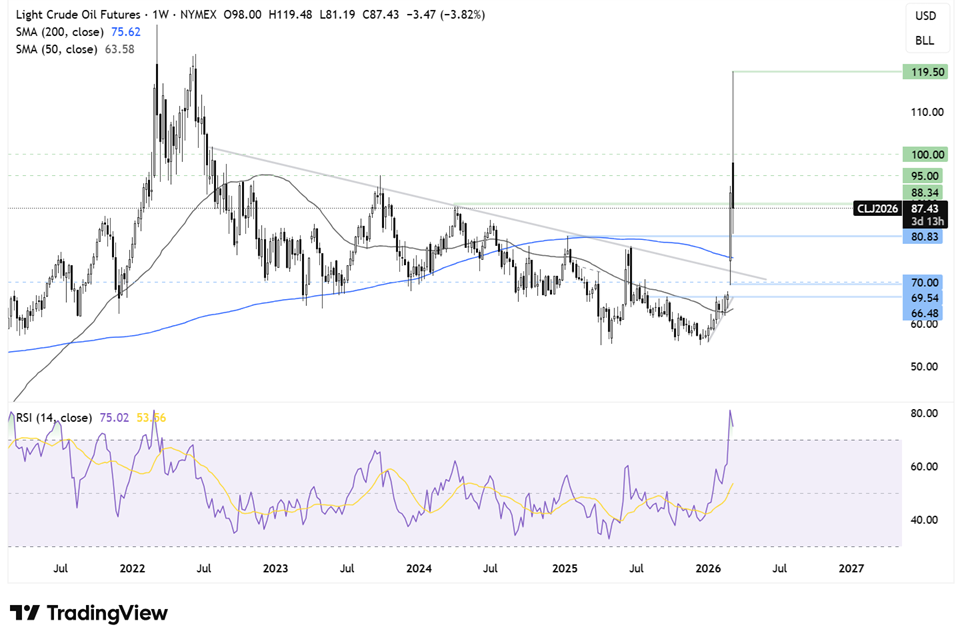
After breaking out above the multi-year falling trendline, oil surged to an almost 4-year high of 119.50, before falling back below 90.00. The long upper wick on the candlestick signals weak demand at higher price levels; the RSI remains very overbought, suggesting further declines are possible.
Sellers have taken out last week’s high at 92.60 and 88.30, the 2024 high. A break below here will target 85.00, the July 2024 high, as the next downside level ahead of 80.70, the 2025 high, and the 200 SMA at 75.60.
On the upside, buyers will look to rise above $90 and $100 as the key psychological targets.
DAX bounces as energy prices and yields fall on hopes of a quick end to the war
With oil and energy prices retreating, bond yields are falling, and the DAX is rising on optimism that the Middle East war could soon be over, even as Iran's military signalled it would continue fighting.
Trump’s words have sparked significant unwinding in oil and energy prices, helping to ease those fears of inflationary pressures and lift risk sentiment. These moves highlight just how much the market is hanging on to Trump's words.
However, we are definitely not out of the woods yet, and any gains will remain limited until there are clear signs of an end to hostilities in the Gulf and shipping through the Strait of Hormuz improves. While the DAX has recovered, it remains around 3-month lows.
While stocks are rebounding, there have been few fundamental changes with no resolution firmly in sight, so volatility is likely to remain elevated. Furthermore, central banks will likely remain cautious.
For now, attention will remain firmly on developments in the Middle East, with any signs of de-escalation likely to drive oil prices lower and stocks higher. However, any sense that the conflict remains in full flow could see energy prices rebound and stocks take another step lower.
Looking ahead, this afternoon, the US ADP employment change four-week average will be released together with existing home sales. Tomorrow, German inflation data for February will be in focus, though it is the second reading and tends to be less market-moving.
DAX forecast – technical analysis
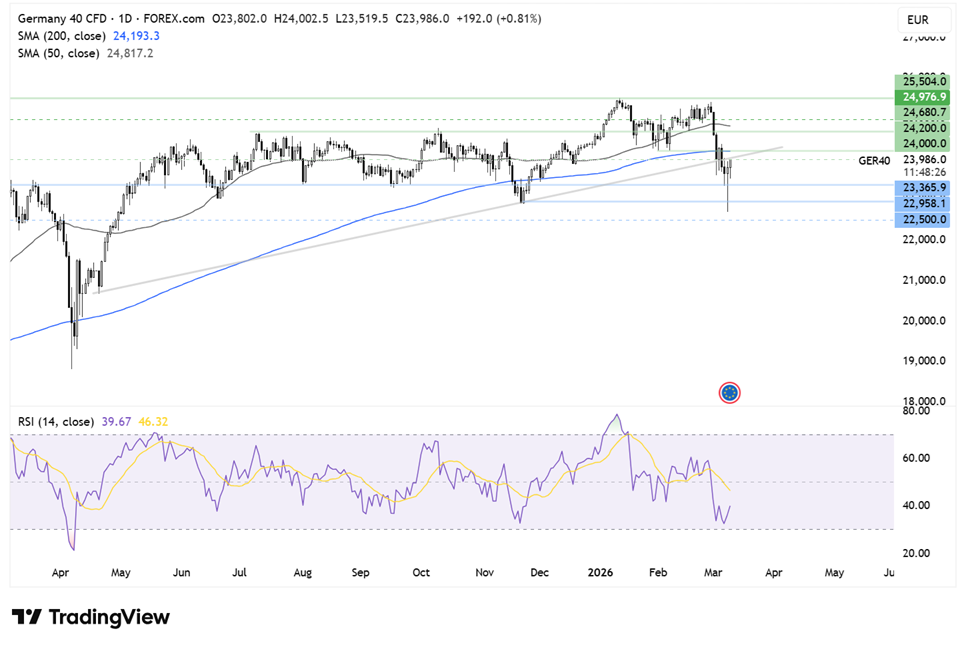
The DAX ran into resistance at 25,150, breaking below its 50 and 200 SMA as well as the multi-month rising trendline, to a low of 22,700. The price then rebounded higher, reaching 23,950 at the time of writing, testing the trendline resistance. The long lower wick on yesterday’s candlestick indicates weak selling pressure at the lower levels.
Buyers will need to rise above the trendline resistance and the 200 SMA at 24,200, also the February low, to be on a firmer footing. Above here, 24,700 comes into focus.
Failure to retake the trendline resistance could see the price rebound lower towards 23,400, a level which has offered support on numerous occasions ahead of 22,900, the November low.



Comments
Log in or sign up to join the conversation.