


Gold Eases After 4% Rally as Treasury Yields Stabilise
Gold is easing slightly after rallying 4% in the previous session to a two-month high, following a U.S. Treasury announcement aimed at supporting long-duration bonds that weakened the dollar and pulled Treasury yields lower.
The U.S. Treasury announced yesterday that it would double the size of its buyback operations for long-dated bonds, targeting maturities between 10 and 30 years.
The announcement came after a major bond sell-off at the start of the week, which saw the 30-year Treasury yield rise to a 19-year high amid concerns over inflation and the U.S. fiscal outlook. Total U.S. government debt also topped $40 trillion for the first time.
At the same time, foreign investors are scaling back their purchases of U.S. Treasuries, adding another concern for the bond market.
The Treasury announcement helped pull the U.S. dollar down to a three-month low, where it remains today.
For gold, the combination of rising concerns over U.S. debt and weaker confidence in the Treasury market is potentially bullish. If investors become increasingly concerned about the U.S. fiscal outlook, gold could benefit as an alternative store of value.
However, inflation remains a risk.
The minutes of the Federal Reserve's July meeting showed that policymakers had become more hawkish compared with the June meeting. Since then, however, inflation data has been relatively subdued and the labour market has weakened, suggesting that a rate hike is unlikely to be imminent.
The market is now pricing in a 69% probability that the Fed will leave rates unchanged in September, up considerably from 45% two weeks ago.
Whether gold can hold these levels will depend partly on where Treasury yields go from here and what Federal Reserve Chair Kevin Warsh says at next week's Jackson Hole Symposium.
If U.S. yields rebound and the dollar recovers, gold could come under pressure again. But if yields remain contained and concerns over the U.S. fiscal outlook continue to build, the backdrop remains supportive for gold.
Gold Forecast – Technical Analysis
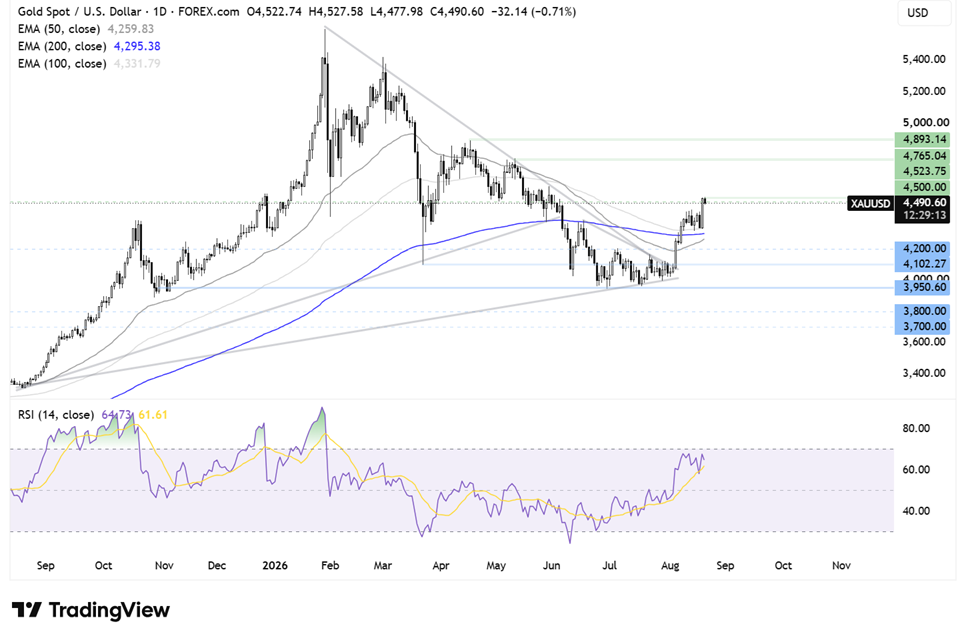
Gold extended its breakout from the triangle pattern to a 10-week high of 4,525 before easing back towards 4,490 at the time of writing.
The price remains above its key EMAs and the RSI is above 50, keeping buyers hopeful of further gains.
Buyers will look to break above 4,525 to bring 4,765, the May high, into focus, followed by 4,890, the April peak, and then 5,000, the psychological level.
On the downside, support comes from the cluster of EMAs, with 4,325 providing immediate support. Below here, the 100 and 200 EMAs around 4,300 and the 50 EMA around 4,260 come into focus.
A break below 4,260 would open the door to 4,200, the round number, followed by 4,100, the March low.
EUR/USD Jumps Towards 1.17 as Dollar Falls to Three-Month Low
EUR/USD has rallied to its highest level since May after the U.S. Treasury stepped in to support the bond market, pulling the U.S. dollar down to a three-month low against its major peers.
The surprise announcement that the Treasury would significantly increase its bond buyback operations hit the dollar, as Treasury yields fell back from their recent highs.
The U.S. Dollar Index, which tracks the greenback against six major currencies, fell to an 11-week low near 98.70.
The weaker dollar has been the main catalyst behind the latest move higher in EUR/USD.
The euro also has some support of its own. The ECB is expected to raise interest rates at its September meeting, contrasting with the Federal Reserve, which is increasingly expected to leave rates unchanged following subdued U.S. inflation data and a weaker-than-expected non-farm payroll report.
That is despite the latest Fed minutes showing that policymakers remain concerned about inflation.
Markets are pricing in around 45 basis points of additional ECB tightening this year, with the final hike expected in September as inflation remains above the ECB's 2% target.
Oil prices above $90 a barrel strengthen the case for higher European inflation, although expensive energy also creates a problem for the Eurozone economy by putting pressure on consumers and businesses.
The bigger point, however, is that this remains largely a dollar story. That makes the latest jump in EUR/USD potentially fragile. If Treasury yields rebound or U.S. data starts to support higher Fed rate expectations again, the dollar could recover and put the recent euro gains under pressure.
EUR/USD Forecast – Technical Analysis
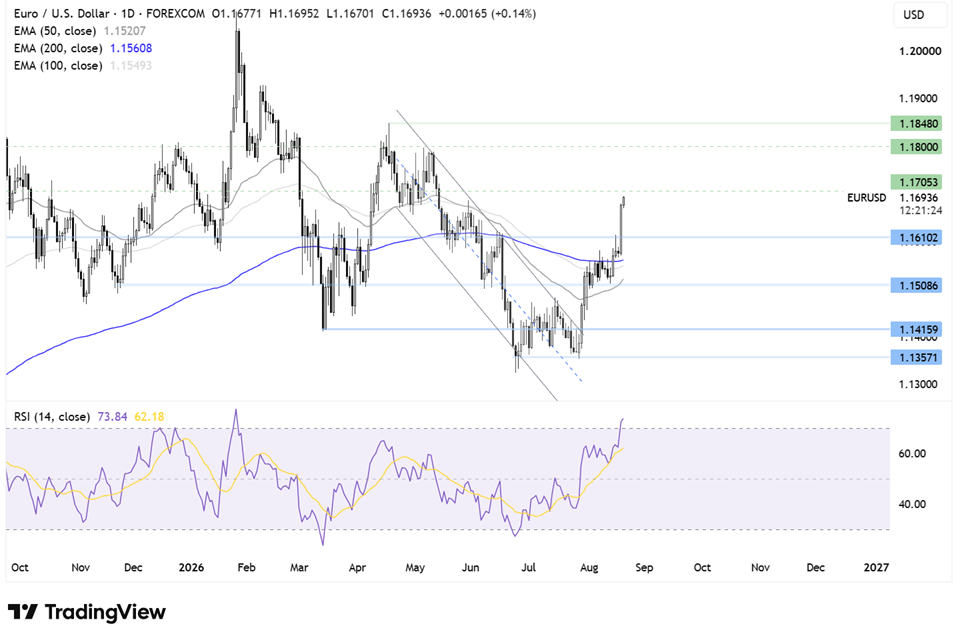
EUR/USD has extended its recovery from the 1.1350 July low, breaking out of the falling trend channel and moving above both the 50 and 200 EMAs.
The pair has reached 1.17, while the RSI has just moved into overbought territory. This raises the possibility of some consolidation after the recent move higher.
Buyers will look to break above 1.17 to bring 1.18 into focus, a level last seen in early May.
Above here, attention turns towards 1.1850, the April high.
On the downside, support can be seen around 1.16, the round number.
A break below here would bring the moving averages into focus, with the 200 EMA around 1.1560 and the 50 EMA providing the next layer of support ahead of 1.15.



Comments
Log in or sign up to join the conversation.