


GBP/USD Falls From 1.3550 as UK Jobs Market Weakens
GBP/USD is falling away from the 1.3550 resistance level amid a stronger U.S. dollar and after weaker UK jobs data.
While the UK unemployment rate was unchanged in June, earnings growth in the private sector slowed and vacancies fell to their lowest level in more than five years.
According to the Office for National Statistics, unemployment remained at 4.9% in the three months to June, slightly above expectations of 4.8%. Meanwhile, vacancies fell by 6,000 to 707,000, the lowest level since 2021.
The decline in vacancies is being driven largely by smaller businesses, which have cited higher labour and operating costs as reasons for holding back on hiring. UK employers also removed another 13,000 workers from company payrolls in July, following similar declines in previous months.
Overall, the data points to a labour market that continues to weaken.
Average earnings were slightly higher than expected, rising 3.5% in the three months to June from 3.4%. However, regular wage growth in the private sector fell to a six-year low of 2.8%.
Public sector pay growth remained much stronger, rising 6.1% from 5.5% previously.
The jobs market is therefore showing few signs of generating the wage or demand pressures that would force the Bank of England to raise rates, but it is also not weakening quickly enough to make aggressive rate cuts the obvious next step.
Attention will now turn to UK inflation data tomorrow, which is expected to show CPI rising to 2.9% year-on-year from 2.6% in June. Core CPI is expected to ease to 2.5% from 2.6%.
Meanwhile, the U.S. dollar is pushing higher on safe-haven demand as oil prices rise and Treasury yields extend their gains.
The move comes after President Trump said he was not seeking an extension to the U.S. ceasefire with Iran, which expired on Monday.
The renewed geopolitical uncertainty is supporting the dollar as a safe haven, but it also raises the risk that the Federal Reserve could keep rates higher for longer if oil prices remain elevated and inflation expectations rise.
The FOMC minutes due tomorrow will therefore be important, particularly for clues over how policymakers are viewing the inflation risks.
GBP/USD Forecast – Technical Analysis
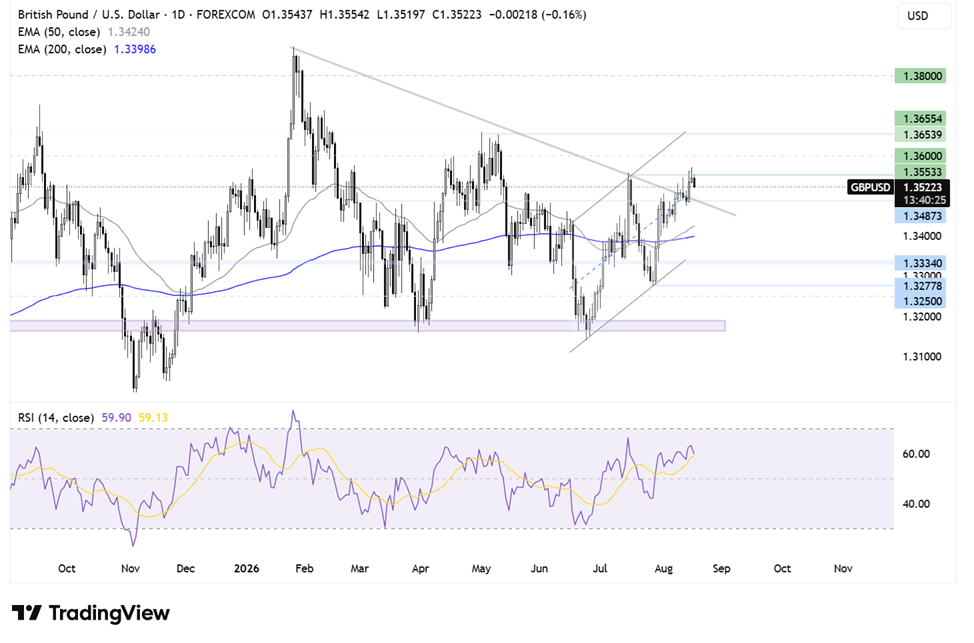
GBP/USD has recovered from the 1.32 support zone and continues to trade within an ascending channel.
The price has risen above the trend line dating back to the start of the year, while the RSI remains above 50, keeping the near-term momentum constructive.
However, the pair has struggled to break above 1.3550. Buyers will need to rise above 1.3550 to extend the bullish move towards 1.36 and 1.3650, the May high. Above here, attention turns towards 1.38.
On the downside, support can be seen around 1.3480, where horizontal support and the falling trend line converge. A break below here would expose the 200 EMA around 1.34, before attention turns towards the lower band of the rising channel and horizontal support around 1.3340.
Gold slips as treasury yields & oil rise
Gold prices are falling on Tuesday amid higher Treasury yields and rising oil prices as traders await the minutes of the July FOMC meeting for clues on the outlook for interest rates.
Yields on the U.S. 10-year Treasury note have risen, while the 30-year Treasury yield has reached a 19-year high. The move highlights concerns over higher inflation expectations and growing uncertainty over how quickly inflation will return to the Fed's 2% target.
In the near term, rising yields are usually negative for gold because they increase the opportunity cost of holding a non-yielding asset.
However, the longer-term picture could be more supportive.
If the rise in long-term Treasury yields reflects growing concerns over U.S. deficits, inflation and confidence in the dollar, then the same factors could ultimately support gold. In other words, higher 30-year yields are not necessarily bearish for gold if they are being driven by concerns over the longer-term fiscal and inflation outlook.
For now, however, the focus remains on the immediate impact of higher yields and oil prices.
Oil prices are rising after Iran said it would shift to a fully offensive military posture following the breakdown of diplomatic efforts to end the war with the U.S.
Higher oil prices are particularly important for gold because they increase near-term inflation expectations, potentially limiting how quickly the Federal Reserve can ease monetary policy.
After weaker economic data last week, the market is now pricing in a 65% probability that the Fed will leave interest rates unchanged in September, up from around 45% two weeks ago.
Attention will be on the FOMC minutes from the July meeting, due Wednesday, which could provide more insight into the Fed's debate over inflation and the path for interest rates.
A more hawkish tone could limit gold's upside, particularly if policymakers express concerns over the recent rise in energy prices.
However, if the minutes reinforce a wait-and-see approach and suggest that the Fed remains comfortable holding rates steady, gold could find renewed support.
Gold Forecast – Technical Analysis
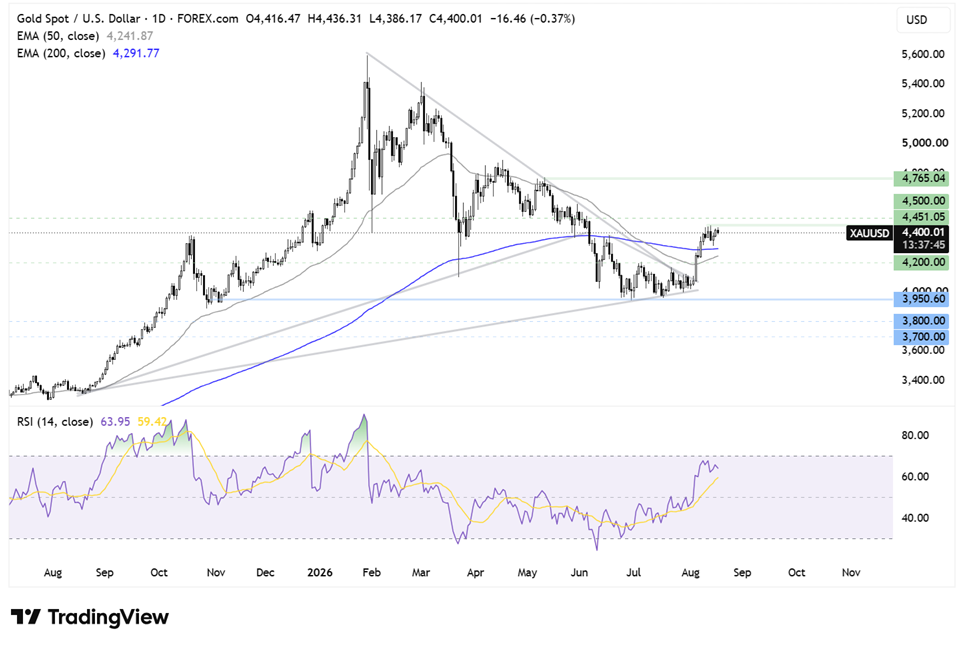
Gold broke out of the symmetrical triangle pattern, pushing above both the 50 and 200 EMAs before running into resistance at 4,450.
The RSI remains above 50, keeping buyers hopeful of further upside.
Buyers will look to rise above 4,450 and then 4,500, the psychological level, in order to bring 4,765, the May high, into focus.
The major support is seen at the 200 EMA around 4,300.
A break below here would open the door to the 50 EMA at 4,230 and 4,200, the round number.
Below 4,200, attention would turn towards 4,000, the next major psychological support level.


Comments
Log in or sign up to join the conversation.