


FTSE 100 Falls for Fourth Day as Oil and Mining Stocks Weigh
The FTSE 100 is falling for a fourth straight day on Thursday, lagging its European peers after mixed UK economic data and as weakness in oil and mining stocks weighs on the index.
UK GDP data showed that the economy grew 0.4% quarter-on-quarter in Q2, in line with expectations but slightly below the 0.6% recorded in Q1.
Meanwhile, the June reading showed an unexpected 0.3% expansion, a positive surprise compared with the 0% forecast. May's reading was also revised lower to show no growth, following a contraction in April.
UK factory activity was weaker than expected, with industrial production contracting 0.2% in June rather than increasing as forecast. Rising oil prices were one factor weighing on activity.
Elsewhere, falling metal and oil prices are also putting pressure on the FTSE given the index's large weighting towards commodity-related sectors.
Metal prices are lower across the board, with copper falling after reaching recent record highs. Precious metals are also giving back some of their recent gains as investors take profits following the strong rally driven by lower Fed rate hike expectations.
Looking ahead, attention will turn to U.S. PPI data, which could influence Fed rate hike expectations and commodity prices. Developments in the Middle East will also remain in focus, with Brent trading around $88 and little progress towards a deal to reopen the Strait of Hormuz.
FTSE Forecast – Technical Analysis
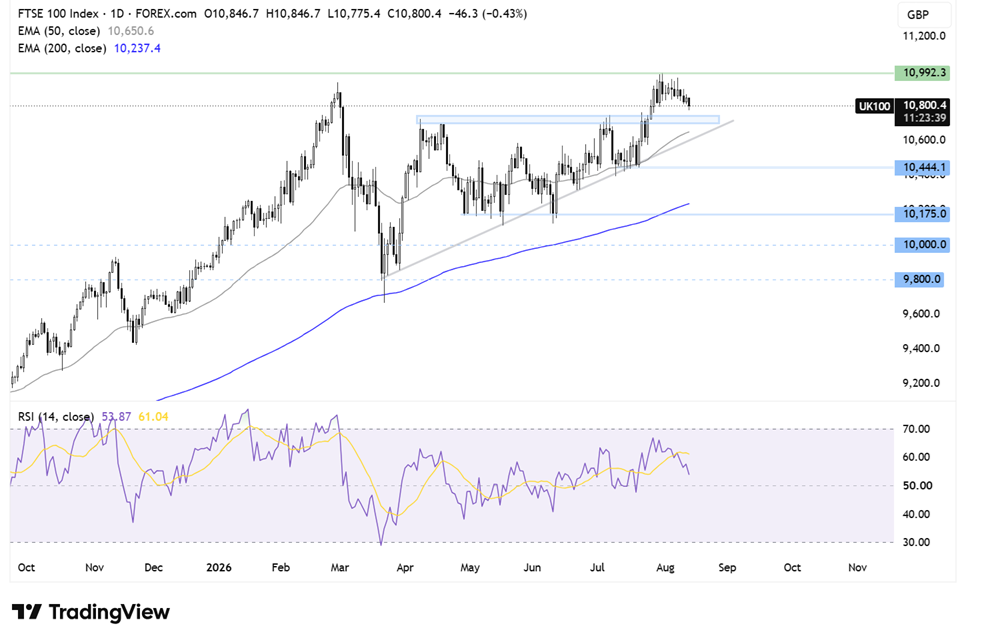
The FTSE 100 continues to trade above its multi-month rising trend line and above both the 200 and 50 EMAs, keeping the broader trend constructive.
The index ran into resistance at the record high of 10,990 and has since eased back towards 10,800. Momentum is fading, so buyers will need to see the index regain strength.
A rise back above 10,990 would bring fresh record highs into focus, with 11,000 and 11,200 the next logical targets.
On the downside, immediate support can be seen around 10,750. A break below here would expose the 50 EMA at 10,650 and the rising trend line around 10,600.
Below here, attention turns towards 10,450, the July low. A break below this level would create a lower low and change the structure of the chart.
EUR/USD Inches Higher After Hotter Spanish Inflation and Ahead of U.S. PPI
After three days of losses, EUR/USD is edging higher towards the 1.1530 region, supported by hotter-than-expected Spanish inflation and the lack of an upside surprise in U.S. CPI.
U.S. CPI released on Wednesday eased pressure on the Federal Reserve to hike rates in the near term. After headline CPI cooled to 3.4% and core CPI eased to 2.5%, the market now sees just a 40% probability of a Fed rate hike in September, down from 55% just a week ago.
However, markets are still pricing in a relatively high probability that the Fed will be forced to raise rates before the end of the year, owing to concerns that higher energy prices could rekindle inflation.
Attention now turns to PPI data, which is due this afternoon and is expected to ease to 4.9% YoY in July from 5.5%. Cooler PPI, combined with the softer CPI and Friday's weaker-than-expected jobs report, could see markets reduce Fed rate hike expectations further.
However, the latest developments in the Middle East remain a risk. The Strait of Hormuz remains closed and relations between the U.S. and Iran have deteriorated, keeping oil prices elevated and providing some support for the U.S. dollar.
Weekly jobless claims will also be in focus alongside the PPI report.
The euro is finding some support from hotter-than-expected inflation data in Spain. Inflation rose to 3.9%, its highest level since May 2024, up from 3.6% in June, driven by higher energy costs, particularly motor fuels and electricity.
Money markets are pricing in around a 90% probability that the ECB will raise interest rates by 25 basis points at its September meeting. This hawkish outlook could limit aggressive bearish bets against the euro in the near term.
However, Eurozone GDP data is also due tomorrow and is expected to be in line with the preliminary reading. Weak data could highlight the challenge facing the ECB if it attempts to raise rates against a backdrop of weak economic growth.
EUR/USD Forecast – Technical Analysis
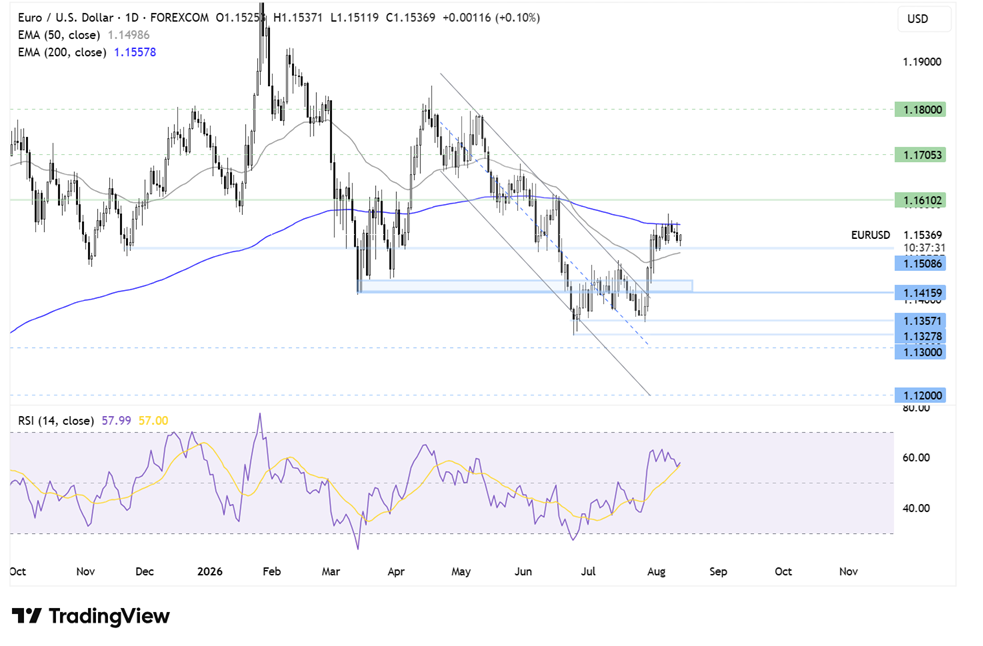
EUR/USD recovered from the 1.1360 low, rising out of the falling channel and moving above the 50 EMA, pointing to improving near-term momentum.
However, the pair has faced rejection at the 200 EMA, reinforcing the longer-term bearish bias.
Buyers will need to rise above the 200 EMA at 1.1560 to turn the outlook more positive and bring 1.16 into focus. Above here, attention turns to 1.17.
On the downside, support can be seen around 1.15, where horizontal support and the 50 EMA converge.
A break below this level would make the near-term outlook more bearish and bring 1.1440 into focus. A break below 1.1350 would create a lower low and further strengthen the bearish outlook.


Comments
Log in or sign up to join the conversation.