

DAX falls as oil prices rise again & Trump criticises allies for not helping to reopen the Strait
The DAX, along with its European peers, are lower on Tuesday as investors continue to assess the potential economic damage from a prolonged Middle East conflict.
The war in the Middle East shows no signs of easing, with Iran launching fresh attacks on the United Arab Emirates, while Tehran has denied seeking talks or a ceasefire. Oil prices remain high around $100 a barrel, with the Strait of Hormuz continuing to be a key focus.
As the conflict enters its seventeenth day, President Trump has criticised nations for not committing to help reopen the strait. The European Union has decided against expanding its naval operations in the region, despite pressure to secure the vital waterway.
The longer the conflict drags on and energy supplies remain disrupted, the more likely it is that oil prices will stay elevated, weighing on oil-importing regions such as Europe.
In addition to geopolitical developments, attention will also turn to the ECB rate decision this week, where the central bank is expected to leave interest rates unchanged at 2%. The focus will be on the outlook, particularly given the risk of stagflation from the energy shock.
Germany’s ZEW economic sentiment index is due today and is expected to fall in March from 58.3.
Utilities and energy companies are outperforming.
DAX forecast – technical analysis
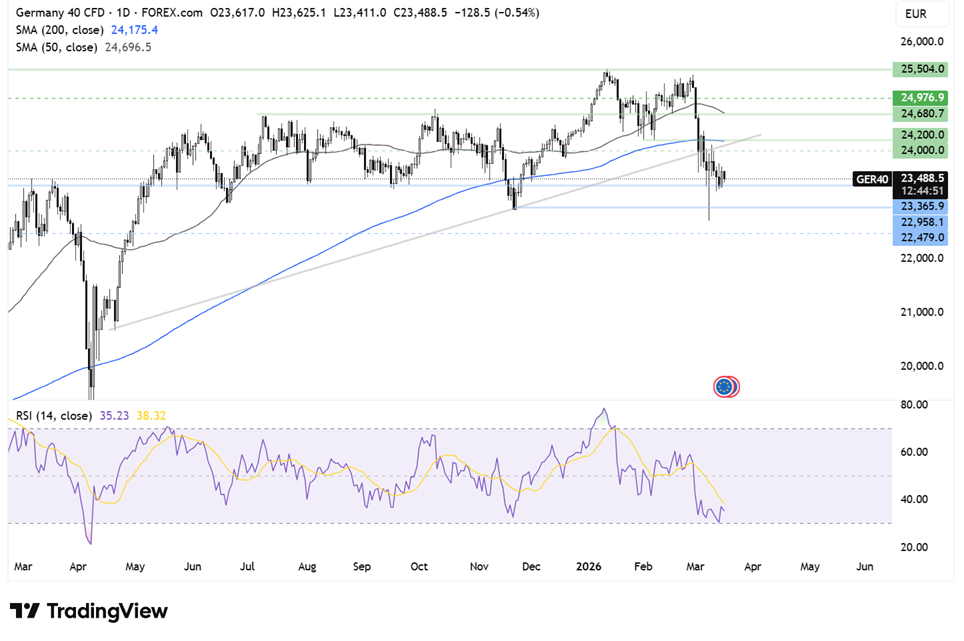
The DAX ran into resistance at 25,400 before rebounding lower, breaking below its multi-month rising trendline, the 50 and 200 SMA to a low of 22,700. The price recovered from the low but failed to retake the rising trendline resistance, reinforcing the bearish bias.
Sellers will look to take out horizontal support at 23,400, to test 22,915, the November low. Below here, 22,700 comes into focus, with a break below here creating a lower low.
Any recovery needs to rise above resistance around 24,000 – the rising trendline, the 200 SMA and the horizontal resistance. Above here, the DAX is on a firmer footing.
GBP/USD falls on USD strength & as attention shifts to the BoE, Fed rate decisions
GBP/USD is falling towards 1.3250 in the European session after once again failing to hold above the 1.33 level. The pair remains under pressure amid renewed safe-haven demand for the US dollar as markets remain cautious amid the lack of clear de-escalation in the Middle East.
Attention is also shifting towards the Federal Reserve and Bank of England policy announcements due later this week.
The Bank of England is expected to leave interest rates unchanged at 3.75%, likely with a 7–2 vote split, as the Middle East conflict and rising energy prices have renewed inflation concerns in the UK.
Prior to the Iran conflict, markets had expected the BoE to cut rates by 25 basis points, amid a weakening labour market, easing inflation, and sluggish growth.
UK jobs data will be released on Thursday, with the unemployment rate expected to hold at 5.2%, near a five-year high. Meanwhile, UK growth was flat at 0% month-on-month in January, even before the impact of the Iran conflict is fully felt.
The US dollar is once again benefiting from elevated oil prices and safe-haven flows.
The Federal Reserve begins its two-day FOMC meeting today, with the policy decision due tomorrow. The Fed is expected to leave rates unchanged at 3.5%–3.75%. Markets are currently pricing in one rate cut this year, so investors will closely watch the Fed’s updated projections for inflation and growth, as well as the dot plot, for clues on the policy outlook.
GBP/USD forecast- technical analysis
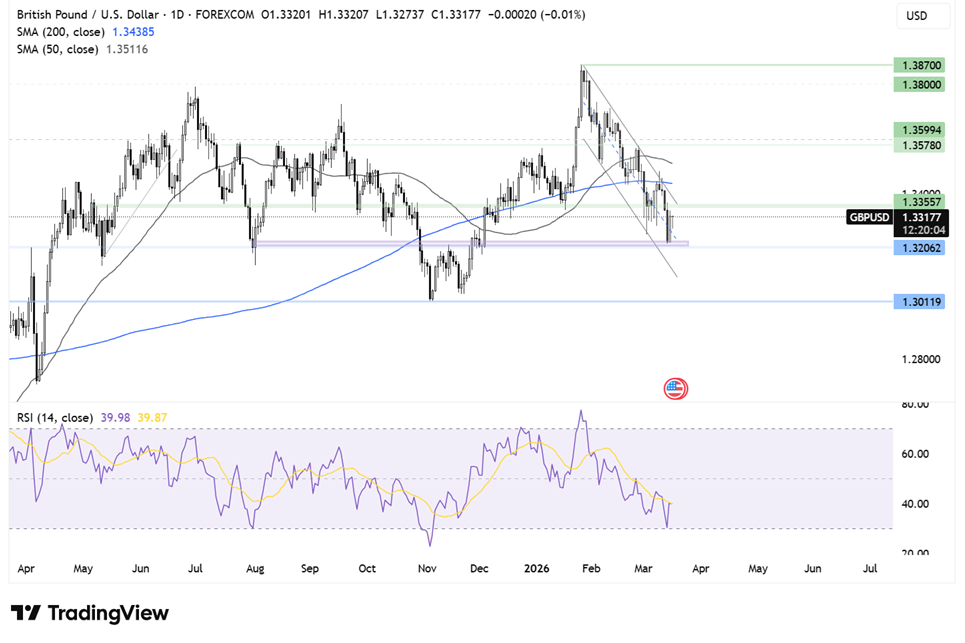
GBP/USD trades in a falling channel dating back to the 1.3870 peak from late January. The price broke below the 50 and 200 SMA, which, combined with the RSI below 50, keeps sellers hopeful of further downside.
Sellers will look to break below 1.3225, the March low, to extend the bearish move towards 1.3150, the lower band of the falling channel. Below here, 1.30 comes into focus.
Buyers need to rise above 1.3350 and the 200 SMA at 1.3430 to negate the downtrend.



Comments
Log in or sign up to join the conversation.