


Slightly better-than-expected August CPI data pushed annual inflation lower, but the pace of disinflation remains slow, underscoring the challenges of bringing inflation down.
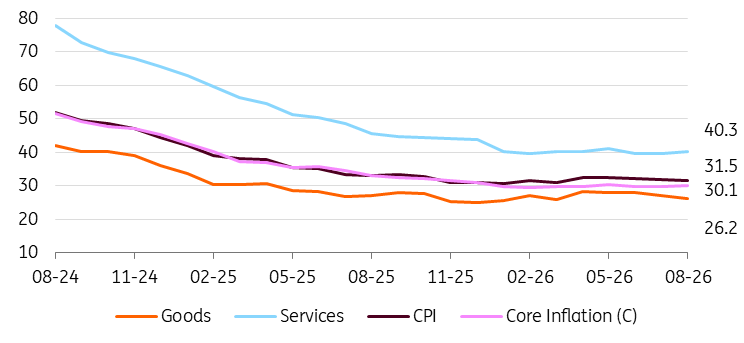
Monthly inflation in August was 1.84% vs the market consensus of 1.95% (but above our call of 1.6%), while annual inflation maintained a downtrend with a slight decline to 31.5% (vs the Central Bank of Turkey's target of 24% and forecast of 28% in the latest inflation report) from 31.8% a month ago. Despite energy and education pushing inflation higher, food inflation was relatively benign.
Core inflation (CPI-C) rose by 1.8% MoM, slightly above last year's level, resulting in an increase in the annual rate to 30.1%. The managed currency by the central bank, with modest nominal TRY depreciation – by 1.6% in August on average and 16.9% YoY, significantly below inflation in the same period – limited the increase. This indicates that the CBT maintains its exchange rate policy, which continues to support the disinflation objective through the cost channel.
In August, PPI stood at 2.6% MoM and 27.8% YoY, floating in the 26-28% range since last October, while a significant part of the monthly increase was driven by coke and refined petroleum products in addition to electricity and gas production. Global commodity prices and particularly oil prices in the current geopolitical backdrop will remain the key risk factors to the PPI and CPI in the near term.
Preliminary seasonally adjusted data, set to be published by TurkStat and closely monitored by the CBT, indicate that the seasonally adjusted headline CPI showed a limited recovery after the temporary uptick in July, though the services figure reinforced long-held views about inertia in this group.
Evolution of annual inflation (%)
A breakdown of the data shows that:
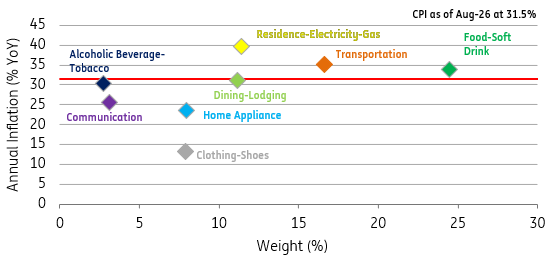
The transportation group made the largest contribution to the headline figure (0.82ppt), driven by diesel prices and transportation services. This happened despite a new scheme that reduced the special consumption tax on diesel to TRY 0 per litre in the second half of August. From the end of August until the end of 2026, the tax will be TRY 3 per litre, before reaching TRY 13.90 per litre as of January 2027. The new system should alleviate some of the near-term pressure on diesel pump prices.
Housing followed, attributable to rent and energy-related items with a monthly impact on the headline at 0.27ppt.
Education, catering and alcoholic beverages & tobacco were other major contributors, with a 0.17-0.18ppt impact each on the headline. After the regulation to reduce backward indexation in education, the August (driven by tertiary education fees) and September readings will be key for the inflation outlook.
The food group reading turned out relatively benign with a mere 0.06 impact thanks to a 2.0% MoM drop in unprocessed food prices vs a 2.0% increase last year and a slower increase in processed food. Accordingly, annual inflation fell to 33.8% (vs the CBT’s assumption for this item of 28.5% for this year) from 37.5% a month ago.
On the flip side, the clothing group dragged the headline figure (-0.24ppt) due to seasonal factors.
As a result:
Goods inflation dropped to 26.2% YoY, while core goods inflation fell to 15.9%, remaining subdued given the CBT’s tight grip on the exchange rate supporting disinflation in this group.
Services inflation rose to 40.3% YoY, while rent declined further with gradual normalisation continuing for more than two years.
Annual inflation in expenditure groups
Overall, slightly lower-than-expected August CPI data helped maintain the downtrend in the annual figure, though the pace of disinflation is quite slow. Uncertainty surrounding oil prices – along with their spillover effects on other commodity prices – continues to pose risks to the inflation outlook. The resumption of the Iran-US peace process, on the other hand, would calm geopolitical tensions and help oil prices return to prewar levels, which in turn would be supportive for the inflation outlook.
Towards the end of August, the CBT took a step to normalise liquidity and started weekly repo auctions. Accordingly, the effective cost of funding and TLREF dropped directly to the level of the policy rate at 37%, from 40%. The CBT is likely to remain on hold at the September MPC meeting next week given the limited time between the meeting and its liquidity move.


Comments
Log in or sign up to join the conversation.