


CEE inflation risks are rising as the US-Iran conflict drives energy, food and shipping costs higher. Weak food prices have delayed inflation, but fading base effects and January resets may expose broader pressures, prompting faster central bank tightening and renewed fiscal intervention if inflation surprises to the upside.
Pass-through takes time
When the US-Iran conflict began in March, we argued that conditions differed from 2022 and that a comparable inflation surge was unlikely. But as the conflict persists and escalates, the picture has changed. In some respects, it increasingly resembles 2022. In others, the inflation outlook is worse. We dubbed 2022 a "perfect storm" of soaring energy costs, loose fiscal policy, Russia-Ukraine war spillovers and the post-pandemic reopening. Today, many of those forces are re-emerging, and in some cases, proving even more powerful. The CEE region is especially vulnerable to the latest supply shock, given the heavy weighting of energy and food in regional CPI baskets.
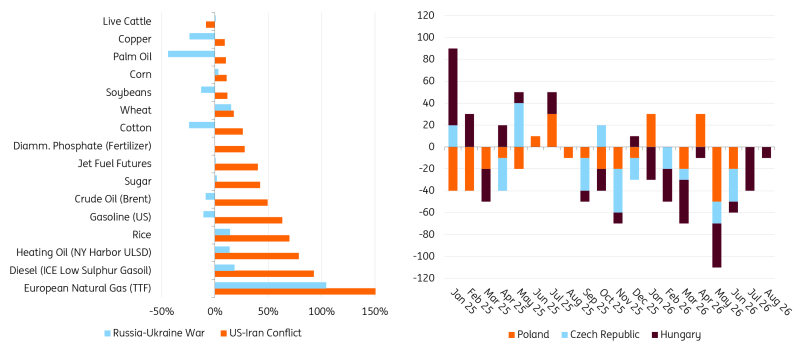
Inflation rose across the region in September, driven mainly by fuel prices. Core inflation remained stable, suggesting that significant second-round effects have yet to emerge in consumer prices, a pattern also seen elsewhere in Europe. But that may change. One lesson from 2022 is that price pass-through, especially from energy, can take considerable time.
Price increase eight months after the start of the conflicts (%) and inflation surprises in CEE region (bp vs consensus)
The perfect storm is gathering again
Let's start with the global backdrop. Oil and gas prices are again in sharp focus. Expectations for a brief conflict and rapid de-escalation proved wrong, leaving energy prices elevated long enough to invite comparisons with 2022. At this stage, however, energy prices have risen much faster after the US-Iran conflict than they did following Russia’s invasion of Ukraine.
Unlike in 2022, price pressures now span a much broader range of commodities. Oil and refined products face added disruption because they must be transported to end users, while many refineries in the Middle East and Russia are offline following military strikes. Meanwhile, shipping costs have surged to record highs, a pressure absent in 2022. Although oil flows through the Strait of Hormuz are recovering, crude prices remain elevated, and some refined products have exceeded their 2022 peaks.
Food prices face a similar “perfect storm”. Alongside higher energy costs, agricultural commodity prices have risen sharply. Since the US-Iran conflict began, rice has surged by 70% and sugar by 42%, while corn, soybeans and wheat have gained roughly 10-20%. Drivers include poor weather, weaker harvests, higher fertiliser prices and disruption to Black Sea shipping. In my view, the market often overlooks that last point in particular.
The outlook is further clouded by El Niño. It’s now classified as “very strong”, with a 75% probability that the October-December episode will be the most intense since 1950. Of course, CEE is not among the most affected regions, but combined with elevated fertiliser prices, it adds another piece to the puzzle.
Lower food prices masking higher inflation until now
Unexpectedly weak food prices have been the main reason inflation has repeatedly undershot forecasts since the US-Iran conflict began. It has offset the fuel-price surge over the last several months. This reflected earlier developments and strong base effects after food prices jumped in previous years. But those effects are fading, and the data is beginning to turn. September food inflation figures point to a shift in parts of Europe and CEE, even though headline rates still look stable.
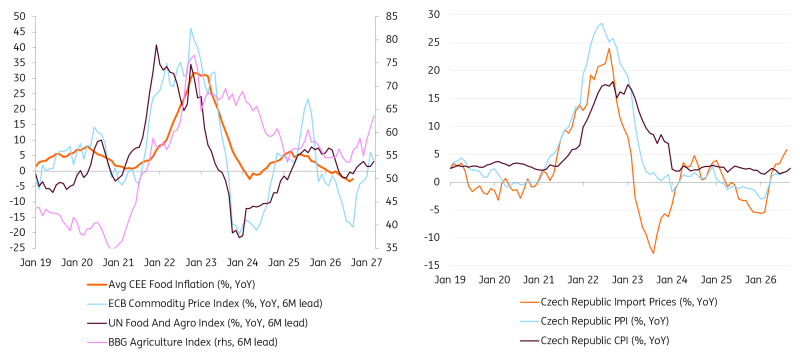
To assess what consumers may face next, we need to look beneath the headline figures. The Bloomberg Global Agriculture Prices Index and the UN Food Price Index are both at their highest levels since 2022. The European Central Bank's food commodity price index is at its highest since 2025. All three are rising, suggesting the peak may still be ahead. Historically, these indicators have tracked CEE food inflation with a 6-12 month lag, and each now points to higher prices.
Local data already offers early warning signs. To gauge the effect of global pressures on CEE, I prefer Czech data. The country has historically faced less distortion from government intervention and price caps than its peers, and its statistics are detailed and timely. In September, Czech import prices recorded their fastest year-on-year growth since January 2023. Producer prices have also rebounded in recent months, while agricultural producer prices are rising.
As pressures mount, the real price test lies ahead
Taken together, the evidence shows a widening supply shock and broader cost pressures. Household gas and fuel prices are set to rise, while higher costs for refined products and food will feed into consumer prices. Our economists have already revised inflation forecasts upwards several times. The forces outlined above suggest further changes are likely. This story is only beginning.
Forecasts at the start of 2022 also failed to anticipate the scale of the shock. By year-end, we were calling it a “perfect storm”.
Why has this not yet appeared in inflation? Pass-through takes time. When the conflict and price spike were expected to be brief, companies could absorb the cost through margins or hedges. Eight months later, however, it’s difficult to believe that inflation will remain unaffected. January is traditionally the main reset point for consumer prices, especially household energy tariffs tied to fixed contracts. I therefore expect upside inflation surprises in the coming months and would be particularly cautious about January’s CEE releases. They may reveal a markedly different picture from current forecasts and justify more aggressive market pricing of central bank rate hikes.
Food inflation in CEE versus food prices leading indicators and the pricing chain in the Czech Republic
Given lessons from past, policymakers won't hesitate
The key question is how policymakers will respond. After the trauma of 2022, when CEE inflation reached double digits, central banks are likely to react more quickly. The fiscal backdrop is more complex. Fiscal policy is often cited as a key difference from 2022, yet in CEE, conditions remain strikingly similar. Poland and Hungary are projected to run deficits this year equal to those recorded in 2020, while the Czech Republic has just raised its deficit target for next year. Meanwhile, regional household savings rates have fallen only slightly from their 2020 peaks, when the pandemic brought the economy to a standstill. Households therefore have the resources to sustain consumption, the region’s main growth engine, and have both the capacity and willingness to absorb higher prices.
Governments, not just central banks, were scarred by the 2022 inflation surge. High inflation damages political support, and policymakers have learnt that household price caps can be essential for survival. Although fiscal policy may appear constrained, recent experience suggests governments will still intervene. Such measures may shift the inflation problem from the short end of the curve to the long end, but they do not solve it.



Comments
Log in or sign up to join the conversation.