

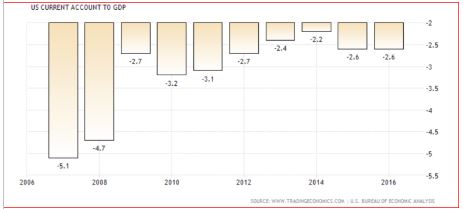
Last month, President Donald Trump ordered a comprehensive study to identify every form of “trade abuse” that contributes to the U.S. trade deficits. The study will examine “country by country and product by product” trade practices and is aimed at identifying the reasons for the large and persistent U.S. trade deficit, according to statements by Commerce Secretary Ross. It is easy to blame the large trade deficit on foreign governments that block the sale of US products into their markets. It is also easy to blame foreign governments that subsidize their exports to the United States. Although the U.S. trade deficit has moderated considerably over the past decade, it equals about 2.5 per cent of GDP or $450 billion annually (Chart 1).
Chart 1 U.S. Trade Deficit as Per Cent of GDP
Foreign import barriers and exports subsidies are not the reason for the US trade deficit. Going on a hunt for violators of trade agreements does nothing to address the real reason. The overall trade deficit is the result of the saving and investment decisions of US governments, households and businesses. Whether the Trump administration is successful in forcing its trading partners to open up their domestic markets or to curtail exports to the United States will not change the overall balance of trade. That change can only come about by a change in U.S. savings/investment decisions. How the deficit is allocated among the 100 countries that trade with the United States is a matter of specific trade practices, but that does nothing to alter the fact that the United States continues to have trade deficits.
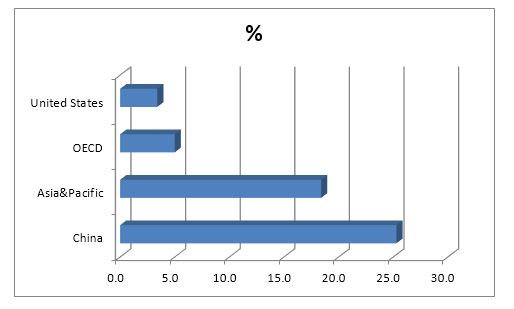
Americans’ savings and investment decisions determine the size of the trade deficit. If a country saves more of total output than it invests in business equipment and structures, it has extra output to sell to the rest of the world. This is the case of China which produces far more than it consumes and hence it generates huge net savings rates--- as high 25 per cent of GDP (Chart 2) The United States, by comparison, has a net savings rate of 3 per cent. That rate is insufficient to fund its investment needs, hence the importance of drawing upon savings from abroad.
Chart 2 Net Savings as a Per Cent of Gross National Income, 2015
Source: World Bank
All the countries that have a trade surplus with the United States willingly lend their accumulated dollars back to the United States, either in the form of purchases of debt (private and public) or investment in physical plant and equipment. Either way, these countries provide the savings that the Americans are not willing to provide themselves. If the United States is serious about reducing its trade deficit, it must become much more serious about boosting domestic savings so that it will not have to rely upon the “kindness of strangers “to fund its trade and government deficits, as it has been the case for more than two decades. As Ben Bernanke and others have stated repeatedly, the excess savings outside the United States, not necessarily U.S. monetary policy, contributes to keeping U.S. long-term interest rates at these low levels.
Now, some would prefer to tackle the trade deficit by price adjustments: lowering the price of U.S. exports and/or raising the price of U.S. imports. A decline in the value of the USD could achieve this, although at considerable cost. As Martin Feldstein argues:
Reducing the US trade deficit by one percent of GDP requires export prices to fall by 10% or import prices to rise by 10%. A combination of these price changes is about what it would take to shrink the current trade deficit by 2% of our GDP, bringing the US close to trade balance. But, because US exports and imports are 15% and 12% of GDP, respectively, a 10% decline in export prices would reduce average real (inflation-adjusted) income by 1.5%, while a 10% rise in import prices would reduce real incomes by an additional 1.2%. ...in short, with no change in the level of national output, Americans’ real incomes would decline by about 5%. Source
Thus, the trade deficit has to be tackled from an entirely different angle than that advocated by the Trump advisors. If the trade deficit shrinks because there has been a marked shift from consumption towards savings, then it is possible to generate more investment and hence greater incomes over time. The elimination of trade deficits requires increased savings and, by definition, investment at home.



Comments
Log in or sign up to join the conversation.