

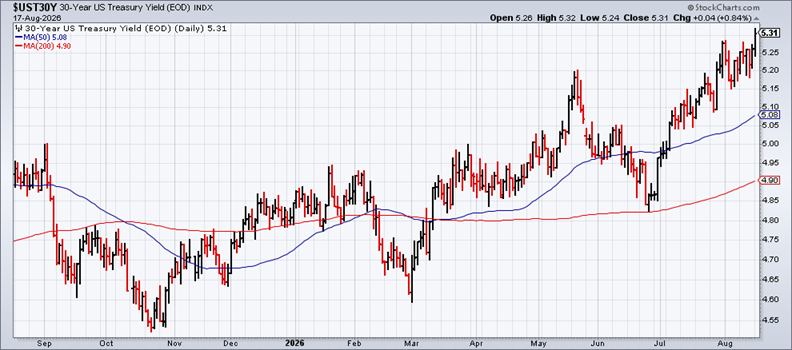
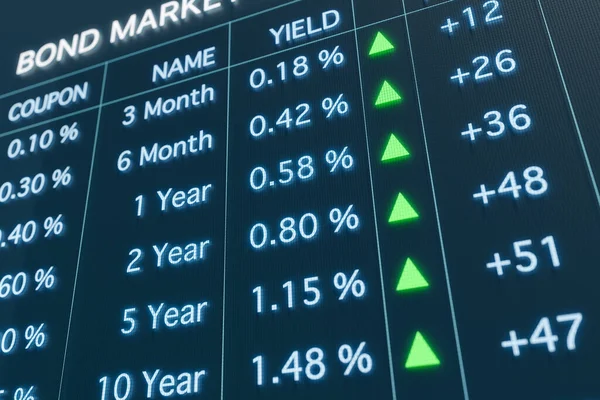
The US 30‑year Treasury yield rose sharply on Monday, breaking higher after spending the first half of August in a tight range. The move signals the bond market’s growing unease with several risk factors, including inflation and government debt.
The 30‑year rate jumped to 5.31%, the highest since 2007, underscoring mounting concern about macro conditions and the stalemate in the Iran conflict, which continues to keep energy prices elevated as shipping traffic through the Strait of Hormuz remains near a standstill after a temporary ceasefire expired on Monday without an extension.
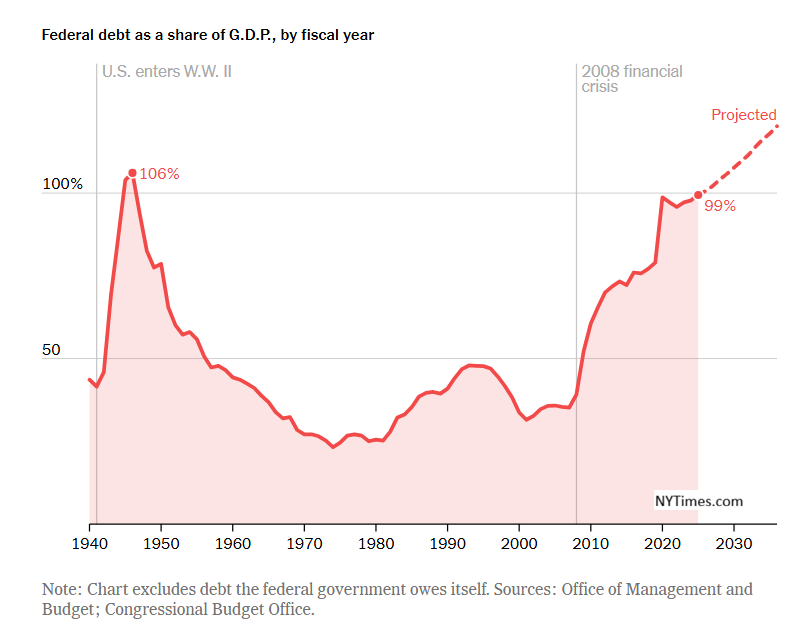
Higher oil prices are adding pressure to headline inflation, but investors are also focused on rising federal debt levels and a widening budget deficit. Congressional Budget Office estimates show federal debt as a share of GDP is on track to exceed the previous 106% peak set during World War II, while the gap between spending and revenue is projected to deepen in the years ahead.
Compounding the deterioating fiscal outlook is the absence of any meaningful policy discussion in Washington to address the runaway debt train. Debt risk is increasingly conspicuous, yet lawmakers treat the issue like background noise, if not ignore it outright. That will work, until it doesn’t, and the bond market may be signaling that the time for tolerance is running short.
Another pressure point pushing yields higher is the surge in long‑dated corporate borrowing tied to AI. The Financial Times reports that “Barclays expects total investment‑grade issuance in 2026 to hit a record $1.9 trillion, compared with last year’s $1.44 trillion.”
Despite the warning signs, US debt likely hasn’t reached a tipping point, in part because the dollar’s reserve‑currency role, the depth of the Treasury market, and longstanding institutional credibility continue to act as buffers. But the structural nature of the red ink ensures the problem will worsen without significant reform in spending and budgeting—reform that only a fully engaged Congress and President can deliver. Part of the issue issue is the feedback loop: as Treasury yields rise, the trend raises the government’s burden of paying interest to finance the debt, a process that puts more upward pressure on yields. Rinse and repeat.
More immediately, the bond market will be looking to the Federal Reserve, and Chair Kevin Warsh, for guidance. Rightly or wrongly, investors are questioning the Fed’s credibility—if only at the margins—after Warsh’s recent public comments sparked skepticism about the central bank’s commitment to returning inflation to its 2% target.
Warsh’s speech on Aug. 28 at the Fed’s Jackson Hole Economic Policy Symposium offers an opportunity for a reset. It’s a high bar, given the structural forces driving the fiscal outlook and the ongoing uncertainty surrounding the Iran conflict. The larger question may be whether Warsh is even interested in resetting market perceptions.
Ultimately, the bond market will win a game of chicken. Warsh cannot control the government’s mounting deficit, nor can the Fed control long rates, which is set by markets. But he can shape expectations for how the Fed plans to manage inflation.
Whether he chooses to do so later this month remains an open question. With Treasury yields rising, the stakes are climbing, making Warsh’s Jackson Hole remarks a potentially pivotal moment for defining the bond market’s risk calculus for the rest of the year and beyond.
Comments
Log in or sign up to join the conversation.