


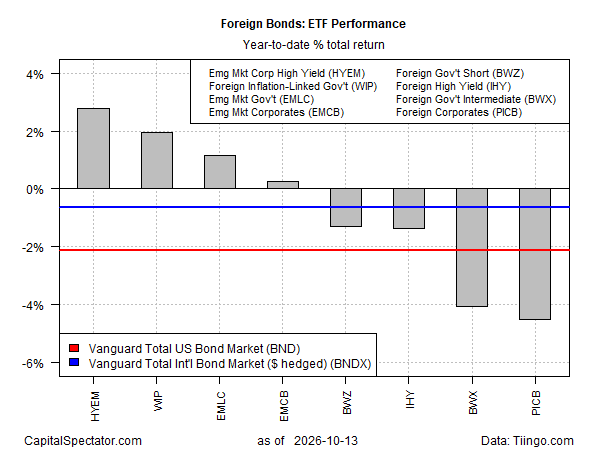
It’s been a rough year for the US bond market, but diversifying into international fixed income has helped ease the pain.
Reviewing a set of ETFs through Tuesday’s close highlights the value of a global bond allocation in 2026. Consider the US investment-grade benchmark, represented by the Vanguard Total Bond Market ETF (BND). Thanks to the sharp rise in Treasury yields this year, BND has lost more than 2% year to date.
If that decline holds through Dec. 31, the fund will post its first calendar-year loss since the 2022 bond rout, when BND plunged more than 13%. This year’s setback is relatively mild, but it still suggests that most US-focused fixed-income strategies are posting losses to some degree in 2026, especially for strategies that hold securities with relative long maturities, which have been hammered.
Certain segments of the non-US bond market, however, have provided a way to temper losses. Emerging-market high-yield bonds (HYEM) lead the pack on our list, generating a 2.8% total return so far this year. US junk bonds have also held up relatively well in 2026, although one proxy, JNK, is roughly flat year to date.
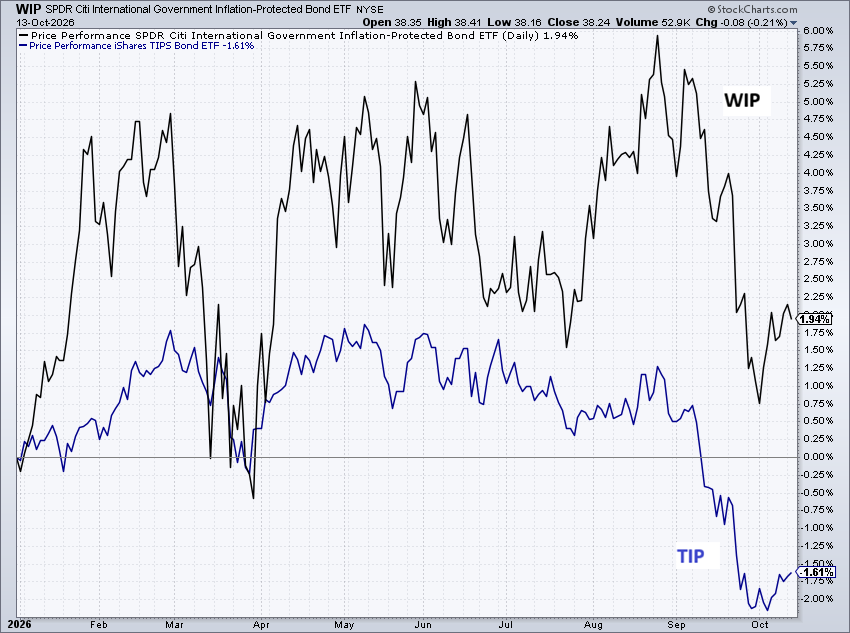
Another comparison between foreign and US fixed-income sectors underscores the outperformance of offshore markets. Foreign inflation-linked government bonds (WIP) have gained 1.9% this year, well ahead of the 1.6% year-to-date loss for their US counterpart, represented by TIP.
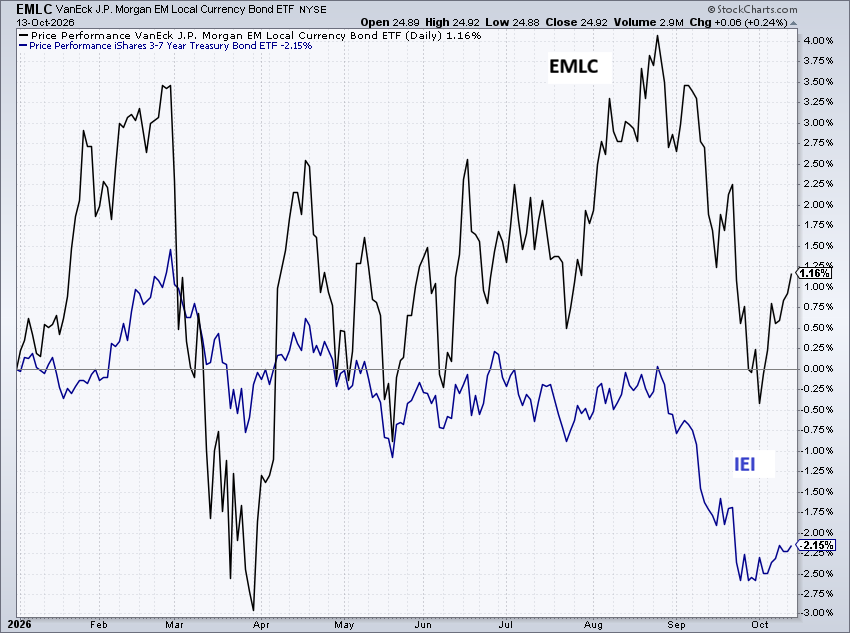
Consider another example: government bonds issued by emerging-market countries. EMLC, which tracks local-currency sovereign debt in emerging markets, is up 1.2% this year, marking a moderate performance advantage over the 2.2% loss for a roughly comparable portfolio of US Treasuries (IEI).
The corporate bond market tells a similar story. Debt issued by companies in emerging markets compares favorably with US corporate bonds. The WisdomTree Emerging Markets Corporate Bond ETF (EMCB) is posting a modest 0.3% gain this year, versus a 1.2% loss for a roughly comparable US corporate bond portfolio (SKOR).
The relative strength of foreign bonds is especially striking in a year marked by a strong US dollar. The US Dollar Index is up 4.0% so far in 2026. Historically, a stronger dollar tends to weigh on foreign bond returns when translated back into US-dollar terms.
What’s different this year? Analysts point to several possible factors, including higher yield premiums outside the US and growing concerns about America’s widening fiscal deficits and heavy debt issuance. Whatever the explanation, the case for maintaining a globally diversified fixed-income allocation has received a boost this year.
Comments
Log in or sign up to join the conversation.