

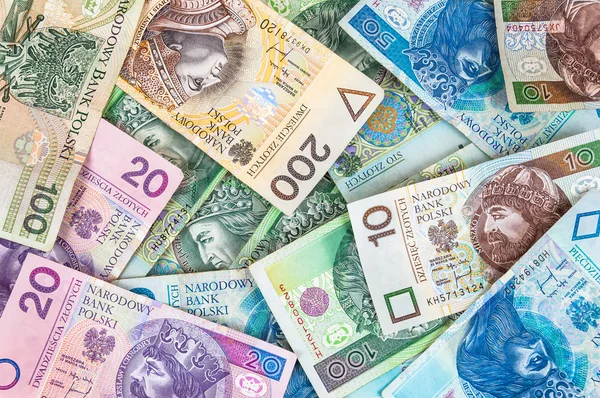
Poland's economy remains one of the strongest in the European Union, underpinned by its national currency, the złoty (PLN). Growth has been resilient, with GDP expanding around 3.5% in early 2026 — moderating slightly from the 4.1% pace seen at the end of 2025 but still well above the EU average — driven by robust private consumption, EU-funded investment, and elevated defence spending (Poland allocates roughly 4% of GDP to defence, the highest share in NATO). The National Bank of Poland (NBP) has held its reference rate at 3.75% through mid-2026, the lowest level since 2022, after a series of cuts brought inflation back near the central bank's 2.5% target following the post-2022 energy-driven price shocks. The labour market remains tight, with unemployment near historic lows around 5% and wage growth still running ahead of inflation, though slowing toward roughly 5-6% year-on-year as the post-pandemic catch-up phase fades. Together, these fundamentals support the case for the złoty, though above-target inflation risk and a widening fiscal deficit (projected near 6.5% of GDP in 2026) remain factors traders watch closely.
Poland's trade profile is overwhelmingly oriented toward the euro area, which makes EURPLN the more structurally meaningful cross for gauging the złoty's fundamentals. The European Union absorbs close to 79% of Polish exports and supplies around 64% of its imports, with Germany alone accounting for the largest single share of both — a dependency that ties Polish industrial output, and by extension the złoty, tightly to eurozone demand cycles. This deep integration means EURPLN tends to trade with relatively low volatility compared to other CEE crosses, anchored by the NBP's implicit tolerance for a firm-but-stable złoty and by steady inflows of EU structural and recovery funds, which support the currency independently of trade flows. The rate differential between the NBP (currently at 3.75%) and the ECB is the other key driver: with Polish rates still running above the eurozone's, EURPLN has faced periodic downward pressure from carry-related flows, though this has been partly offset by Poland's swing into a goods trade deficit (around €6 billion in 2025) as import growth has outpaced exports.
TECHNICAL ANALYSIS
The weekly chart clearly shows the złoty's tendency to strengthen (EUR/PLN lower) from 2022 onwards. This also coincided with a period when the euro was generally weak, trading close to parity—or even below—against the US dollar.
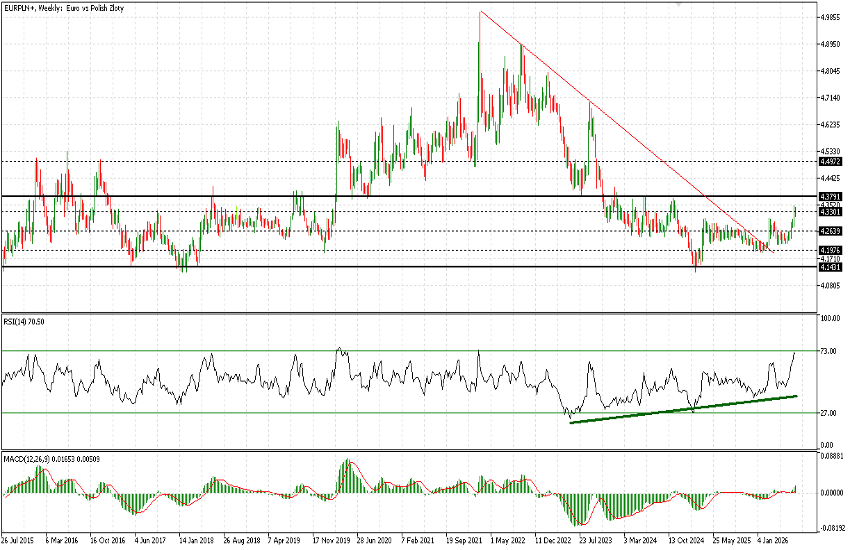
The move was initially much more aggressive in 2023, when EUR/PLN fell from around 4.90 to nearly 4.35 in less than six months. Since 2024, however, the decline has gradually lost momentum, and throughout 2026 the pair has posted two significant bullish legs, suggesting that the market may be laying the groundwork for a slightly more constructive outlook. As discussed in the previous sections, Poland has only relatively recently moved into a trade deficit, starting in Q2 2024. While developments of this nature may sometimes appear to be little more than short-term noise, they tend to become much more meaningful when viewed over a longer time horizon.
It is also worth highlighting the importance of the 4.14 level, which has acted as a major support/resistance area since at least 2014, according to historical data, and in fact stretches back to the early 2000s. The pair reached this level in February last year, and after several months it proved to mark the end of the long-term bearish trend. In effect, 4.14–4.90 has defined the very long-term trading range for EUR/PLN.
We can also observe the RSI bullish divergence that began almost a year before the euro reached its low against the złoty. Meanwhile, the weekly MACD has only recently crossed back above the zero line, and the overall technical configuration continues to suggest further upside potential. How far could the move extend? This brings us back to the 4.35 area mentioned earlier, although we believe a more precise target is 4.38. That is what we consider the first objective of the current advance. Only a decisive break above that level would open the door to a more extended rally, with the next major target located around 4.50.
Finally, two additional points deserve attention. First, as the chart shows, the long-term descending trendline was broken late last year, providing further confirmation of our bullish bias. Second, the current exchange rate stands at 4.3240.



Comments
Log in or sign up to join the conversation.