


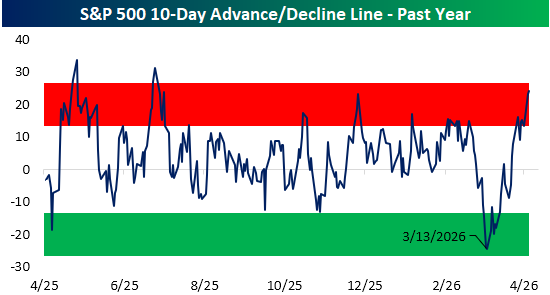
The Iran war resulted in a tough March for US equities. In addition to the S&P 500 falling close to 10% versus its 52-week high, breadth took a measurable hit. As shown below, up until the first week of March, the 10-day advance/decline line, which measures the net share of index members rising or falling each day over ten days, was positive for most of the year. Once equities began selling off, this measure tanked, and at the low on March 13th, it reached the lowest level since 12/19/24, which also ranks as a 2nd percentile reading going back to 1990. With the benefit of hindsight, we can now say that low in breadth pre-dated the low in price (which came on March 30th). It has now been ten trading days since the low, and daily breadth has been positive all but twice (April 7th and April 10th were the only days with negative daily breadth). As a result, the 10-day A/D line is now at the highest levels since 7/10/25.
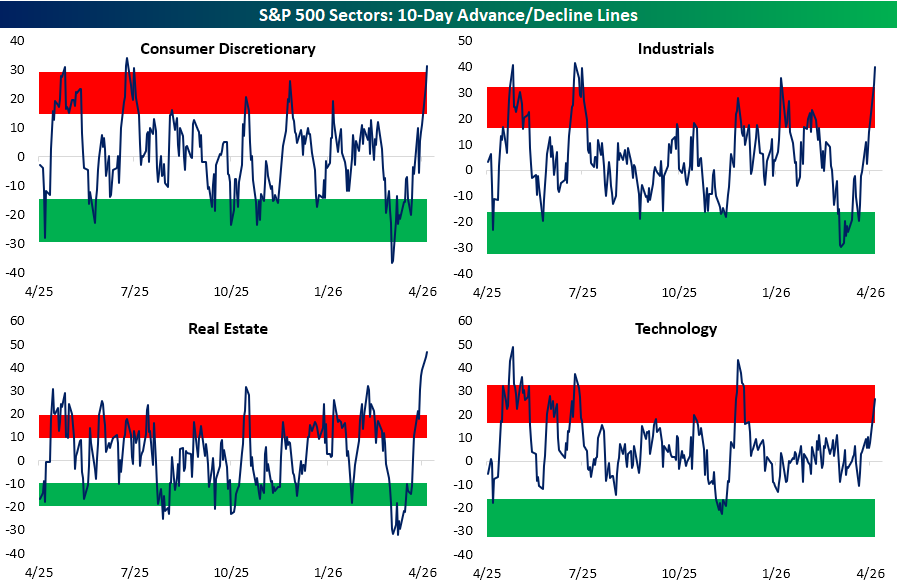
As we highlighted in yesterday's Sector Snapshot, not only has the S&P 500's 10-day A/D line risen sharply, but several other sectors have as well. As shown below, Consumer Discretionary, Industrials, and Real Estate all went from extreme oversold readings (2+ standard deviations below the historical average) to extreme overbought readings today. While the reading isn't quite as extreme, Tech has also seen a sharp rise in its line.
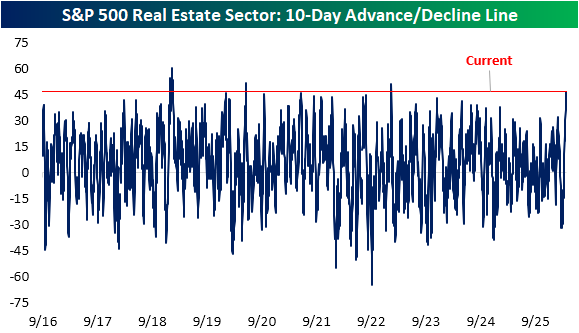
As might be evident from the one-year charts above, by far the most extended breadth measure comes out of the Real Estate sector. To give greater historical context, below we show the 10-day A/D line going back to September 2016, when it became a sector. With another move higher today, Real Estate's 10-day A/D line is at the highest level since 2/2/23. The only other times the 10-day A/D line was more elevated were from January to February 2019 and in June 2020.



Comments
Log in or sign up to join the conversation.