

For two years the easiest question in markets was “which AI stock?” Lately it has changed to “where is the money going instead?” Chip stocks have had a rough month, and a lot of investors are looking at the parts of the market that do not depend on how much Big Tech spends on data centers.
That shift has a name, sector rotation, and it is happening right now. This guide looks at five sectors people tend to check first when money leaves AI and semiconductor stocks: health care, consumer staples, utilities, water, and defense and aerospace. For each one I explain why it is on the list, what the numbers say, and what the catch is.
A Note on the Numbers Most figures below come from our own Sector Rotation Tracker, which uses ETF prices as a stand-in for each sector. They reflect the market close on Friday, November 13, 2026. Figures from outside sources are named in the text. This is a list of sectors to check, not a list of things to buy, and it is not investment advice. The ETFs named under each sector are US-listed. If you invest from the UK or Europe, check whether your broker offers them, or an equivalent fund approved for sale in your country.
What Is Sector Rotation, and Is It Happening Now?
Sector rotation means investors move money from one part of the market to another as their view of the economy changes. When people feel confident, they tend to buy growth areas like technology. When they feel nervous, they move to defensive sectors, which are industries whose sales hold up even when the economy is weak, because people still need the product.
There are signs of that move now. Startup Fortune reported on November 10 that Citi cut its view on US and global tech to neutral from overweight, and that the MSCI global tech index had fallen about 13% since the Nasdaq 100 peaked on October 6. In the same report, MSCI’s global consumer staples index rose 10.6% in October, its best month since 1998, and global health care rose 9.8%. Press reports of an HSBC note, including CNBC’s coverage, say Alastair Pinder at HSBC called the rotation into defensives “extreme.”
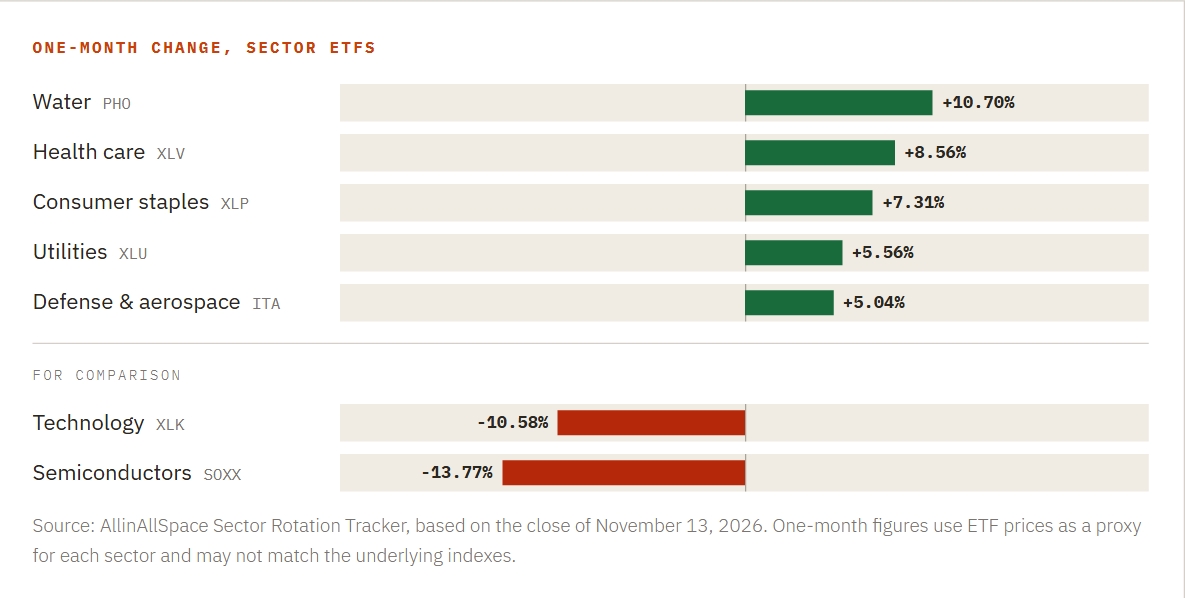
Our own tracker shows the same pattern. Over the past month, the technology sector fund (XLK) is down 10.58% and the semiconductor fund (SOXX) is down 13.77%, while all five sectors in this guide have a better month than the chip sector. But rotation is not a straight line. SOXX is up 9.35% over the past week, so chips bounced hard even inside a bad month. That is why this is a list to watch, not a signal to sell everything and switch.
The Five Sectors at a Glance
Here is how each sector has done over the past month, with technology and semiconductors alongside so you can see the gap.
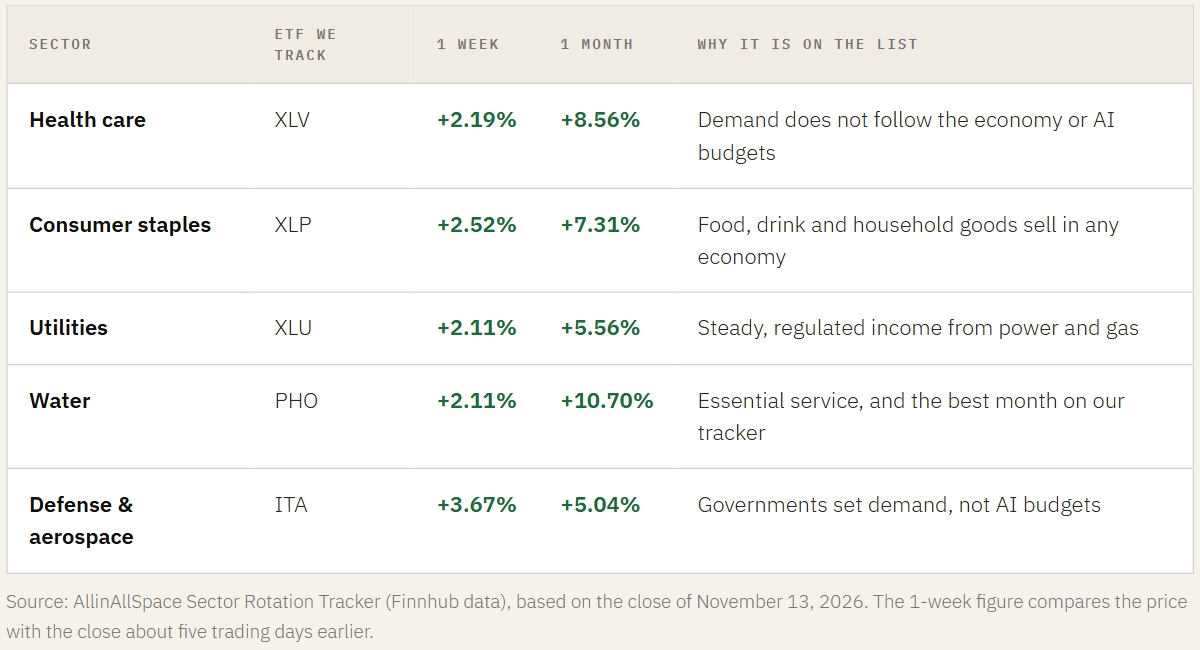
The table adds the past week and a one-line reason each sector made the list.
Health Care: People Keep Paying for It
Health care is the textbook defensive sector. Drugs, hospital visits and medical devices get bought whether the economy is booming or not, and none of it depends on how many chips a cloud company orders. That is why it tends to get attention when tech wobbles.
The numbers fit. Our tracker shows the health care fund (XLV) up 8.56% over the past month and 2.19% over the past week. Outside our tracker, MSCI’s global health care index rose 9.8% in October, according to Startup Fortune.
The catch is that “health care” is a wide label. Big drugmakers and insurers behave very differently from small biotech companies, which can swing wildly on one trial result. Prices for medicines are also a political issue, so rules can change. If you look here, check what a fund actually holds.
ETFs to look at: XLV Health Care Select Sector SPDR (the one our tracker uses). Similar funds: VHT (Vanguard), IYH (iShares).
Consumer Staples: Defensive, but Not Cheap
Consumer staples are the things people buy every week: food, drinks, cleaning products and basic groceries. Sales are steady, which is why this sector often does well when investors get nervous.
It is doing exactly that. Our tracker shows the staples fund (XLP) up 7.31% over the month and was the best sector in the last session, up 1.42%. Startup Fortune reported that, since the Nasdaq 100 peaked on October 6, Walmart (WMT) is up about 15% and Procter & Gamble (PG) and Coca-Cola (KO) about 10% each.
Here is the catch. When a lot of money piles into safe stocks, they stop being cheap. In the same reports, HSBC’s Pinder is quoted saying Walmart trades at roughly 40 times its expected earnings over the next year, against about 13 times for Nvidia (NVDA). In other words, you pay $40 today for each $1 of profit analysts expect from Walmart, and about $13 for each $1 from Nvidia. “Defensive” describes how steady the business is, not whether the price is fair.
ETFs to look at: XLP Consumer Staples Select Sector SPDR (the one our tracker uses). Similar funds: VDC (Vanguard), FSTA (Fidelity).
Utilities: Safe Dividends, With an AI Twist
Utilities are the companies that supply electricity, gas and water to homes and businesses. Their prices are usually set by regulators, so their income is steady, and many pay solid dividends, which is the part of profit paid out to shareholders in cash.
Our tracker shows the utilities fund (XLU) up 5.56% over the past month, a smaller move than health care or staples. That is still a solid month for a sector people buy for steady income, not for fast gains.
The twist is that utilities are not fully separate from AI. Data centers use a huge amount of electricity, and part of the case for owning power companies is that AI will keep demanding more of it. If AI spending slows, that part of the story slows too. So utilities can be a defensive holding and an AI-linked one at the same time, which is worth knowing if your goal is to get away from AI.
ETFs to look at: XLU Utilities Select Sector SPDR (the one our tracker uses). Similar funds: VPU (Vanguard), IDU (iShares).
Water: The Strongest Month on Our Tracker
Water is the quiet one. It covers the companies that supply and treat water, and the ones that make the pipes, pumps and filters. Nobody cuts their water use because markets are nervous, and many countries need to spend on ageing water systems.
Our water fund (PHO) is up 10.70% over the past month and 2.11% over the past week, the strongest one-month result of any sector or theme we track. That is a big number for a sleepy sector.
The catch is size and focus. One fund is a narrow window into a small corner of the market, and it holds a mix of companies, not just regulated water suppliers. Some of them sell equipment and depend on industrial and construction spending, so they are less defensive than a plain water bill. Check the holdings before you assume it behaves like a utility.
ETFs to look at: PHO Invesco Water Resources ETF (the one our tracker uses). Similar funds: FIW (First Trust), CGW (Invesco, global).
Defense and Aerospace: Spending Set by Governments
Defense and aerospace companies build fighter jets, missiles, ships, satellites and the parts that go inside them. Their main customers are governments, which sign contracts that run for years, so sales follow defense budgets and not chip orders or consumer mood. That is why this sector can hold up when tech sells off.
Our tracker shows the defense fund (ITA) up 5.04% over the past month and 3.67% over the past week. That is a smaller gain than health care or staples, but it is positive over both periods, so the move is not just one good week.
The catch is that this sector runs on politics. Budgets can be cut or delayed, and peace talks can knock the shares even when business is fine. The “aerospace” half matters too, because funds like ITA usually hold big commercial aircraft and parts makers as well, and their sales depend on airlines, not armies. So the fund is not a pure defense bet.
ETFs to look at: ITA iShares U.S. Aerospace & Defense ETF (the one our tracker uses). Similar funds: XAR (SPDR), PPA (Invesco).
What Could Go Wrong With a Rotation Trade?
The first risk is that you arrive late. The defensive sectors above have already had a strong month, so some of the move may be done. HSBC’s Pinder called the shift extreme, and extreme moves sometimes reverse.
The second is that the rotation can flip back quickly. Chips rose 9.35% in a single week on our tracker even though they fell 13.77% over the month. A bounce in AI stocks could take money straight out of the defensive names.
The third is that sector funds hide a lot. A fund called “health care” or “water” can hold very different companies, and an ETF price is only an approximation of a sector. Look at what is inside before you rely on the label.
If even defensive stocks feel too risky for you right now, some investors look at fixed income funds instead. These funds hold bonds, which are loans to governments and companies that pay interest, and they usually swing less than stocks. They have their own catch, though: bond prices tend to fall when interest rates rise.
Our View Rotation is real right now, but it is not a one-way street. If you want to look beyond AI, health care and staples are the clearest defensive options, utilities come with an AI link, water is a small niche, and defense and aerospace depends on government budgets. A mix across several sectors is safer than betting on one. This is our opinion based on the sources named above, and not personal advice.

Comments
Log in or sign up to join the conversation.