

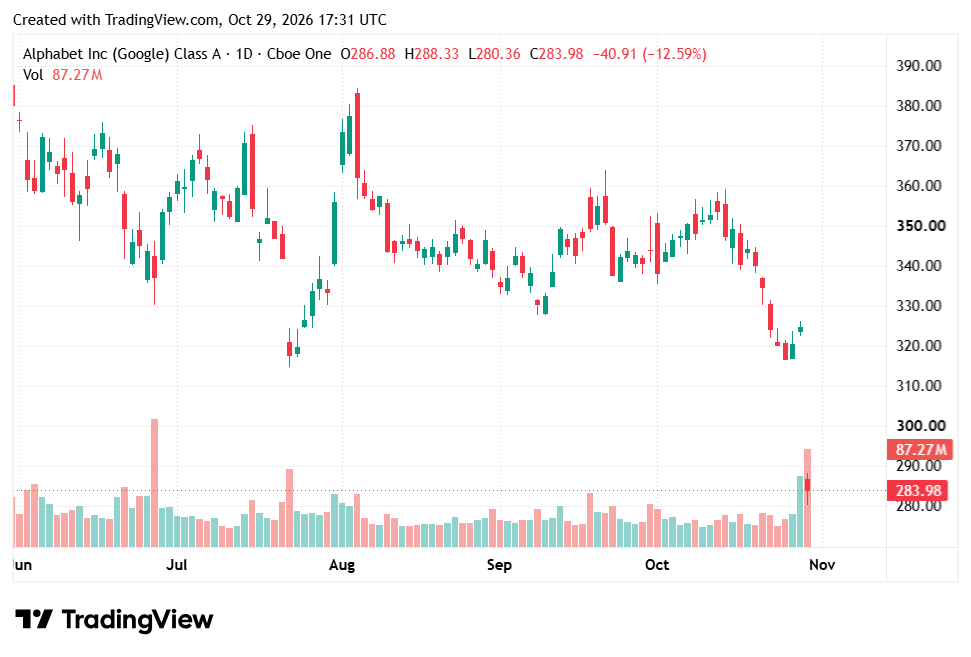
Picture this. The most important division of your company just doubled its revenue in a single year, its profit tripled, and its order book is now worth more than half a trillion dollars. Surely the stock jumps, right? Not if you are Alphabet (GOOGL, GOOG). On Wednesday evening, October 28, Google’s parent reported exactly that kind of quarter, and within minutes its shares were down almost 10%, from $324.89 to about $292.50 in after-hours trading. So what did investors see that the headlines did not? In short: a company that is growing fast and spending even faster, and a market that has started asking when the bill gets paid.
Revenue $127.6B +25% year on year
Google Cloud +103% $30.7B revenue
Capex $51.4B vs $23.95B last year
Free cash flow -$9.1B vs +$24.5B last year
Key Takeaways
Cloud is on fire. Revenue doubled to $30.7 billion, operating profit tripled to $11.1 billion, and the order backlog reached $561 billion.
Search is still huge, but it is slowing. Growth dropped to 12% from 17% a quarter earlier, and Google admits its new AI Mode earns less per query than classic search.
The cash ran out. Alphabet spent $51.4 billion on capex but generated only $42.3 billion from operations, so free cash flow was negative $9.1 billion, the second negative quarter in a row.
The bill is getting bigger. Capex guidance for 2026 is $195 to $205 billion, 2027 will be “significantly” higher, and there are no buybacks this year.
Why the stock fell: not one bad number, but a mix of slower Search, a softer profit and no date for when the cash turns positive.
What Just Happened in Q3
Let’s start with the good news, because there is a lot of it. Alphabet’s revenue rose 25% to $127.6 billion, and operating income grew 30% to $40.6 billion, a healthy 31.8% margin. YouTube advertising grew 9%, subscriptions and devices grew 11%, and the Gemini app crossed 1 billion users. On paper, this is a company firing on almost every cylinder.
But here is where it gets more complicated. Revenue came in slightly below what analysts expected, about 0.5% short of the roughly $128.2 billion consensus, and advertising revenue of $82 billion was about $1.4 billion lower than forecast. That is not a disaster. Still, when a stock is priced for excellence, even a small miss gets noticed.
Then there is the profit puzzle. Earnings per share were $2.12, down from $2.87 a year ago, and net income fell 25% to $26.2 billion. Most of that gap comes from an $8.66 billion paper loss on investments, mainly Alphabet’s stake in SpaceX, which alone cost about 55 cents a share. Add it back, though, and EPS is still roughly $2.67, below the $3.02 Wall Street had in mind. So the investment loss explains part of the disappointment, but not all of it.
There is a second, quieter detail. Operating income barely moved from the previous quarter, $40.77 billion in Q2 and $40.58 billion in Q3, even though Cloud added $2.3 billion of profit. Why? Because Search and other Google Services earned slightly less, and the cost of shared AI research, which Alphabet books at the corporate level, rose by almost $1.9 billion. In other words, Cloud’s extra profit was eaten by the price of building AI everywhere else.
And then comes the number that moved the stock the most. Alphabet generated $42.3 billion in cash from operations and spent $51.4 billion on data centers, chips and equipment. The result was free cash flow of negative $9.1 billion, compared with a positive $24.5 billion a year ago. Part of that was one-off: a $5.2 billion payment of a European Commission fine, and $3.2 billion tied up in inventory for Google’s TPU chip systems. But even adding both back, free cash flow is still slightly below zero. The cash burn is not bad luck. It is the plan.
Google Cloud Doubled. Why Wasn’t That Enough?
Let’s be clear about how good the Cloud numbers are. Revenue jumped 103% to $30.7 billion, up from $15.2 billion a year earlier. Operating profit hit $11.1 billion, a 36.2% margin, compared with 23.7% a year ago. The order backlog, the contracts customers have signed but Google has not yet delivered, grew to $561 billion from $514 billion just three months earlier, and a bit more than half of it should turn into revenue within two years. Nearly 100 customers now use Google’s own TPU chips, including names like Anthropic, Apple (AAPL) and Oracle (ORCL). And Cloud now brings in about a quarter of Alphabet’s revenue and more than a quarter of its operating profit, which makes it much more than a side business.
What does it mean? Three things. First, Google has become a serious AI infrastructure company, not only the owner of the world’s biggest search engine. Second, with $561 billion already contracted, the demand for what Google is building looks real. And third, that demand comes with a price tag: every dollar of Cloud growth requires data centers and chips to be built first and paid for long before the revenue arrives. The CFO also warned that third-party computing capacity coming online in the fourth quarter will weigh on Cloud margins, so the 36.2% margin may not last.
That is why Cloud doubling did not calm the market. The real question is how much growth is enough to justify the cost. Cloud is clearly growing. What the market does not yet know is how much of that growth will end up as free cash for shareholders, and when.
So What Do Investors See?
Put yourself in an investor’s shoes for a moment. You hold a stock that was up only about 3% for the year before the report, while the S&P 500 was up about 13%. You open the results and see this:
1. Search is growing, but earning money from it is getting harder
Search and other revenue grew 12% to $63.4 billion, down from 17% in Q2, and that happened even though Google says query growth was the fastest in five years. How can usage speed up while revenue slows? Management pointed to currency effects, changes in retail advertising and advertisers’ budgets returning to normal after a burst of World Cup-related spending. But the ad chief also admitted that AI Mode, Google’s new conversational search, makes less money per query than the classic results page.
That admission is the heart of the worry: Google could stay a leader in AI and still lose some of the exceptional economics of traditional search. A 2025 Pew Research study of 900 US adults points in that direction, finding that people clicked a regular result on 8% of visits to pages with an AI summary, against 15% on pages without one. To be fair, that study is observational, so it raises the concern but does not prove it. Google Services still earned a 40.7% operating margin, and its profit grew 17% from a year earlier. So this is a worry, not a verdict.
2. The cash is going the wrong way, and it will get worse before it gets better
Alphabet kept its 2026 capex guidance at $195 to $205 billion. Through nine months it has spent about $132 billion, which means the fourth quarter alone could reach roughly $68 billion if it lands at the midpoint. On top of that, the CFO said spending will “increase significantly in 2027”.
So who pays? Partly Alphabet’s own cash, and partly the market. In the quarter it sold $28.7 billion of notes and raised $12.4 billion by selling shares, and it did not buy back any stock this year, against $11.5 billion of buybacks a year ago. To keep this in perspective, the company is not in trouble: it holds $265.1 billion in cash and securities against $125.1 billion of long-term debt. But the days when Alphabet could spend freely and still return piles of cash to shareholders are paused.
3. Rivals are giving investors a clearer picture
Here is the comparison that probably hurt most. Microsoft (MSFT) recently generated $18.6 billion of free cash flow while its Azure cloud grew 48%, and its stock rose about 4% after earnings. (That 48% is Azure’s growth, not Google’s.) Oracle’s cash flow is also negative, but it gave investors a timeline, with positive free cash flow expected in the second half of fiscal 2028 and capex peaking before that, and its shares jumped nearly 11%. Meta Platforms (META), which also burned cash, fell nearly 7%.
The message seems to be that the market is not punishing AI spending as such. It is punishing spending without a finish line. Alphabet has told investors that capex will keep rising in 2027, but not when the cash will turn around. It is also the kind of doubt that Michael Burry and his fellow AI bears have been voicing for a while: that the AI spending race is running ahead of the money it will actually earn.
Put it together
That is the full picture of why the stock is falling. Revenue slightly missed, EPS missed, free cash flow turned negative for a second quarter, Search growth slowed just as AI Mode started to change how people search, and spending is set to rise again next year with no promised return date. Any one of these might have been shrugged off. Together, for a stock priced to see things go well, they were too much for one evening.
The Number to Remember
Alphabet earned $42.3 billion in operating cash flow and spent $51.4 billion on capex in a single quarter. Until that gap closes, the growth story and the cash story will keep pulling the stock in different directions.
So What’s Now? Is Alphabet a Buy After the Pullback?
This is the question everyone asks after a 10% drop in one of the world’s biggest companies: is it a sale, or is it the first step down? The honest answer is that it could be either, and the next few weeks should tell us which. One note on prices: Alphabet closed at $324.89 on Wednesday and fell to about $292.50 in after-hours trading. As of writing, it is trading around $285 in pre-market, down about 12%, so the numbers below are a snapshot, not a final level.
The case for an opportunity
Let’s start with why buyers will be tempted. The business that just reported is not a struggling one. Cloud is doubling, the backlog is $561 billion, and operating income grew 30%. Part of the profit miss was a paper loss on the SpaceX stake, and part of the cash shortfall was a one-off fine and a stock of chips waiting to be sold, so the underlying picture is a little better than the headline.
The price also looks different now. At the after-hours price of about $292.50, the stock trades roughly 28% below its 52-week high of $408.61 and near 24.6 times this year’s earnings estimates, or about 19 times next year’s $15.36. For a company growing revenue 25% a year, that is not an extreme multiple. And Search, while slower, is still growing, with query growth at its fastest in five years.
The case for a falling knife
Now the other side, and it is just as real. The earnings estimates behind those friendly multiples were set before this report. If analysts now cut next year’s profit to account for higher depreciation, margin pressure in Cloud and a bigger spending bill, the “cheap” 19 times quickly becomes 21 or 22. In other words, the stock may be less cheap than it looks today.
Then there is the cash. Free cash flow has been negative for two quarters, and based on the guidance, the fourth quarter could bring the heaviest spending of the year, with 2027 higher still. Nobody can say yet when it turns around. At the same time, Search monetization is a genuine open question because Google itself admits that AI Mode earns less per query. And with no buybacks this year, there is no company buyer stepping in to cushion the fall. Finally, the stock is still less than 10% above its 52-week low of $266.50, and in pre-market it is already closer to it, so there is not much cushion if the mood sours further.
Our view: patience over catching the knife
So, is this the moment to jump in? In our view, not right now. Not because Alphabet is a bad company, it clearly is not, but because the most useful information has not arrived yet. The first reaction to a report is usually emotional. The more telling part comes next: how analysts reset their numbers over the coming days, what the company’s quarterly filing shows about the backlog and the chip business, and whether the stock steadies on its own or keeps sliding.
There is a cost to waiting, of course. If Cloud keeps accelerating and investors warm to the spending story, the shares could rebound before a patient buyer feels comfortable. We would accept that trade-off. The risk is not that Alphabet fails, it is that today’s price assumes a payoff that is still unproven. The signals that would make us more comfortable are straightforward: clearer guidance on when spending peaks, free cash flow that stops getting worse, Search growth holding near 12%, and a stock that finds a floor after analysts update their forecasts. The next big checkpoint is the fourth-quarter report in early February, which will include the first look at 2027 capex plans.
Comments
Log in or sign up to join the conversation.