

[Cullen is back from hiatus, thinking about what he thinks again. Yay! - Ed.]

I apologize for the recent hiatus. In the last 15 years I’ve written over 10,000 posts and I’ve never missed a month. But I have to admit – after publishing the new book, rolling out the new strategies, the new software and raising two redheads who run wild over me, I needed a break. And boy was it nice. I went to the Tour de France and visited Park City for the first time. But don’t be fooled. I did not stop thinking about lots of things this whole time and I certainly didn’t skip any leg days. In fact, the downtime let me think about way too many things and my legs might be becoming a problem for all of the pants I own. I won’t go into detail on that. But here are some finance things I THINK I’ve been thinking about.
1) Do Advisors Have a Cash Problem?
Here’s a Wall Street Journal article from this week talking about how wealth managers have a $3 trillion cash problem. The basic conclusion from the piece is that advisors don’t want people to hold cash because the cash earns lower long-term returns, doesn’t generate the same fees that other products can and makes the advisor look like they’re not doing anything. But investors like cash, especially when it’s paying 4%+. Personally, I don’t see the problem here.
I’ve never really liked the way we assign certain labels to different allocations because it creates this binary sort of distinction that creates confusion. For instance, “cash” is really just any high quality 0-1 year bond. If you open up your money market funds in your brokerage account you’ll notice that it’s loaded with something like 0-12 month Tbills. With a binary “cash, bond” designation if you own 50% 6 month Tbills and 50% 2 year T-notes your standard asset allocation says you own 50% cash and 50% bonds. But a 2 year T-note is just a bond that becomes a cash equivalent in 1 year. It’s not binary at all. It’s a spectrum that changes across time. Ahhhh. Time. You can probably see where I am going with this.
Defined Duration eliminates this binary distinction because you can think of every instrument as having a specific type of time horizons. In fact, my very favorite thing about our HourglassFP software is how it assigns asset allocations across time and not vague asset classes. That whole pie chart with stocks/bonds/cash becomes irrelevant. Now you think in time horizons and every asset is assigned a specific duration. Cash isn’t just a low yielding asset class in this framework. It’s an essential piece of a good temporal asset allocation because it’s the only thing (other than earned income) that can be perfectly matched to specific short-term expenses. Thinking of instruments as temporal instruments instead of vague asset classes transforms the whole process. This is even true of the stock market. When you quantify a “duration” for the stock market you can match it to appropriate long-term goals or even blend it with other instruments and then you can create an instrument with a relatively predictable time horizon that isn’t just a bond. For instance, let’s say you wanted to create an instrument with a very predictable 5 year time horizon. If stocks have a time horizon of 25 years you can take an average 1.5 year bond duration and blend it into an instrument that is 85/15 bonds/stocks and you’ve created something that has a very similar drawdown profile to a 5 year T-note but has significantly more potential upside because it’s capturing an equity premium. This instrument might have a Defined Duration of 5 and it might be one of the best performing short-term bond instruments in its category since inception, wink, wink.
You can do the same thing with 60/40. 60/40 isn’t 60% stocks and 40% bonds in this framework. If stocks have a Defined Duration of 25 and bonds have a Defined Duration of 5 then 60/40 is very specifically a 17 year instrument. Think about that for a second because this is really important. If you were asked to buy a 17 year T-Bond paying 5.3% or a 60/40 portfolio which one would you prefer? Which one do you think will do better over the vast majority of 17 year rolling periods? The answer is actually really important because 60/40 has generated 8.9% on a rolling 17 year basis while long-term bonds have generated 5.2%. What’s more interesting here is that long bonds failed to beat inflation in 35 of 82 windows, 43% of the time with a -4.5% per year worst outcome! A 60/40 was negative in real terms in only 3 windows and the worst was -1.1%.
This way of thinking completely transforms the asset allocation process because you’re no longer thinking in these arbitrary stock/bond/cash buckets. You’re thinking in time horizons and you’re blending assets or compartmentalizing assets to match those time horizons. Which is really important because good financial planning is all about time management. And when you can assign better time horizons to your assets you can better match them to your financial plan. And the best part for retail investors is you don’t have to succumb to using bonds only like so many institutions are required to do. And by holding cash (and other short-term instruments) you get to have your cake and eat it too because it becomes the only asset in your plan that needs to be 100% predictable while everything further out on the curve becomes a relative probability play that doesn’t rely on the near guarantee of lower returns on long-term bonds. In fact, long-term bonds become the enemy of a Defined Duration strategy because a long-term instrument with a low expected real return is a terrible asset for asset-liability matching purposes. Stocks, real assets and even 60/40 are vastly superior for those time horizons. Heck, even a bond aggregate becomes a bad instrument in this framework because it holds so many long-term bonds inside of its average 6 year duration.
Anyhow, back to the article at hand. “Cash” isn’t a problem at all. It’s an essential piece of any good financial plan. And if you’re a financial advisor helping clients, their plan needs this to be communicated clearly because holding “cash” isn’t just a low yielding instrument with reinvestment and inflation risk. It might be the very most important part of your financial plan because it’s the most predictable part of the plan. It’s the part that keeps them calm when all that longer duration stuff is gyrating around creating uncertainty.
2) Stop With All the Gambling. Seriously.
Here’s the most depressing chart you’ll maybe ever see. Okay, that’s a little dramatic. But seriously, this is no bueno. It shows that 26% of the Gen Zers treat sports betting as a deliberate part of long-term financial planning. I’ve talked about this in the past, but it’s important to emphasize the fundamentals here. Sports betting is a negative sum game in a closed system where your probability of gain decreases over time. Investing in stocks and bonds is a positive sum game driven by endogenous corporate growth where your probability of gain increases over time. Negative sum games should NEVER be part of a financial plan as they cannot reliably fund future liabilities.
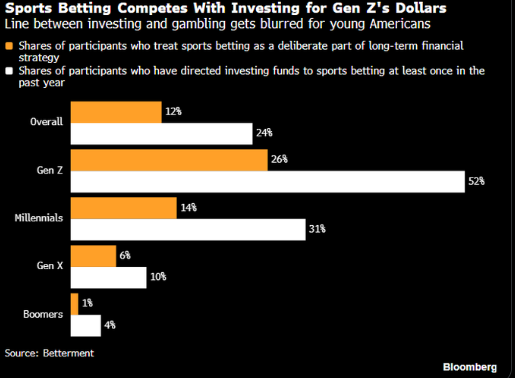
I used to gamble a decent amount. Casinos and poker were fun when I was in my 20s, but I’ve become an absolutist about it now. I will never gamble again. I know, I am no fun now, but I feel like I can’t ethically call myself a financial advisor and also participate in negative sum games with my own money. Maybe that’s taking it too far into the no fun zone, but that’s me. I eat my own cooking. I do asset-liability matching, lots of leg day and have no fun. We’re not the same, but if you’re doing financial planning you should treat far, far less than 26% of your financial plan to regular negative sum exposure. 0% is probably too little, but negative sum games should not be a big part of your financial plan.
So please – all you young guys out there. Have fun. But also, don’t be so impatient to get rich. Think long-term and stick to stocks, bonds and more traditional planning instruments.
3) The AI Blow Up That Wasn’t a Blow Up.
The big news story of July was the Situational Awareness hedge fund blow up. The fund, founded by AI investor Leopold Aschenbrenner, apparently grew as large as $45B before collapsing to $10B. But what I found most interesting about this collapse was that you had this gigantic volatility event occurring in a market that is pretty boring. The global stock market is near its all-time high as I write and was down just 1.5% in July. But you somehow had a 67% blow-up in a pretty big hedge fund.
Of course, it was all concentrated and leveraged bets, but I still find it strange that this sort of thing can happen in a market like this. But I guess that goes to show what concentration risk can do and how the AI bet is becoming increasingly risky. As the AI boom becomes more concentrated in certain firms and styles you need to be increasingly mindful about how you’re getting exposure to your equity investments. It does worry me a bit to be honest. It makes me wonder how people will react if we ever see some real volatility and how much this trade could decline if and when that does happen. I am a huge optimist about AI. It’s completely transformed my life and business for the better. But I also know that there is a hugely asymmetric risk in these trades that makes global, value and equal weight investing pretty attractive these days. That doesn’t mean you should be bearish about AI, but in the temporal framework it just means these strategies have longer average durations so you need to be increasingly patient with them as these crazy gyrations play out.
Well, that’s all I’ve got for you for now. I should be back to a more regular writing schedule for the rest of the year, but I am also whipping together a pretty cool little market dashboard like the macro dashboard so I might start doing a monthly letter built around that. Stay tuned, and of course, stay disciplined out there.


Comments
Log in or sign up to join the conversation.