

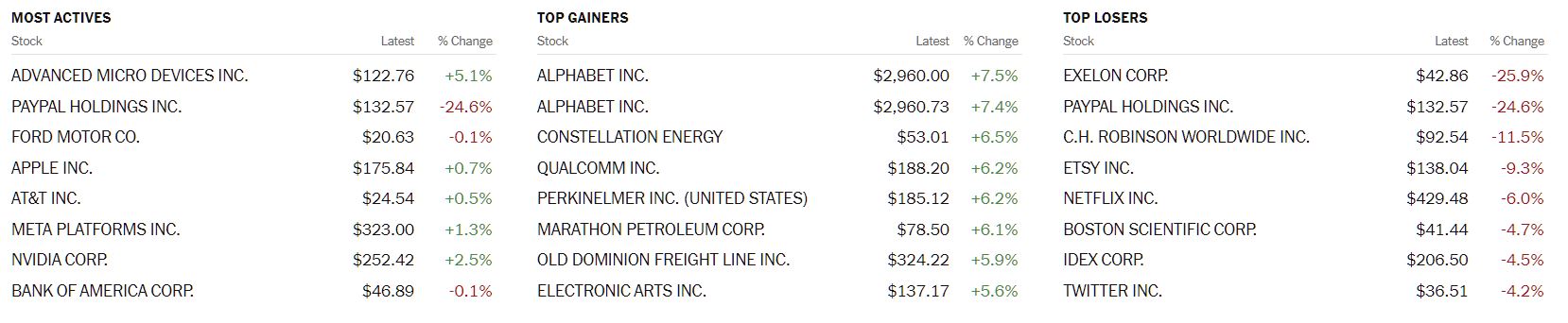
Stocks continued a fourth day of recovery with oil and technology related issues again in the spotlight. PayPal (PYPL) was in a spotlight of its own with a one day tumble of nearly 25%.

Continued shuffling among the large caps continues as can be seen by a cursory look at the most actives, top gainers and top losers charts from yesterday.
Charts: The New York Times
Wednesday, the S&P 500 closed at 4,589, up 43 points, the Dow closed at 35,629, up 224 points, and the Nasdaq Composite closed at 14,417, up 71 points. Currently market futures are pointed in the opposite direction with S&P futures trading down 49 points, Dow futures trading down 105 points and Nasdaq 100 futures trading down 327 points.
Many commentators are wondering aloud if the market is in a classic dip, rise, dip pattern with another dip on the immediate horizon. Contributor Declan Fallon examines just this in his column Retest Of January Lows To Commence.
"After some disappointing after-hours earnings report, we may see this market bounce move towards the next step, the confirmation test of the lows. Will markets confirm the January lows as a swing low, or will markets evolve into some broader measured move lower?"
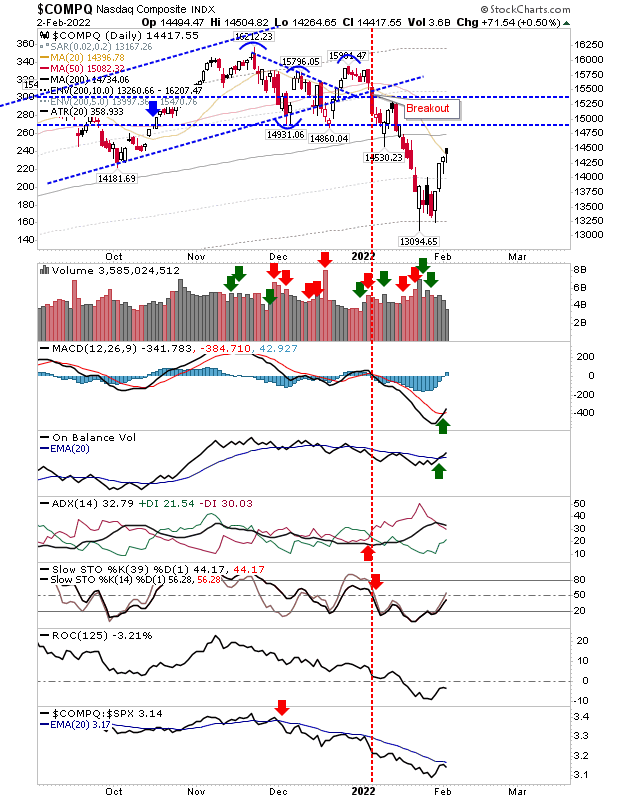
"In the case of the Nasdaq we had a narrow 'black' candlestick at the top of the bounce - and at 20-day MA resistance...A move down would not be surprising - the question is whether it will go all the way back to its 200-day MA...In the case of the S&P... we saw a modest gain as the index made its way past its 20-day MA and on course to test its 50-day MA. There were positive 'buy' triggers for the MACD, On-Balance-Volume, and intermediate stochastics, so there is a good chance that even if markets were to fall here, there is enough demand here to see the rally resume...The Russell 2000 was the only index to report a loss on the day as it remains some distance from retesting its 50-day or 20-day MA...its technicals remain net bearish.
If you were able to take a trade on the swing low, then you have an opportunity to take profits. If your time frame is longer, then you can hold - but the likelihood of your position spending some time underwater is relatively high. However, as a buy-and-hold, you have a good chance of having a position in the money in the long run."
Keeping reshuffling in mind contributor Diego Colman notes Value Stocks Remain Attractive But Risks Begin To Rise, Dow Jones Key Technical Levels.
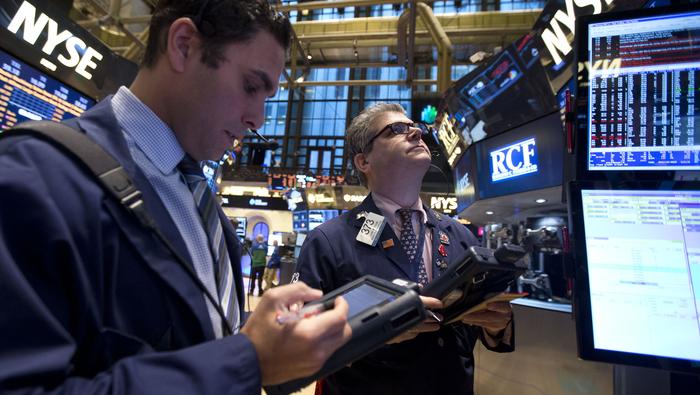
"A temporary setback in hiring, which ultimately reverses in February and March, is unlikely to have a major negative impact on value stocks, but a sustained and pronounced slowdown may bring the ongoing rotation to a screeching halt. In fact, if the recession story begins to take hold, investors/traders are likely to start dumping value shares furiously, refocusing on growth and tech, as a downturn in the economy during an election year may prevent the Fed from being overly aggressive in terms of its hiking cycle. Should the recession narrative become ubiquitous on Wall Street, the Nasdaq 100 could shine again, outperforming the value-leaning indices such as the Dow Jones."
TM contributor Dennis Miller writing in This Time IS Different is concerned that a larger dip looms.
"(When) Asset prices soar to ridiculous levels, well beyond anything regarding true, intrinsic values create a bubble. Eventually, things come crashing down. Those holding overpriced assets lose a lot of money and the ripple effect can cause economic hardship to many others."

With regards to the Nasdaq, Miller quoting Lance Roberts, notes "There is no precedent for when so many stocks were in a bear market, and the index wasn’t." This is just part of a larger conversation which Miller engages with readers in his article, so in addition to the following excerpt below, do see the full piece for more.
"Things are different, at least in our lifetime. Historically the Fed raised rates to cool an overheated economy and inflation. This time around we DO NOT have a strong economy but DO have double-digit inflation. If the Fed pays lip service to inflation as Chuck suggested, inflation will continue to destroy the economy along with much of the wealth of the nation.
“You can choose to ignore reality; but you cannot ignore the consequences of ignoring reality.”
— Ayn Rand
If they make a real effort to raise rates and tame inflation, the economy will also suffer; however, it will likely recover more quickly, while the banks are screaming….
We soon will know what the Fed intends to do. It’s probably going to take something as dramatic as the Great Depression to get our government to do what is right and reign in the banks."
Contributors Warren Patterson and Wenyu Yao take a look at oil and gas prices in their column, The Commodities Feed: OPEC+ Sticks To Its Plan.
"Yesterday’s OPEC+ meeting offered little relief to the market. As widely expected the group agreed to a further output increase of 400Mbbls/d for March. The concern for the market is that whilst the group may announce sizeable production increases, in reality what the market will see is smaller...This is an increase of just 50Mbbls/d MoM, a far cry from the slightly more than 240Mbbls/d that OPEC could have increased production by."

"European gas prices have come under some downward pressure in recent days. Russian pipeline flows have picked up from the low levels that we saw for much of January...whilst we are seeing some relief, the market is still tight. European gas storage is a little more than 37% full, compared to a 5-year average of almost 53%. There is also still plenty of geopolitical risk around Russia-Ukraine, and what a further escalation could mean for Russian gas flows to Europe."
Staff contributors from Equity Management Academy, in a TalkMarkets Editors Choice column write Fed Monetary Policy (is) Leading To A Major Crisis.
"The Treasury yield curve at the front-end is almost at zero, while on the long end it is about 2 percent. The Fed Funds is right at the start of the curve.
JPMorgan said they think the Fed will raise the Fed Fund rates five times this year and three in the following year. Bank of America predicts 11 rate hikes of a quarter each. Other banks are in the same ballpark.
What happens if Bank of America is right and the Fed Fund rate hits 3 percent? It would devastate the economy. Total federal public debt is $28.4 trillion. Debt went vertical up in 2020 and shows no sign of stopping."

"The 10 Year Note is trading at about 2 percent, yet real inflation is much, much higher than that level. Therefore, we're running a major deficit between real inflation and the interest rates...If tapering continues, the economy will suffer. If the Fed continues to taper, the economy will slow down over the next few quarters. The Fed will then have to reverse course and print more money to prop up the market."
Spoiler alert, the Equity Management Academy in their article also make a strong pitch for Bitcoin (BITCOMP) as the asset to counter the actions of The Fed. To wit they note the following:
"Bitcoin has come down more than 78.8% Fibonacci in a few months. As we trade above 39,643, the bearish trend will be negated and we will see a bullish price momentum with targets of 46,417 to 54,448."
Caveat emptor.
That's a wrap for today. I'll leave you with this quote from Warren Buffet:
See you on Tuesday.
Comments
Log in or sign up to join the conversation.