


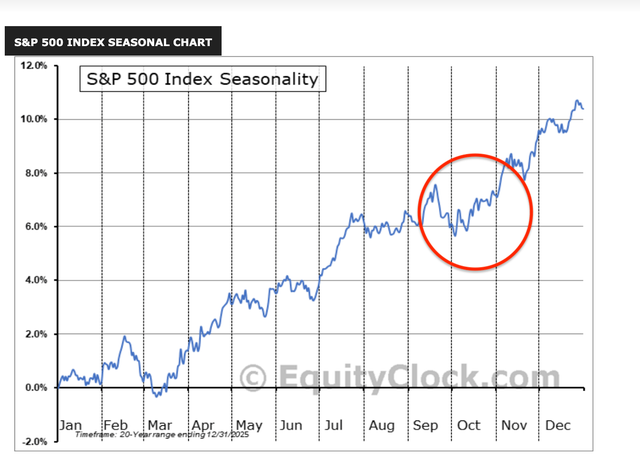
Last Friday's rout was not the start of a bear market. The market remains in the seasonal weakness common at the start of the new fiscal year (chart below).
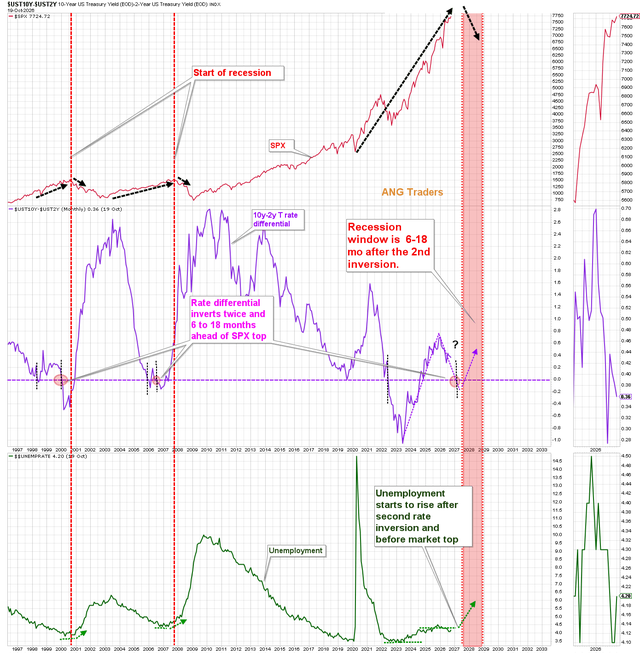
Long term, bear markets and recessions tend to occur 6-18 months after the second rate inversion of the 10y-2y Treasury rates differential (highlighted by pink ovals on the chart below). The differential is still positive, but is dropping toward the second inversion. If the current slope is maintained, an inversion would occur in late December or early January, and a recession would be expected to start sometime between mid-2027 and mid-2028 (red-highlighted area below).
angtraders.com, stockhouse.com
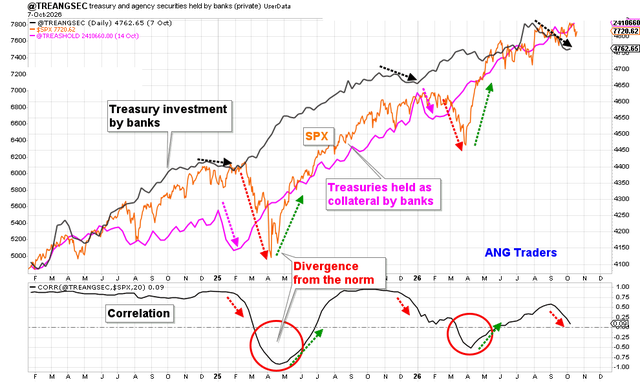
Last week, I published the chart pattern that shows how lower Treasury investment by banks, and Treasuries held as collateral by banks, front-run SPX pullbacks.
ANG Traders, stockcharts.com
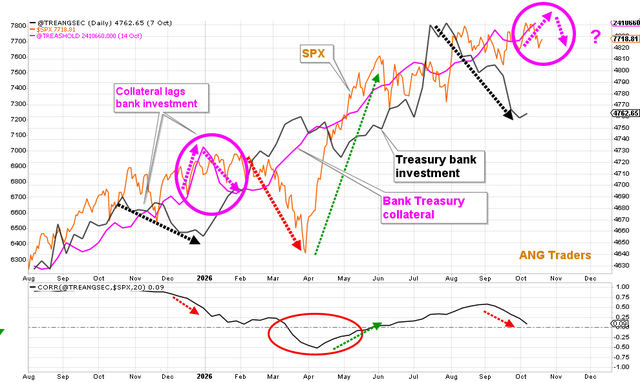
A closer look (chart below) shows that the Treasury collateral held by banks (pink lines) lags the Treasury investment held by banks, and the SPX lags both of them. The collateral held by banks (pink line) is still rising, which means the SPX is unlikely to experience a sustained drop in the near term. The pink line could drop a month or two down the line, and the SPX could suffer a serious pullback a month after that, but that is not the current situation.
ANG Traders, stockhouse.com
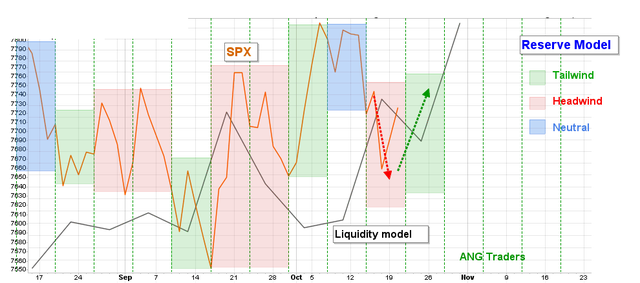
In the very short term (next two weeks), our proprietary Reserve and Liquidity models show that downside is limited for the rest of October.
ANG Traders, stockcharts.com
Investors can add to long positions in broad-spectrum ETFs such as SPY, DIA, IWM, and in more targeted ETFs such as QQQ



Comments
Log in or sign up to join the conversation.