


The AI boom continues to be the main factor driving GDP growth, with investment rising at a 12.7 percent annual rate, adding 1.78 percentage points to the quarter’s 3.4 percent growth. Consumption continues to rise rapidly, increasing at a 3.8 percent annual rate, adding 2.52 percentage points (p.p.) to growth. With slow job growth, and falling real wages, this rise in consumption was almost certainly attributable to spending based on stock gains. Inventories rose modestly, after falling in the prior five quarters, adding 1.61 p.p. to growth.
Investment Growth Is Driven Almost Entirely by AI
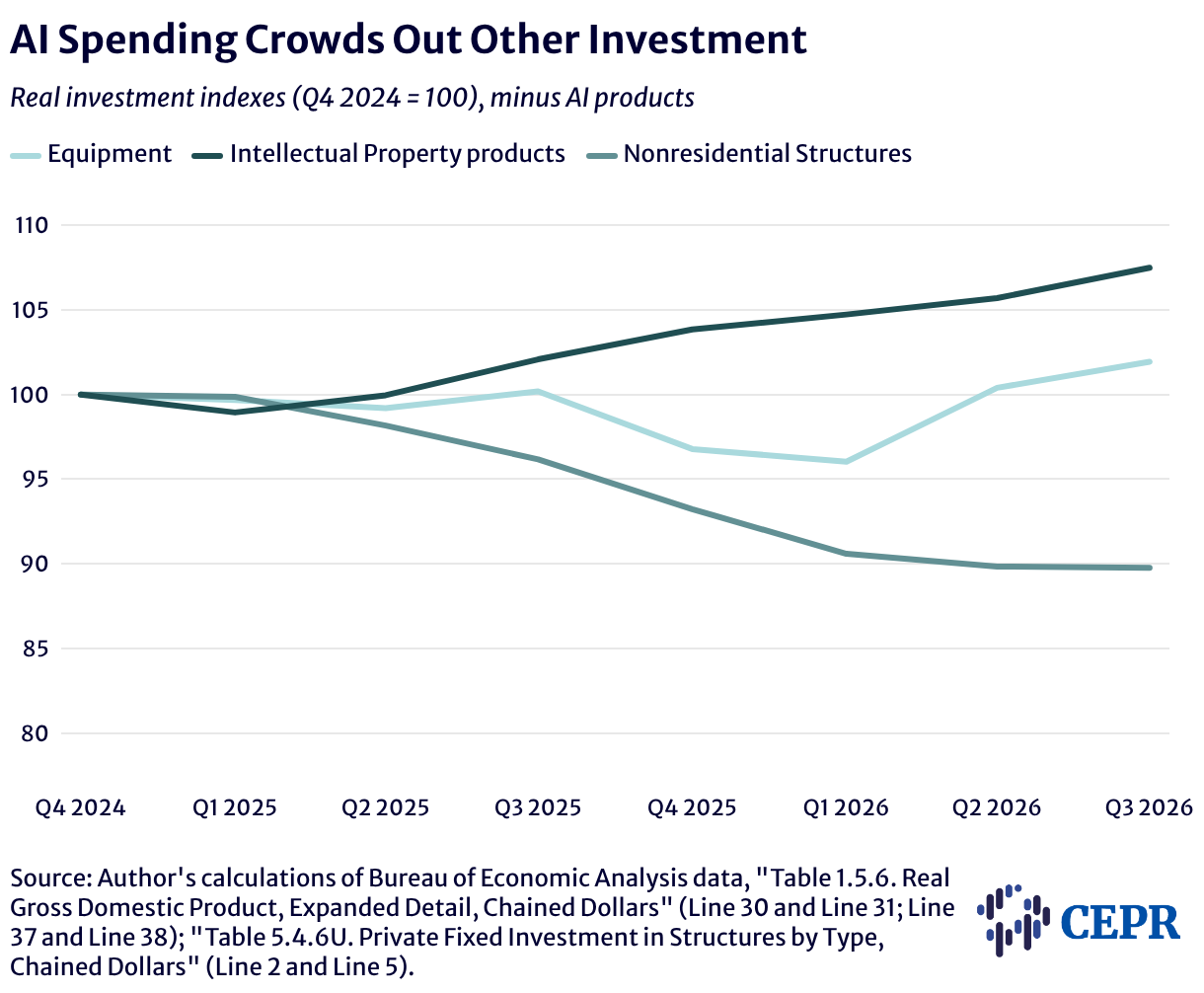
The impact of AI on investment is evident when examining its subcomponents. Structure investment rose at a 5.4 percent annual rate, adding 0.15 p.p. to growth. All of this growth came from data centers, which accounted for 107 percent of the rise in structure investment in the quarter. Factory investment continued to fall, declining at a 15.3 percent annual rate. Real spending on factory construction was 36.6 percent below its peak in the third quarter of 2024.
Equipment investment rose at a 20.9 percent rate, adding 1.16 p.p. to the quarter’s growth. Information processing equipment accounted for 74.1 percent of this rise. Investment in intellectual property products rose at an 8.4 percent annual rate, adding 0.47 p.p. to growth. Just under half of this came from investment in software.
Consumption Growth Driven by Health Care, Restaurants, and Drugs
Health care services continue to be the largest single driver of consumption growth, with real spending rising at a 4.9 percent annual rate, adding 0.56 p.p. to the quarter’s growth. Nominal spending rose at a 7.4 percent annual rate. Health care spending is driven largely by endogenous supply factors, since spending is not for the most part discretionary. Real spending on restaurants rose at an 8.8 percent annual rate, adding 0.33 p.p. to the quarter’s growth.
There was strong growth in the quarter in both spending at full-service restaurants and fast-food restaurants. The latter is noteworthy because it is more likely a measure of how moderate and middle-income families are feeling about their economic prospects. The third quarter was an anomaly in this respect, with growth in real spending on fast-food restaurants up 1.5 percent over the last year, compared to a rise of 3.1 percent in spending on restaurants at full-service restaurants.
Real spending on drugs and other pharmaceuticals rose at a 12.2 percent annual rate, adding 0.34 p.p. to the quarter’s growth. There were some quirks in the consumption data for the quarter. Real spending on housing services rose at just a 1.1 percent annual rate, as vacancy rates increased in the quarter. This was offset by a 21.8 percent jump in real spending on household gas and electricity. This is likely weather driven, since it followed declines in the prior two quarters.
Real beef consumption rose in the quarter but is still 13.6 percent below the level in the fourth quarter of 2024. Real spending by foreign tourists traveling in the United States fell at a 16.7 percent annual rate, despite the World Cup taking place in July. It is now 13.7 percent below its level in the fourth quarter of 2024.
Residential Construction Falls at 3.3% Rate, Offsetting Modest Second Quarter Rise
High interest rates continue to have an impact on housing construction, as the third quarter decline more than offset a 2.8 percent rise in the second quarter. Housing construction has now fallen in six of the last seven quarters. With interest rates continuing to rise, it is unlikely that there will be any substantial turnaround in housing any time soon.
Government Spending Rises at a 5.3% Rate, Driven by the War in Iran
The third quarter increase in spending was the largest since the third quarter of 2023 and added 0.9 p.p. to the quarter’s growth. Defense spending was the driving factor, rising at an 11.7 percent annual rate and added 0.41 p.p. to the quarter’s growth. This is not a good measure of the cost of the war, since most of it takes the form of depleted weapons systems, as well as base destruction, which will be replaced in future years.
Non-defense spending also rose at a rapid 22.2 percent rate, but this followed a 12.7 percent rate of decline in the second quarter. Much of this likely reflects the erratic timing of contracts as well as continuing adjustments from the DOGE cuts. Real federal non-defense spending is still 4.7 percent below its level in the fourth quarter of 2024.
Spending at the state and local level fell at a 0.1 percent rate, the first drop since the second quarter of 2022. State and local spending had been growing at more than a 4.0 percent annual rate in 2024, but growth slowed sharply in 2025 and averaged less than 1.0 percent in the last four quarters. This reflects cutbacks in federal support.
Trade Deficit Jumps to Near-Record Levels
The real trade deficit increased to $1,320.3 billion in the third quarter, subtracting 3.32 p.p. from the quarter’s growth. This is only slightly below the record $1,352.7 deficit hit in the first quarter of 2025. (The nominal deficit was larger in the third quarter.)
The deficit was driven largely by a huge rise in imports of computer chips and other items associated with the AI boom. Some analysts choose to examine GDP growth by pulling out both inventories and changes in the trade deficit to get a measure of “core” GDP growth. This is a mistaken view with the current economy, since the strong growth in investment is directly related to the rapid increase in imports.
Inventories Add 1.61 PP to Growth
After falling for five consecutive quarters, inventories showed a modest rise in the third quarter. This is far from a boom in inventory accumulation, it just means that they are rising rather than falling.
Overall Picture: Strong Growth, but Clearly Driven by AI Boom
The 3.4 percent growth rate for the quarter was in line with most analysts’ forecasts. While it is a solid growth figure, it is clearly driven by AI-related investment and stock-driven consumption growth. If the AI boom continues, we will continue to see strong growth. If not, the picture will look considerably worse.
One bright spot is that we are likely to see productivity growth in the quarter of above 2.0 percent based on the weak job and hours growth in the quarter. This is not the sort of earth-shattering productivity gains AI promoters promise, it is not even back to the pace of the 1990s tech boom or the post-war Golden Age, but it is the right direction.


Comments
Log in or sign up to join the conversation.