

My guess is that most people would be surprised if you told them car insurance prices dropped 5.0 percent over the last year, but that is what the Consumer Price Index (CPI) shows. In fact, according to the CPI, the average price of an auto insurance policy fell by 0.8 percent in August alone.
There are different ways to measure the rate of inflation in car insurance. The CPI monitors the change in the price of a sample of policies from one year to the next from specific insurers. This means it might measure how much it costs for a young adult to insure an SUV for $30K from Geico with a $500 deductible, or for a retiree to insure a compact car for $20,000 with a $1,000 deductible from State Farm. It would be looking at the change in price for the same policies, at the same company, not mixing across policies and companies.
Also, it measures the cost of the premium. The premium must cover the insurers’ operating costs, plus profits, as well as payments to beneficiaries for damages.
The Bureau of Economic Analysis uses a somewhat different methodology for the auto insurance component of the Personal Consumption Expenditure deflator (PCE). The PCE measure only looks at operating costs and profits of insurers; it doesn’t include the portion of a premium that covers damages paid out to consumers
It is also possible to simply take an average of what consumers pay for their insurance. This approach is used by The Zebra, a car insurance website for consumers. It takes a sample of available policies and averages them.
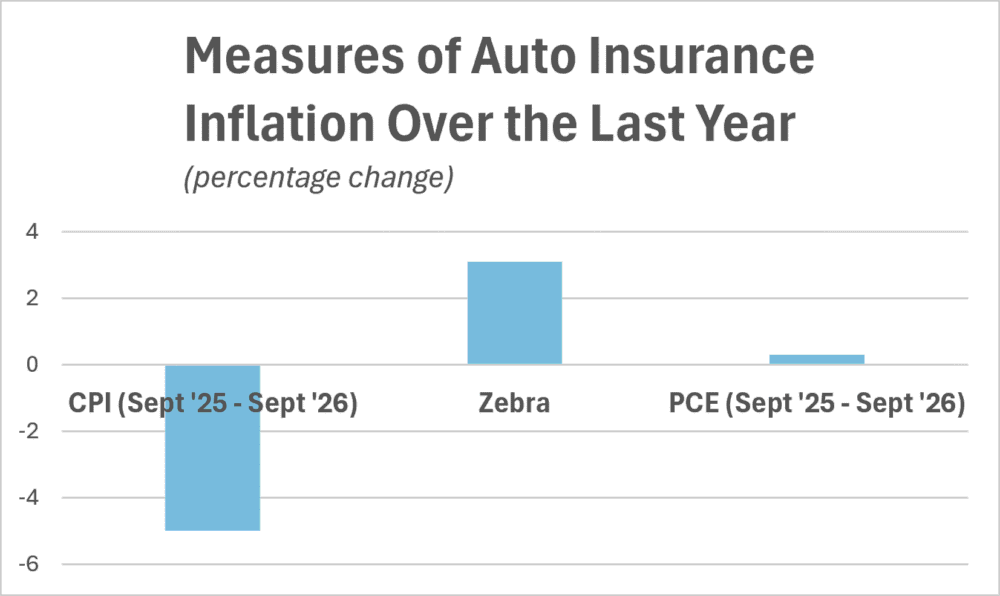
It turns out these different methods give very different measures of inflation for auto insurance. While the auto insurance component of the CPI showed a 5.0 percent drop from September 2025 to September 2026, the PCE measure shows modest positive inflation in 2026, with the index rising by 0.3 percent from September 2025 to September 2026. By contrast, The Zebra’s measure showed the average price of car insurance increasing by 3.1 percent to $2,079 in 2026.
This difference matters not only for people’s pocketbooks, but also for our measure of inflation. The auto insurance component of the CPI accounts for 2.6 percent of the overall index. As a result, the drop in the price of insurance in the CPI lowered the year-over-year inflation rate by 0.2 percentage points. This means that the year-over-year inflation rate reported by the CPI for September would have been 3.9 percent (rather than 3.7 percent) if the price of auto insurance had just remained unchanged, instead of being reported as falling by 5.0 percent. The core inflation rate also would have been 0.2 percentage points higher.
If the CPI measure had shown the same 3.1 percent increase as The Zebra found, it would have shown an inflation rate of 4.1 percent from September 2025 to September 2026.
Before going on, let me make a disclaimer that is very important in the era of Donald Trump. I am not accusing anyone at the Bureau of Labor Statistics (BLS) of fudging the numbers. They have an established methodology for measuring inflation in auto insurance, as in all other items, which they follow rigorously.
There may be reasons why this methodology does not always provide the best measure of inflation. BLS does review its methodology and make improvements where the evidence indicates changes are warranted, but it never arbitrarily changes numbers for political reasons. There is a real risk that Trump could change this. The fact that Trump fired BLS Commissioner Erika McEntarfer because he didn’t like the data BLS published was not a good sign. But to date, he has not sought to directly manipulate BLS data.
There are plausible reasons why the measure from The Zebra could show a higher rate of inflation than the CPI measure. For example, it could be driven by a changing mix of vehicles, which in principle would not be picked up in the CPI, since the CPI would keep the mix constant.
It could also be the case that the average policy costs more because people are choosing to get better coverage, say with lower deductibles or higher maximum payouts. This would also not be counted as inflation in the CPI.
It would take a more careful analysis to determine the extent to which the CPI measure of inflation in auto insurance reflects the price changes people are seeing. However, the judgment calls that BLS makes with its choice of methodology do matter, and it looks like they make a large difference with auto insurance.

Comments
Log in or sign up to join the conversation.