

Two weeks ago I drew you a map of what Iran’s proxies can reach: the Strait of Hormuz, the East-West pipeline, the Bab el-Mandeb, and as of last weekend, the Saudi capital. Every point on that map is a place where supply the world depends on can be held hostage by someone with drones.
On Friday night, Washington drew its own map.
Trump announced that the United States had reached a deal with Denmark and Greenland giving it, in his words, the “complete ability to do what is necessary in Greenland to secure and defend the security of Greenland,” permanently. Danish and Greenlandic officials were quick to say the agreement preserves Greenland’s sovereignty, and on paper that is true. Nobody annexed anything. What changed is that the U.S. now controls the security perimeter around one of the largest rare earth deposits on earth, and that is the part the market cares about.
Stocks reacted immediately.
Critical Metals (CRML), which owns the Tanbreez project in southern Greenland, jumped 37.5% on Monday. Greenland Energy rose 126%. Greenland Mines rose 136%. Tanbreez holds roughly 45 million tonnes of resource, and about 27% of its rare earth content is the heavy rare earths that go into magnets, guidance systems, and precision electronics. China refines the overwhelming majority of the world’s heavy rare earths today. Friday’s deal put a second source inside the American security umbrella.
Put simply, Iran spent the summer hitting energy chokepoints. Washington spent it securing strategic assets and critical minerals.
Here is why that matters more than one deal.
For thirty years, every U.S. administration handled critical minerals the same way: a strategic stockpile, a tariff here and there, and a hope that the market would sort it out. It did not. The market did exactly what markets do and moved every mine, refinery, and processing plant to wherever was cheapest, which was China. Washington understood the problem for years, but nobody acted on it. And over time, China became the dominant supplier of the rare earths, refined minerals, and magnets that defense and advanced manufacturing depend on.
Then Beijing turned that dominance into a weapon.
In 2025 China imposed export licenses on rare earths and magnets, slowed approvals to a crawl, and let American automakers and defense contractors discover what happens to a production line when a single input stops arriving. China did not need to cut supply to zero. It only needed to show it could.
That is when a supply chain problem became a national security problem. And the Trump administration’s response has been rapid, strategic, and unlike anything Washington has tried before.
It is running a completely different playbook. Every prior administration reached for the same two tools, tariffs and stockpiles, and neither one works against a chokehold. A tariff makes Chinese supply more expensive without creating another supply. A stockpile buys time, but it runs out and the chokehold does not.
The only durable answer is to own the supply.
So that is what this administration is doing. It is taking equity stakes in producers. It is writing 25-year loans through the Office of Strategic Capital that no private bank would write. It is invoking the Defense Production Act to fund refining capacity inside the United States. And now it is signing security agreements that put entire territories inside the perimeter. This is not trade policy. It is the government deciding which mines get built, where, and by whom, and then paying to make sure it happens.
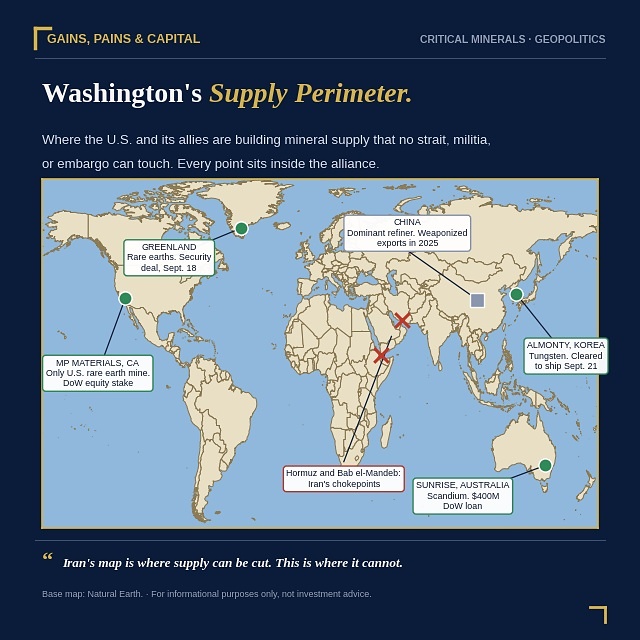
Look at the pattern. The Department of War took an equity stake in MP Materials (MP), the only rare earth mine in the United States, and guaranteed it a price floor. It committed $400 million to Sunrise Energy Metals to build the first primary scandium mine outside China, in Australia. On Monday, South Korea cleared Almonty Industries to start shipping tungsten from its Sangdong mine to Western customers. And now Greenland. Not all of that is U.S. soil. It does not have to be. The perimeter is the alliance, and every one of those moves puts a mineral supply inside borders that no militia can reach and no adversary can embargo.
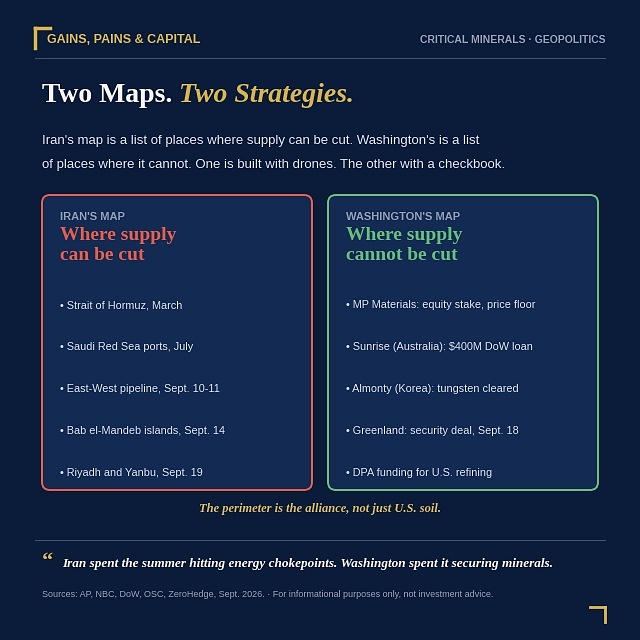
That is the map Washington is drawing, and it is the mirror image of Iran’s. Iran’s map is a list of places where supply can be cut. Washington’s is a list of places where it cannot. One side of that trade is a militia on an island. The other is a government with a checkbook, a permitting pen, and now a security agreement over a territory the size of Western Europe.
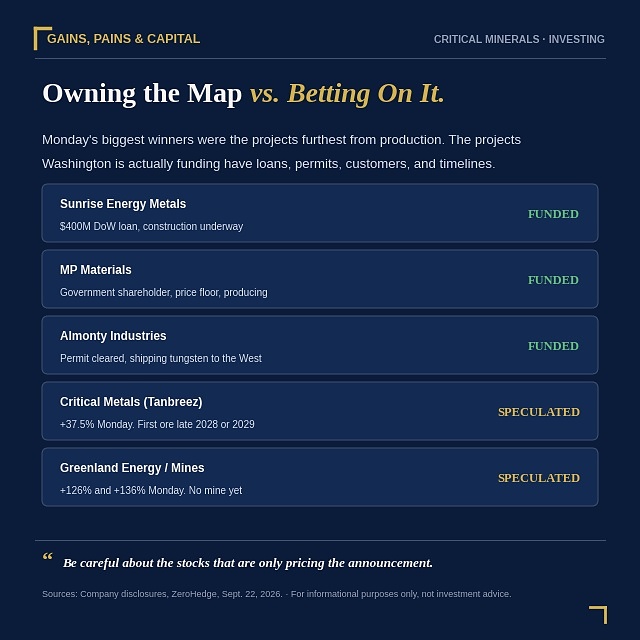
To be clear, this does not mean investors should buy everything that ripped on Monday. Tanbreez is not producing. First ore is targeted for late 2028 or early 2029, with concentrate exports in the third quarter of 2029. A stock that doubles on a security agreement for a mine that ships in three years is pricing hope, and hope gives back a hundred percent as fast as it gained it. The West needs heavy rare earths now, not in 2029.
The distinction that matters is between projects Washington has decided to fund and projects the market has decided to speculate on. Sunrise has a $400 million commitment and a construction schedule. MP Materials has a government shareholder and a price floor. Almonty has a permit and customers. The Greenland names have a deal signed by two governments and a mine that does not exist yet. The first group has a timeline management is accountable for. The second has a press release and a chart. That is the difference between owning the map and betting on it.
And here is the part most investors are missing. The sector that benefits from all of this has been left for dead. The VanEck Rare Earth and Strategic Metals ETF (REMX) is roughly 40% below its June high after a summer in which gold and oil got all the attention and mining stocks got none. It is now putting in a higher low. Friday’s deal and Monday’s Almonty clearance are the first real catalysts the sector has had in months. When a government is this openly committed to building a supply chain, the companies inside it do not stay 40% off their highs for long.
Own the supply Washington is securing. Be careful about the stocks that are only pricing the announcement.
Which brings me to the part that matters for your money.
Washington is spending billions to build mineral and energy supply that China cannot cut off and Iran cannot reach. Every one of those dollars is inflationary. So is every barrel that cannot clear Hormuz, every cargo that has to be insured at ten times the pre-war rate, and every rare earth magnet that now has to be made somewhere more expensive than China. Kashkari said it on Friday: inflation is spreading beyond the oil shock. The Greenland deal is part of why.
Put simply, the government has decided that independence is worth paying for. Investors who understand that get to be on the receiving end of the spending.

Comments
Log in or sign up to join the conversation.