

Yesterday, by the end of the day, the Dow Jones Index (US30) fell by 1.21%. The S&P 500 Index (US500) declined by 0.45%. The Technology Index Nasdaq (US100) closed Tuesday down 0.01%.
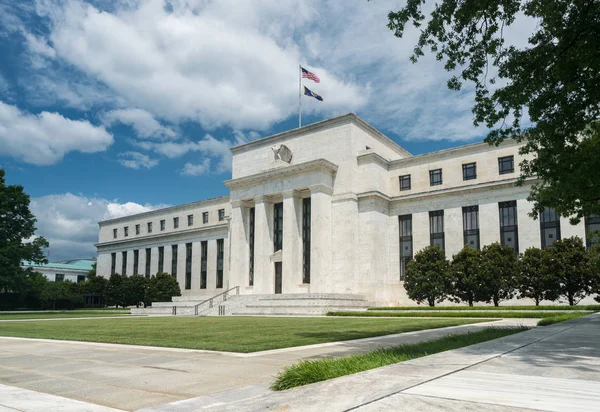
The unanimous decision by the Federal Reserve to raise the key interest rate by 25 basis points to the 3.75-4.00% range marked the official return of the regulator to a tightening cycle for the first time since 2023. The signal from the regulator is perfectly clear: the prolonged persistence of core inflation significantly above the 2% target, combined with the fuel shock, requires not just a one‑off stabilization act but a renewed phase of strict liquidity control. The revised Dot Plot projections finally dispelled market hopes for a “one‑and‑done” scenario: 16 out of 18 FOMC members penciled in at least one more 25‑basis‑point rate hike before the end of the year, and four officials do not rule out two additional steps, confirming the dominance of the hawkish wing within the Committee.
The weakening of the Canadian dollar (CAD) to 1.40 per US dollar and the renewal of a monthly low became a direct consequence of the widening interest rate differential between the US and Canada. The Fed’s decision to raise the rate to 3.75-4.00%, combined with the hawkish Dot Plot signal indicating the likelihood of another hike before the end of 2026, increased the attractiveness of US assets. Against this backdrop, the Bank of Canada’s decision to keep its key rate at 2.25% fixed a notable borrowing‑cost spread of 150-175 basis points in favor of the US dollar, continuing to push capital toward the American jurisdiction.
In Europe, by the end of Wednesday’s session, Germany’s DAX (DE40) rose by 0.53%, France’s CAC 40 (FR40) closed up 0.62%, Spain’s IBEX 35 (ES35) gained 0.41%, and the UK’s FTSE 100 (UK100) ended the trading session higher by 0.28%. Donald Trump’s threats to impose harsh tariffs on the European Union or even restrict trade altogether reflect rising transatlantic tensions amid geopolitical and trade fragmentation. Ursula von der Leyen’s initiative to grant Ottawa “associated member” status is perceived in Washington as an attempt to form a new transatlantic bloc bypassing US interests.
The local pullback in WTI oil prices below $103 per barrel reflects an attempt by financial markets to lock in profits after multi‑month highs amid conflicting information about the timeline for restoring logistics. Assessments by Saudi Aramco and the US Department of Energy regarding the possibility of launching bypass schemes and restoring up to half of the East-West pipeline’s capacity within several days temporarily eased fears of a physical shortage. Nevertheless, independent experts and market participants remain skeptical: full elimination of the consequences of the attacks may take more than six weeks. Additional pressure on prices came from the divergence between actual US inventory data and preliminary API estimates. The reduction in commercial crude stocks by 640 thousand barrels to 423.4 million barrels, along with declining volumes at the Cushing hub, offset speculative fears of a sharp oversupply triggered by the previous report of an alleged 7.1‑million‑barrel increase.
Pressure on silver (XAG/USD), which fell to $63 per ounce, illustrates the synchronized reaction of commodity and technology markets to tightening by global regulators. The Fed’s decision to raise the interest rate by 25 basis points, combined with persistent inflationary pressure and a strong labor market, shifted investor priorities toward yield‑bearing instruments. An additional blow to silver prices came from a crisis of confidence in the technology sector. Warnings from leaders of major AI laboratories about safety risks of advanced models triggered a reassessment of speculative demand for computing infrastructure and data centers. Since silver is widely used in microelectronics and power systems for data centers, the cooling of the investment boom in artificial intelligence weakened the industrial component of demand for the metal.
In Asia on Friday, Japan’s Nikkei 225 (JP225) rose by 0.69%, China’s FTSE China 50 closed higher by 0.74%, Hong Kong’s Hang Seng (HK50) gained 0.19%, and Australia’s ASX 200 (AU200) closed up 0.28%.
The foundation for a potential trend reversal in the AUD/USD pair is forming around the upcoming September 29 meeting of the Reserve Bank of Australia. Markets are pricing in an 85% probability of an RBA rate hike from the current 4.35% by 25 basis points, expecting it to reach 4.85% by early 2027. IMF warnings about the risks of entrenched inflation due to the Middle East conflict and logistical disruptions in the Strait of Hormuz are forcing the Australian regulator to maintain an extremely tight monetary stance.
New Zealand’s economic growth of 0.2% quarter‑on‑quarter and 2.6% year‑on‑year exceeded both analyst consensus expectations and the Reserve Bank of New Zealand’s (RBNZ) own zero expectations. The economy demonstrated the ability to withstand the global fuel shock and rising logistics costs, supported by the construction sector. These figures eased officials’ concerns about slowing economic activity and strengthened the likelihood that the RBNZ may continue its current tightening cycle from 2.75% to 3.00%.
The local strengthening of the offshore yuan (CNY) to 6.70 per US dollar reflects Beijing’s pragmatic strategy to reduce dependence on dollar‑based infrastructure amid the high rigidity of the global monetary system. The launch by the Shanghai Clearing House of central counterparty (CCP) services for direct transactions with the Singapore dollar, New Zealand dollar, and Thai baht marks a shift from isolated bilateral agreements to systematic construction of multilateral clearing hubs.
S&P 500 (US500) 7,551.81 -33.92 (-0.45%)
Dow Jones (US30) 51,461.90 -631.21 (-1.21%)
DAX (DE40) 25,537.75 +135.47 (+0.53%)
FTSE 100 (UK100) 10,688.47 +30.34 (+0.28%)
USD Index 100.29 +0.67 (+0.67%)
News feed for: 2026.09.17
New Zealand GDP (q/q) at 01:45 (GMT+3) – NZD (MED)
Switzerland Trade Balance (m/m) at 09:30 (GMT+3) – CHF (MED)
Eurozone Consumer Price Index (m/m) at 12:00 (GMT+3) – EUR (MED)
UK BoE Interest Rate Decision at 14:00 (GMT+3) – GBP, UK100 (HIGH)
UK BoE MPC Meeting Minutes at 14:00 (GMT+3) – GBP, UK100 (HIGH)
US Initial Jobless Claims (w/w) at 15:30 (GMT+3) – USD (MED)
US Building Permits (m/m) at 15:30 (GMT+3) – USD (MED)
US Natural Gas Storage (w/w) at 17:30 (GMT+3) – XNG (HIGH)


Comments
Log in or sign up to join the conversation.