The U.S Fed and Global Deflationary Pressures

We suspect China, so desperately in-need of higher growth levels, plans a further devaluation of the Renminbi, not just because of low average wages in China, but their need to ramp exports, almost at any cost.
Deflationary pressures - were hinted at persisting in Europe today yet-again; and we suspect China, so desperately in-need of higher growth levels, plans a further devaluation of the Renminbi, not just because of low average wages in China, but their need to ramp exports, almost at any cost. 


Bearing that cost will be manufacturers in most of the world, which will trigger another bout of competitive devaluations; and incidentally, a stronger Dollar's overall upside continuation pattern, which we've outlined for weeks now. What that also does is compel institutions like the IMF to lower global GDP estimate and other measures of economic activity further, while upward wage pressures are resisted by industry, for the same competitive reasons.

Normally this is something that would be called 'deflation', not 'lower inflation'; a favorite term of central bankers, governments, and even financial media; as all are loathe to call a 'spade a shovel' given broader economic implications. It is pretty obvious to the public, and is part of why 'consumers' and 'businesses' alike restrain themselves from major spending ventures; simply because they hear, but apparently don't accept, the recovery cheerleading from government or other sources (including super-bullish market pundits).


This is about a coming-to-grips with reality; not a bullish or bearish bias. That was my point about a reporter interpreting Stanley Druckenmiller's reflections on the economy and markets as 'negative', rather than just looking at the facts (as Mr. Druckenmiller rightly responded is what he intended); and that's been my point as well. 

We know there's a 'cottage industry' (essentially hand-holding propaganda) to convince us all that the economic data is less mixed than it really is; or to try to suggest productivity improvements are helpful (actually it's weak and hurts job hires and new plant investments without much growth). That 'campaign' really had strong allies between Wall Street, Government, and even financial media; but it's gotten to the point where apologists are running out of ammunition.
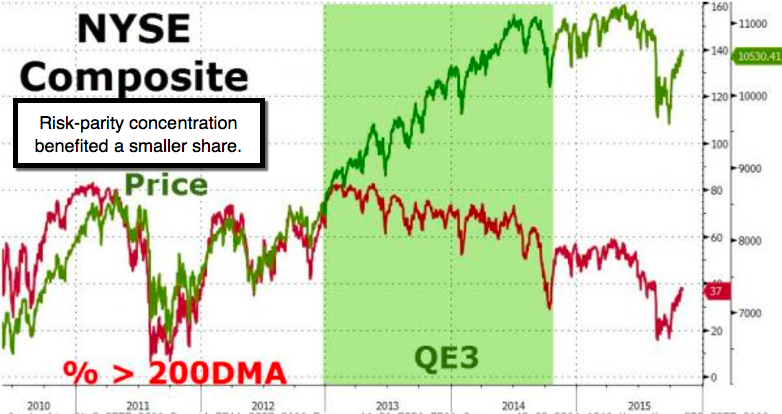


The export situation won't improve with the currency wars that are ongoing just as we had to forecast; and the 'service' gains are welcomed but most at levels that allow people to mostly survive, but not particularly thrive. Labor force and participation 'rates' have slowed; and that's not going to be as bullish as those suggesting such 'negative' facts will lift equities; because of sidelining the Fed. 

First of all, we don't presuppose the Fed will be sidelined; and second, we've indicated the market pundits will both hope for poor numbers (south of 175k in the a.m.) to rally stocks; but if it's stronger (perhaps seasonal service jobs will do that) they'll argue the market 'can live' with a Fed rate increase. The Fed is desiring to make the move; that's pretty clear. And history (and credit markets) suggests it won't be a single 'all and done' move. 
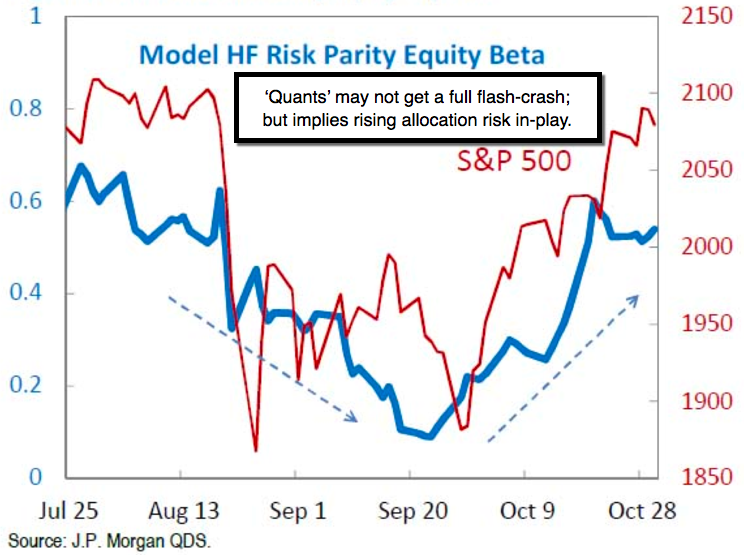


Hence let's minimize how they focus on the Jobs number or Fed move; even suggesting that this is not what the market is about, going forward. It needs a modicum of 'real' and vibrant growth; not what is massaged to 'pass' as good economic recovery. 

Yesterday I mentioned how shipping rates (for container loads, truckloads and rail-car loads) were collapsing yet-again; and that too contributes to Chinese desires to devalue perhaps, while also aiding to commodity price woes (when it costs more to produce or extract than demand will allow in unregulated price markets, well that doesn't play well for long periods). Our view has been 'deals' and drilling and farming and mining and more... all are structured at cost levels that assume 'regression to the mean' periodically (floating profits and sales of course); but don't presume nearly perpetual business at fairly low levels. 


Today Maersk (the world's largest carrier) is cutting 4000 jobs and cancelling a lot of new orders. German operator Hapag-Llpoyd, about to go public, reduced it's offering expectations several times due to slowing business. Notice that the 'hype' about 'auto-sales' hasn't made a dent, or if it has, it tells you how soft all the other sectors are, that aren't dependent on a low-interest-rate frenzy that's 'temporarily' supported sectors that are sufficiently expensive to be financed at least by most people (cars). Not to overlook in shipping, this year has a fleet of new huge container ships coming onto transpacific markets; absent demand.

In sum: we're just not growing as fast as 'officials' proclaim; thus high capacity, lower or sluggish demand, low shipping rates.. they all combine to discourage CapEx investment, and every major business see this, even if not reported as widely as it deserves. Seaspan and a few others say they're 'confident', but of course are dependent on the North American trade and aren't going to openly talk down prospects. 


Of course this will ultimately turn; but our point (reviewed and updated partially to remind and for new members) is it's as slow as turning a supertanker that's moving at trolling speed. All the rating agencies, institutions, and governments have gradually had to revise their estimates lower; while previously denying all the deteriorating trends ignored but as we argued, have been evident in factual data all year. This leaves an even wider yawning gap between equity prices in a host of big-caps especially, which haven't corrected adequately, or did, but of course subsequently rebounded because they could be lifted, not because the fundamentals had really improved. 

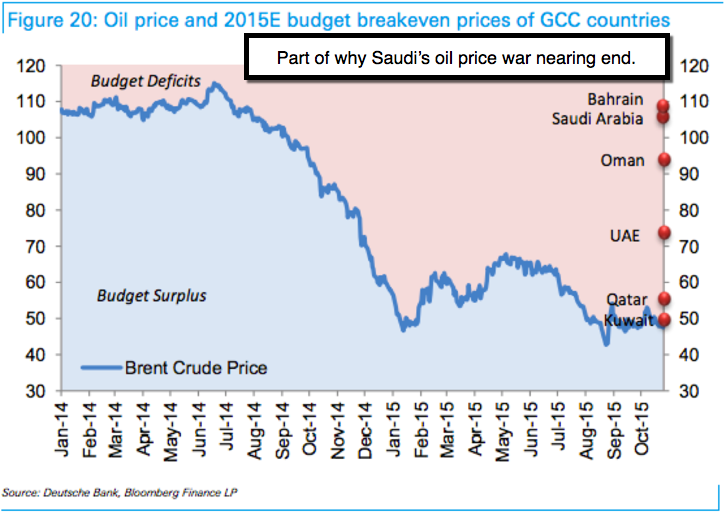
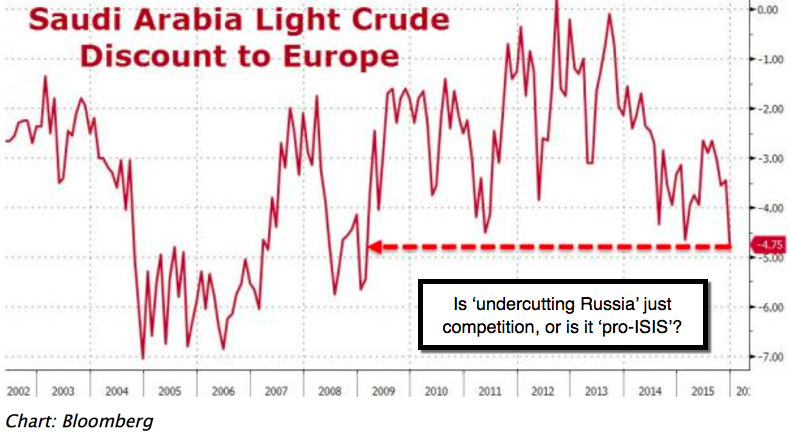
There are exceptions, even in technology; but there many winner harm others; as the problem with technology is technology. To wit: a Facebook success is a arrow in the heart of other advertising medium (we liked FB at 20; not to buy at high levels of course), while consumer's thrilled that Saudi Arabia is winning a latest version of OPEC's periodic energy wars, might consider the jobs lost in Texas and the Dakota's, as a result. (And incidentally today an OPEC official let slip that OPEC won't reduce production levels in December unless other oil producers in the non-OPEC world do so too. Clearly they're aiming mostly at Russia, not the U.S. We don't think Washington has encouraged this, but you never know, given the agenda some have. Today Saudi Arabia also cut prices to Europe so as to 'undercut' Russian light-crude prices; and that's obvious.) 

Again; regression to the mean is fine; but only the equity market is reluctant to engage on that trek. It's showing signs of being frayed; and we'll have to see if stocks can again increase their pace in that direction. If it's like the economy; a risk of a move beyond the median, is something to contemplate.     
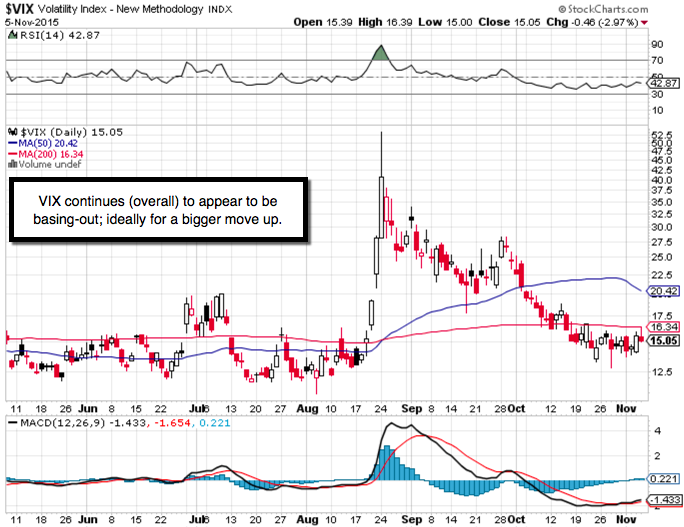


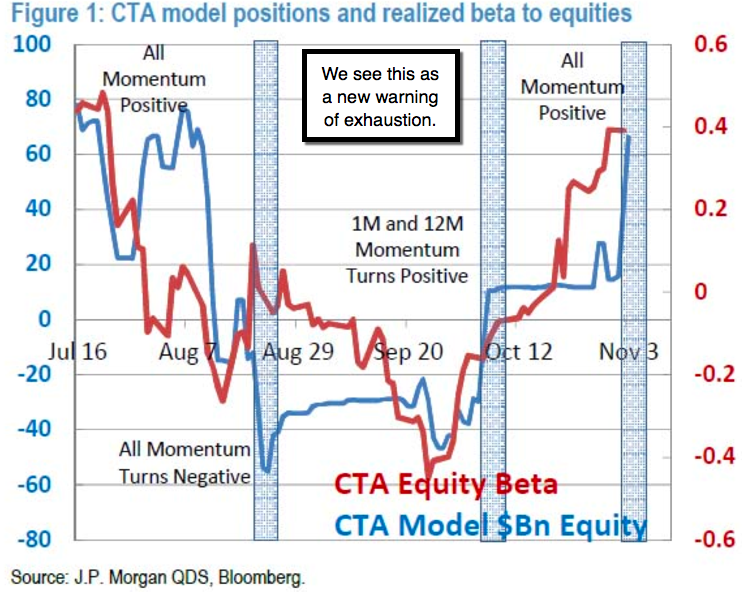
For now, we continue short Dec. S&P / E-mini from 2109. What we've seen in markets until a couple days ago was as described: short-covering; and bear capitulation from frustration; or to be kind, not substantial money coming in but a form of 'residual' and late-stage forced buying, which wasn't sustainable.     

Thursday (final) MarketCast 

 Last hour (intraday) MarketCast
 

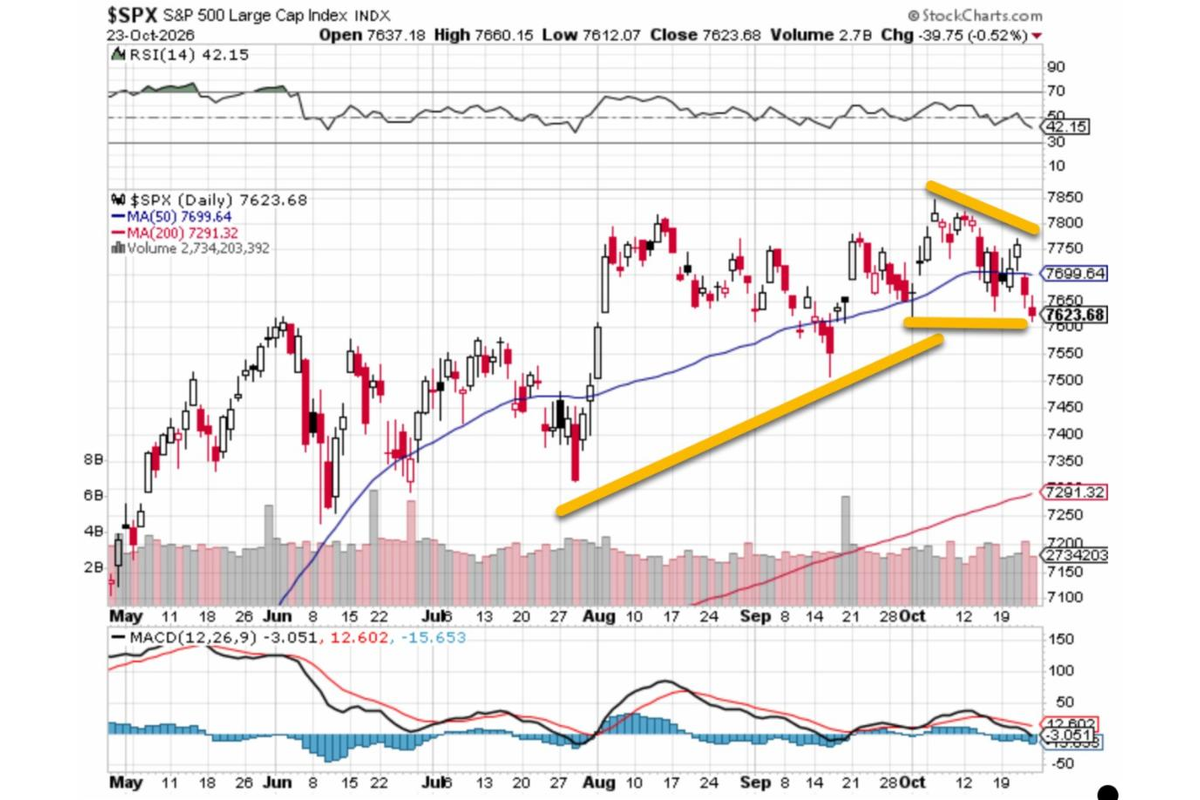
Daily action - again continues to expect the market ideally to crumble a bit; it's too pat to simply expect another string of advances; the pattern is at risk of not less than the 'accelerated uptrend' being broken; and an S&P drop roughly into the mid-2070's would be the first hint of that (about 20 handles lower for now). 


As to the Jobs number initial reaction? We think it's more a non-event, though I would not be surprised if hit-and-run traders (HFT guys too) try to make more of the number either way. If it's up early; look for it to turn down, bounce and to fail; if down early; look for a rebound (because they almost always catch those who short into weakness); and then perhaps another shot to the downside. 


Of course that's our bias, that it evolves into more decline, which is why we're holding short overnight again; same guideline since Tuesday; that's for E-mini / December S&P short-sales from 2109 to be retained with a fixed mental stop at 2104; though even if that came-out we'd hold a portion with a break-even or 2109 control. Also if they 'jerk' the market up in the opening moments we'd not close a short; or if one is out, consider putting one back on because we'd be a good bit suspicious of any out-of-the-box upward thrust on Jobs data. 


So ideally look for lower price levels essentially regardless of early jockeying. And, if they manage to hold things together; don't expect that to persist long.

Prior highlights follow:   

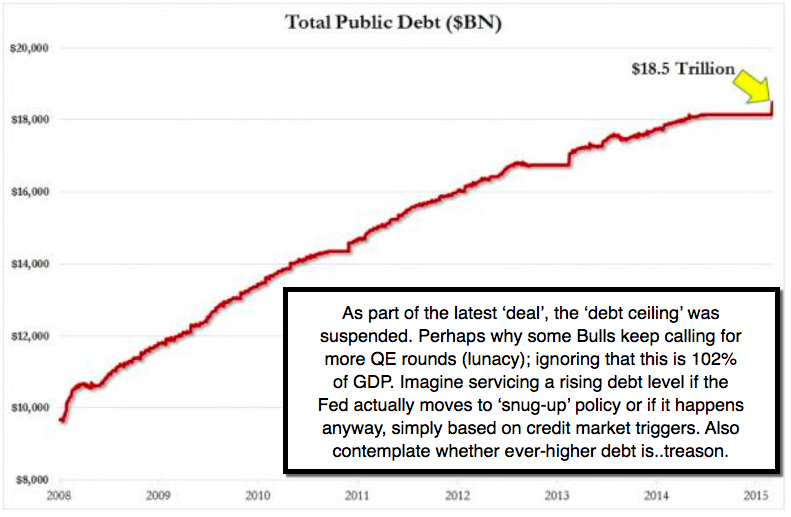
The 'global debt bubble' - is really at the heart of multi-market issues, which go way beyond seasonality; or whether or not money managers can 'eek-out' a few percentage points more out of a move showing every sign of withering. 

It's not simply a market that's retraced everything lost since August; but did so in the 'Indexes', especially the more-domestic-centric NASDAQ, which hasn't a handicap of being loaded with multinationals, impacted by our forecast Dollar strength over these last two years.


That's an ongoing evolution, and matters both to monetary policy wonks, and it matters to export-oriented companies; and also impacts Oil prices. When you get oil up like yesterday concurrent with Dollar strength, it's initially mostly just short-covering (which is partially why it retraced some today); then if it moves higher despite a firm Dollar, you know what it means with respect to geopolitics if not demand; plus a strong Dollar with firm Oil are detrimental to firm S&P's. (Ed: we see Saudi Arabia's drop in price to Europe as a counter to Russia.)


Besides believing this market was in a sort of 'buying climax' frenzy seeking to move back over S&P 2100, while only a handful of momentum stocks carried the weight of that climb, we viewed the nature of the move as departing from a typical upward trek that normally would point higher after retracing lost ground. That's in-part because it was accomplished by 'rotation' not a general advance and that it was extending the move while the disconnect with factual reality in fact widened. That might be acceptable 'if' we had another correction; but not in-absence of at-minimum a 'pause to refresh'. 


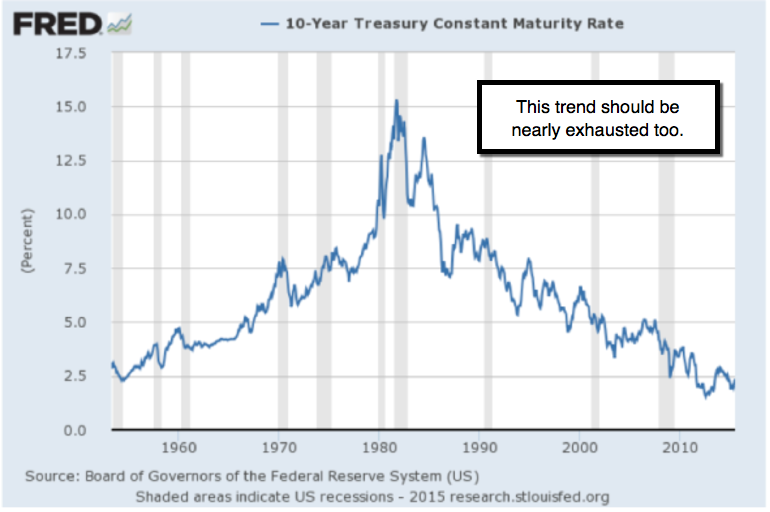
However part of the problem besides a moribund Fed that knows what it wants to do; but somehow seeks to shake the blame for what happens to markets, is the reality that economic activity and growth rates are sloppy to mediocre now; and oddly enough (while pundits claim that will hold back the Fed); that's what I suspect they actually require. How so? Because they want to snug-up policy in the most gentle way (normally it becomes a series of hikes) since while for sure they proclaim a desire for 'inflation' (debasing citizen buying power more) they also know that let it happen too fast, and you'll budge the CPI, unleashing all the forces that influence servicing that 'debt bubble' and aside entitlements or more; bringing the downside of an incredible stimulus-induced bubble-debt to center stage. That creates whole sets of additional problems; especially if it fails to ignite the economy into recovery-mode which current policy dissuades.


A problem for the Fed and markets: most central banks have already failed as recoveries were not (as I contended) going to occur the way they did QE or all the variations. The Fed, ECB and clearly BoJ have constantly missed inflation goals. All have loose policies. Unfortunately for the others, the U.S. is the least loose; hence or call for a resumption of the Dollar's push higher; complicating policy decisions. When central banks fail to achieve mandates, it's dangerous for the global economy. That's why we warned all year that 'Submerged Asian' markets weren't really 'emerging' again yet, and that Super Mario's strategy in Europe was going nowhere fast; especially in the midst of historical conquest; despite that invasion of (primarily legitimate) refugees deserving compassion. 


Bottom-line: there are few escape hatches for stimulus carried-on far longer than sensible; and invoking loose policies when everyone else is doing it too. For two years (whether bullish or bearish at times, understanding what they'd mistaken for stimulus when all it did was drain the private sector while allowing the circuitous pattern to banks lifting financial assets) we're argued the bullish case would be to 'normalize' rates or at least back-off the excessive stimulus. 

The Fed 'is' embarked on that trek now; but retarded by fear of repercussions from letting it go far too long. That's precisely why financial pundits suddenly say 'they can live with a rate hike' (how benevolent of them ..hah!). That they switched-their-pitch to making it acceptable (while preferring it not occur) sort of reveals they fear it's really coming. It needs too; way overdue. That's also a reason for high car sales at long-term loans; borrowing future sales that way; and assuring an old fleet of low-interest but upside-down debt, several years hence (millions of people owing more than their vehicles will be worth). 

In sum: analytically nothing changed from yesterday (please see text below if you missed our discussion of Mssr's. Icahn and Druckenmiller's remarks that echoed my warnings). What has changed is more companies 'missing' or just being sold-off on earnings reports. It's constructed to decline, with failing rallies intervening; and defies all the pundits who thought November would be a romp in the upside park. 

We continue holding Dec. S&P / E-mini guideline 2109 short from Tuesday. 


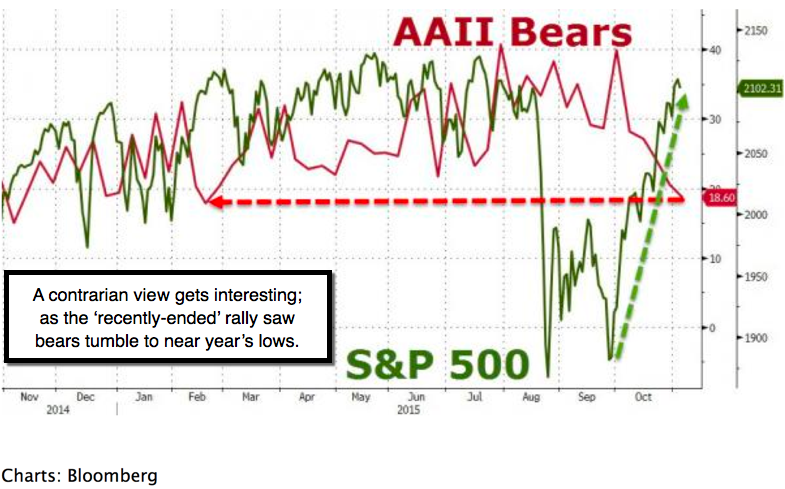
Could the 'edge of a precipice' return - just as the S&P flirts within a percent or so of new highs (despite 'weighting which has really deteriorated with sector rotation trying to sustain the Indexes since May at least)? Perhaps so, while of course the pundits try to rationalize all upside behavior as attractive, and most professionals that have sound principles are not nearly so complacent.


I've seen this movie before; as recently as July in fact; and it normally doesn't end well. Of course more bears capitulated to either neutral or even bullish or 'despondent' perspectives; while most 'public' bulls seem confident that this is a 'monster' bull market that has years to go. That view relies on 'bad news' and a sloppy economy in most sectors; which perpetuates the idea of low rates as time goes on. 

We think this has more to it than rates; and that 'facts' continue unmasking the propaganda intended to convince investors all that matters is rates; and that a lack of 'supportable' earnings gains (either distorted by accounting gimmicks, or buoyed by buybacks allowing numbers to 'appear' better than they were), is somehow not a deterrent to persistently higher equity levels. 


I mentioned yesterday the Friday night 'massacre' that wasn't reported 'much' either (one might wonder if there's media bias; all we seek is transparency and will look at good or bad data and reflect upon it). That massacre was ALL the six largest US banks being put on 'credit watch' for potential downgrade, after the Friday night report. Should a market reversal stick, ponder if the either the Fed report or the 'credit rating watch' will be cited as contributing factors. 
 

Disclosure:

None

Comments