

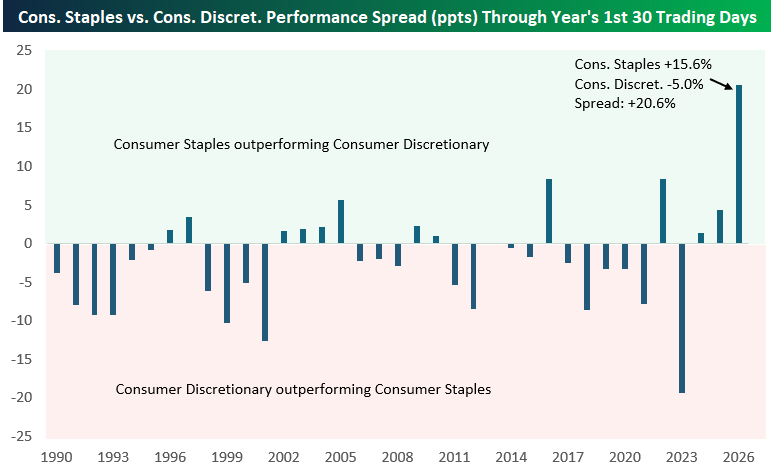
Through the first 30 trading days of 2026, the Consumer Staples sector gained 15.6%. That’s easily the best start to a year for Staples since at least 1990 (when our daily sector price data begins). Prior to 2026, the strongest start to a year for Staples was a 9.2% gain through the first 30 trading days of 1997.
While Consumer Staples has been soaring, the cyclical Consumer Discretionary (XLY) sector has been declining, falling 5% through the year’s first 30 trading days.
With Staples up 15% and Discretionary down 5%, the 20 percentage point spread between the two is a new record through 30 trading days (going back to 1990). No other years have been even remotely close.
 |
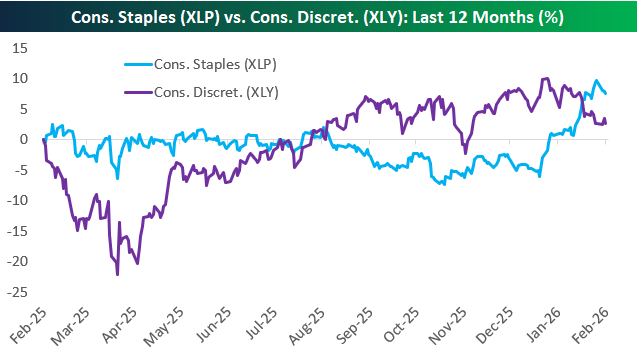
The surge in Staples to start 2026 has left the defensive Staples sector ETF (XLP) up more than Consumer Discretionary (XLY) over the last twelve months. The chart below resembles the classic “tortoise and the hare” race, doesn’t it? Staples slowly moved sideways throughout the first half of 2025 and then slowed even more in the last five months of the year. Discretionary plummeted to start 2025 during the tariff tantrum but then decided to start competing after the first quarter mile.
Discretionary surged past Staples last August and didn’t look back. That is until the calendar year turned to 2026. While Discretionary took a breather, Staples came from behind down the final stretch to win the race! Of course, in markets, the race is never over, but you get the point.
 |
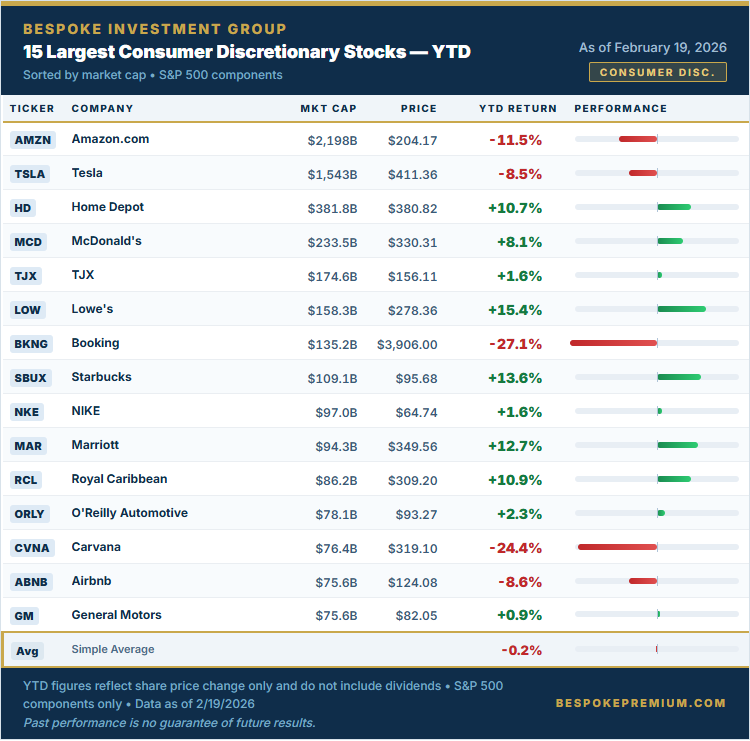
The reason Consumer Discretionary has been so weak is because its two largest stocks have struggled to start the year. As shown below, Amazon (AMZN) is down 11.5% YTD, while Tesla (TSLA) is down 8.5%. These two stocks have a combined market cap that’s nearly $1 trillion bigger than the combined market cap of the remaining 46 stocks in the sector!
Of the 15 largest Consumer Discretionary stocks shown in the graphic below, ten are actually up on the year.
 |
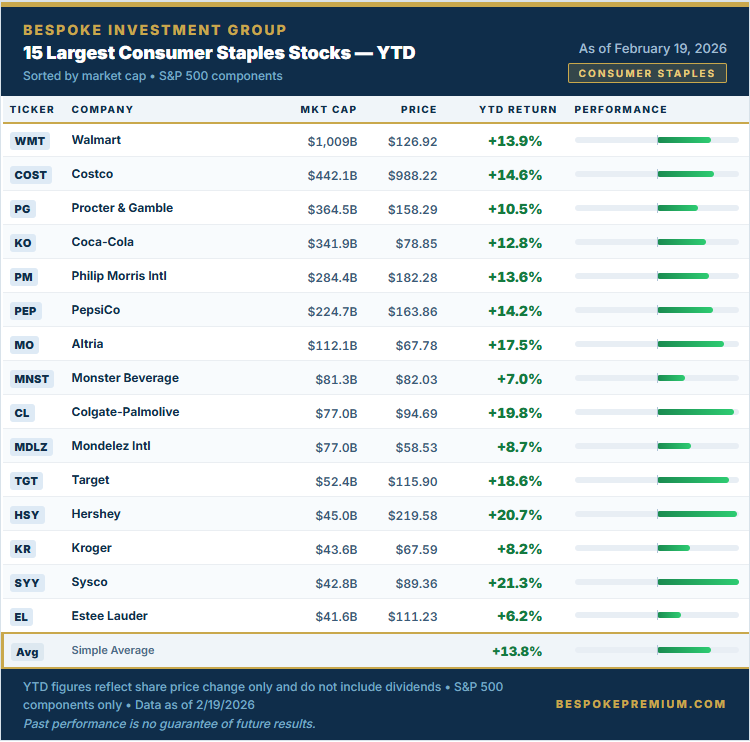
The performance of the 15 largest Consumer Staples stocks to start the year has been eye-popping. Each of the seven largest Consumer Staples stocks are up 10%+ on the year, while all 15 stocks listed are in the green.
 |
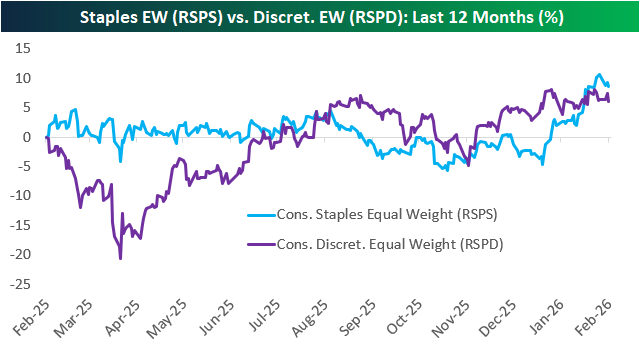
There’s a way to get around the top-heaviness of the market, though, and that’s by focusing on the equal-weight versions of sector and index ETFs. As shown below, the equal-weight versions of Consumer Staples (RSPS) and Consumer Discretionary (RSPD) are much more closely aligned over the past year. That’s because the average stock in the Consumer Discretionary sector has done better than Amazon (AMZN) and Tesla (TSLA) in recent months.
 |
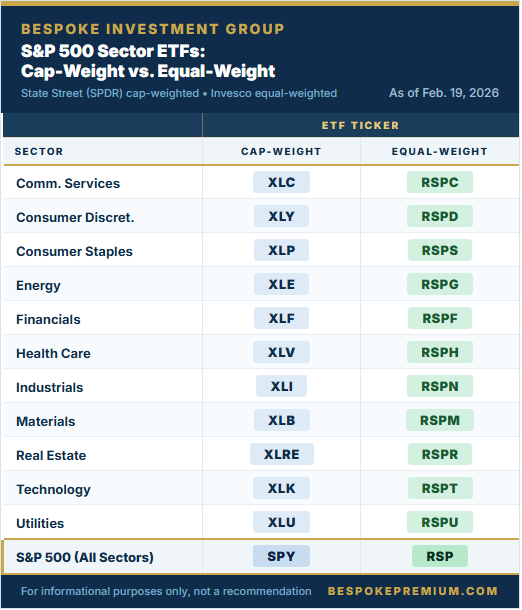
If you’d like to simply bet on the average stock in a sector rather than having more exposure to the biggest stocks, we created the graphic below that lists ETF options for both cap-weighted and equal-weighted S&P 500 sectors.
 |



Comments
Log in or sign up to join the conversation.