

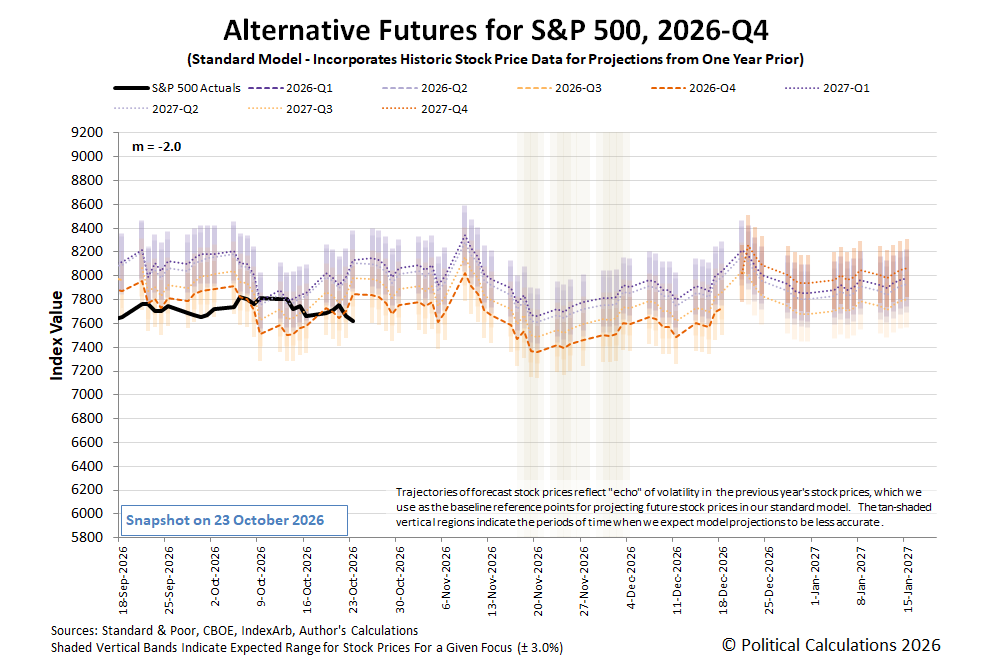
The S&P 500 closed the third week of April 2018 at 2,670.14. If you closed your eyes at that time, and didn't open them again until after the market closed at the end of the fourth week of April 2018, you would barely notice anything changed, with the S&P 500 having hardly moved to close the week at 2,669.91, a change of just 0.23 points.
(Click on image to enlarge)

Overall, investors appear to be about equally splitting their forward attention between the current quarter of 2018-Q2 and the more distant future quarter of 2019-Q1. Which is to say that the last week was not much different from the week that preceded it.
The lack of market movement during Week 4 of April 2018 coincided with a week in which there was very little in the way of market-moving news. Here are the more notable headlines from the week.
Monday, 23 April 2018
- Oil settles higher; fears of Iran sanctions end early slide
- U.S. home sales increase strongly; inventory remains tight
- Wall Street ends mixed as investors eye earnings
Tuesday, 24 April 2018
- Oil slips as Trump, France's Macron talk Iran deal
- Beginning of the End of the Trade Wars?
- Stocks drop on cost worry; U.S. 10-year yields top 3 percent
Wednesday, 25 April 2018
- Oil prices rise on geopolitical worries, shrugs off U.S. build
- Stocks weaker for fifth day as U.S. 10-year debt yield tops 3 percent
- Wall Street ekes out small gain as earnings offset cost worries
Thursday, 26 April 2018
- Oil prices gain on Iran sanctions worries
- Trump tariffs cause headaches for S&P 500 manufacturers
- China's Premier Li says open to trade negotiations with United States
- Wall Street gains on strong earnings, tech resurgence
Friday, 27 April 2018
- Oil inches down but Brent ends week firmer on Iran concerns
- Wall Street flat as earnings offset inflation jitters
If you're looking to consider additional events of potential significance, Barry Ritholtz tallied up the positives and negatives for the U.S. economy and markets in the fourth and final week of April 2018.
On a final note, it is only a matter of time before investors might shift their forward-looking attention more fully to a particular point of time in the future. If you're looking to identify your next investing opportunity, all you need to do is to anticipate when investors might shift their attention and to identify which particular point of time in the future they might shift their focus toward.
How good of an investment opportunity it might be will then hinge on what expectations investors have for changes in the growth rate of dividends are at that point of time. Easy, right?
Comments
Log in or sign up to join the conversation.