

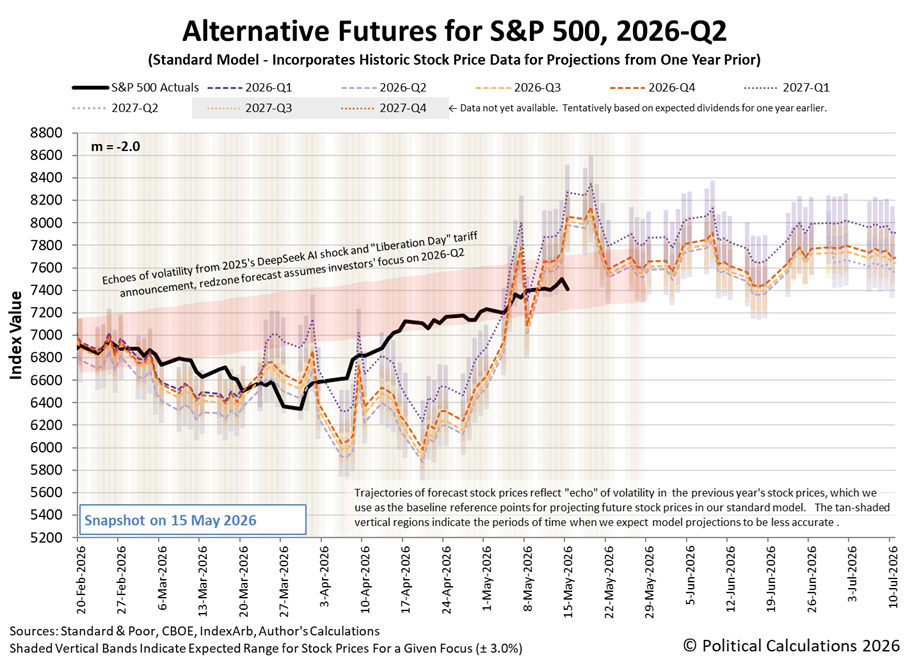
The S&P 500 (Index: SPX)) continued rising during the trading week ending on Friday, 15 May 2026, clocking several new record high closes during the week that was. The index however retreated from those new highs on Friday, but still closed at 7,408.50, up a little over 0.1% above its previous week's close.
Friday was the day inflation fears came roaring back for the U.S. economy, erasing two days worth of gains for the index in the process and taking expectations of rate cuts entirely off the table for 2026.
The CME Group's FedWatch Tool now anticipates no change in the Federal Funds Rate until 9 December (2026-Q4), when it now projects a quarter point rate hike, which is a big change from the previous week. Right now, it's not projecting much more than that increase, but the tool's bias going into 2027 has shifted toward expectations of more rate hikes.
QTR's Fringe Finance captured the Wall Street zeitgeist of the moment:
Lauren Hyslop, investment manager at Mattioli Woods, summarized the situation well in comments to CNBC: “Rising bond yields are once again imposing their will on markets, tightening financial conditions and sapping risk appetite across asset classes,” she said.
She added that investors are confronting the “uncomfortable reality of ‘higher for longer’ rates in the U.S., as stubborn inflation and surprisingly resilient growth push back any meaningful pivot to easing.” She also noted that a stronger dollar, fading expectations for liquidity support, geopolitical uncertainty, and fiscal concerns are all adding pressure simultaneously. That combination is particularly dangerous because it removes the easy narrative markets have relied on for months that rate cuts were inevitable and policymakers would remain quick to intervene.
The fact that the Fed is stuck between a 3.8% CPI and 6% PPI rock and a market-teetering-on-the-brink-of violently-pulling-back hard place was the core of yesterday’s concern. If the bond market starts to get violent, what options does the Fed have to start printing to buy bonds and do yield curve control with inflation already where it is? The central bank’s hands might be tied — and this is a scary (and somewhat unprecedented) thought....
Even so, the latest update of the alternative futures chart shows the trajectory of the S&P 500 remains within the redzone forecast range we forecast for it almost three months ago following the disruption of the Iran war geopolitical event.
The change from being biased to either holding rates steady or cutting rates is a global response to inflation pressures and the disruptions from the Iran war geopolitical event. The market moving headlines of the week indicate they are increasingly expected in the U.S., in Japan, and also in the Eurozone:
Monday, 11 May 2026
Signs and portents for the U.S. economy:
Bigger trouble developing in and out of China:
ECB minions thinking more about ditching their perfect monetary policy:
Wall Street ends slightly higher as U.S.-Iran resolution talks fizzle
Tuesday, 12 May 2026
Signs and portents for the U.S. economy:
Fed minions get closer to having a new chief:
Bigger trouble developing in China:
BOJ minions discussing plans for next rate hike, working to prop up Japan's currency:
Wednesday, 13 May 2026
Signs and portents for the U.S. economy:
Fed minions claim they want to get inflation down, perhaps even to their real target:
ECB minions expected to ditch perfect monetary policy and hike rates in June, starting to worry about AI cyberattacks:
Thursday, 14 May 2026
Signs and portents for the U.S. economy:
Oil prices dip after Iran says dozens of vessels are crossing Hormuz
Fed minions starting to think inflation may be problem for US economy; job opening for new minions opens up:
BOJ minions getting super excited to hike Japan's interest rates:
Friday, 15 May 2026
Signs and portents for the U.S. economy:
Next chief Fed minion's plan to reduce holdings of U.S. government debt to come up against government's need to borrow much more:
Bigger rate hikes developing in Japan:
The Atlanta Fed's GDPNow toolestimate of real GDP growth for the U.S. economy in the current quarter of 2026-Q2 rose to +4.0%, up from the +3.7% it projected a week earlier.
Comments
Log in or sign up to join the conversation.