

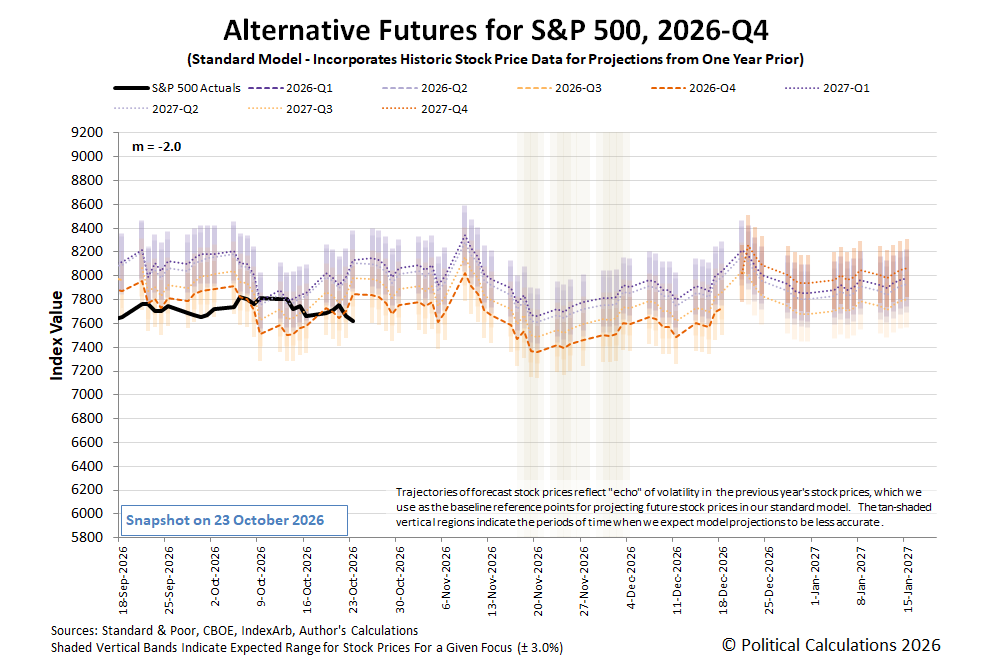
The S&P 500 (Index: SPX) completed its second Lévy flight event. The dividend futures-based model alternative futures chart indicates investors have shifted their forward-looking focus to the more distant future quarter of 2022-Q3.

The signals sent by the Federal Reserve's minions for their next steps are responsible for the shift in how far forward in time investors are looking in making their current day investment decisions. In the past week and a half, investors absorbed the new information that the Fed's March 2022 rate hike will be followed up by half-point hikes through the end of 2022-Q2, which shifted the uncertainty window for what happens next to 2023-Q3.
Those new expectations can be seen in the CME Group's FedWatch Tool, which now projects the Fed's next move will be two consecutive half-point rate hikes in May and June 2022 (2022-Q2), followed by a resumption of quarter-point rate hikes every six weeks with hikes in July and September 2022 (2022-Q3), and more hikes in November and December 2022 (2022-Q4), followed by two more in 2023, one in February 2023 (2023-Q1) and in May 2023 (2023-Q2).
At the same time, there has not yet been any change in the expectations for the year-over-year change in the growth rate of S&P 500 dividend in 2022-Q3, the outlook for which is more positive than the current quarter of 2022-Q2. As would be expected, the level of the S&P 500 has risen substantially with the shift in focus from 2022-Q2 to 2022-Q3.
The large difference between the dividend growth rates expected between 2022-Q2 and 2022-Q3 also puts the index at risk of a substantial decline, even without any erosion in expected future dividends. Should investors have reason to fully shift their attention back to the current quarter of 2022-Q2, it would likely be accompanied by a sharp, sudden decline, on the order of 9-10%. That's without any erosion in the expectations for the S&P 500 future dividends.
The thing that could trigger such a shift is the random onset of new information. Here's our summary of the market-moving headlines from the second to last week of March 2022.
Monday, 21 March 2022
- Signs and portents for the U.S. economy:
- Fed minions wants rate hikes, lots of 'em!
- Bigger inflation developing in the Eurozone:
- Bigger stimulus developing in China:
- ECB minions thinking they may need to do something about inflation, but not along with Fed:
- Wall Street slips after Powell's hawkish remarks
Tuesday, 22 March 2022
- Signs and portents for the U.S. economy:
- Fed minions want rate hikes, big ones! Starting to get onboard with crypto they can control:
- Bigger stimulus developing in Japan:
- ECB minions don't think they have a stagflation problem, want to keep stimulus flowing:
- Wall Street gains, with tech, growth shares in the lead
Wednesday, 23 March 2022
- Signs and portents for the U.S. economy:
- Fed minions getting on board with frequent, bigger rate hikes:
- Bigger inflation developing in the UK, India, Russia:
- Bigger stimulus developing in Japan:
- ECB minion wants to keep stimulus flowing, doesn't think dealing with inflation is needed:
- Wall St drops as oil rally, Russia-Ukraine conflict fuel worries
Thursday, 24 March 2022
- Signs and portents for the U.S. economy:
- Fed minions starting to be concerned by rising house prices, getting really excited about hiking rates:
- Bank of Mexico, Swiss National Bank, BOJ minions start looking to deal with inflation:
- ECB minions studying how to keep rolling out stimulus, say Eurozone won't have recession:
- Wall St resumes rally, led by Nasdaq as chipmakers soar
Friday, 25 March 2022
- Signs and portents for the U.S. economy:
- U.S. pending home sales approach two-year low; consumer sentiment slumps
- Fed minions getting excited about hiking rates, maybe not so much about launching digital dollar:
- Economic impacts from oil geopolitics:
- S&P 500 ends higher with financials as Treasury yields jump
The Atlanta Fed's GDPNow tool's latest estimate of real GDP growth in 2022-Q1 has fallen back to 0.9% after data confirming the continued shrinkage of the U.S. real estate market was released.
Comments
Log in or sign up to join the conversation.