

The second-longest ever winning streak for the S&P 500 (Index: SPX) was broken on Monday, 20 April 2026. The streak had endured for 13 days, one short of the all time record.
While the streak was broken, all was not bad for Wall Street bulls, who could celebrate the index hitting a new all-time record high closing value of 7,165.08 on Friday, 24 April 2026.
The streak largely came about as a result of the cease fire in the Iran War, which was at risk of ending before President Trump announced an extension during the past week. The markets new highs came in response to that event, the prospect of diplomatic talks between the U.S. and Iran soon resuming, and the strength of earnings out of the market's technology sector.
All these things kept the trajectory of the S&P 500 running along the bottom end of the redzone forecast range we added to the alternative futures chart back in February, as shown in its latest update. That range assumes investors would be focused on the current quarter of 2026-Q2, which they certainly have been, even with the disruption of the Iran war geopolitical event.
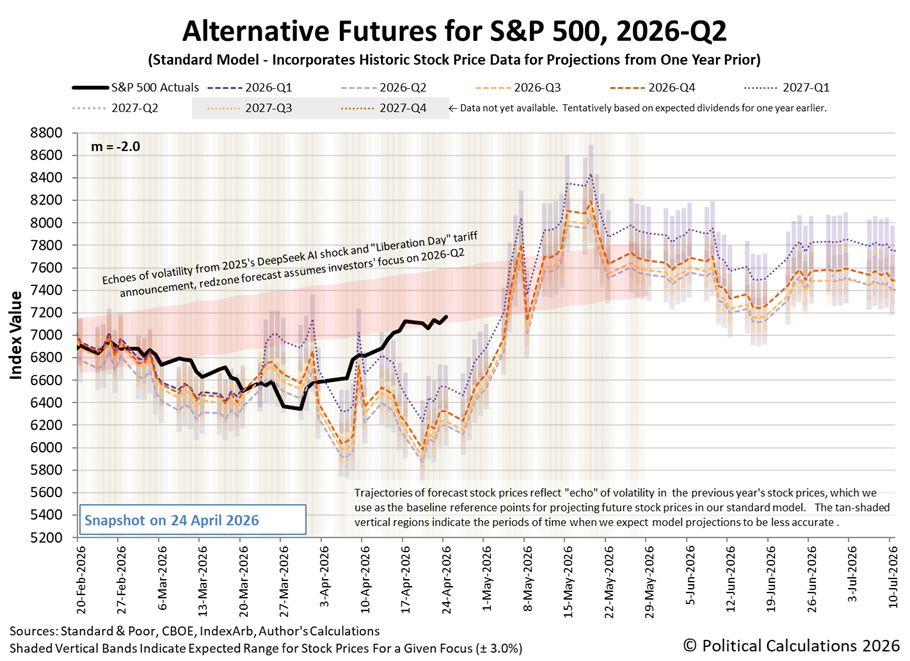
The centerline of the redzone forecast range provides a reasonable estimate of where the S&P 500 would have gone in the absence of the Iran war. From Friday, 17 April 2026 through Friday, 24 April 2026, the index has ranged between 2.5 and 3.0% below that trajectory, which is to say the geopolitical event is keeping the S&P 500 from rising even higher.
What happens next for the S&P 500 will be determined by investor reactions to the random onset of new information. Here are the market-moving headlines that affected the trajectory of the index during the week that was.
Monday, 20 April 2026
Signs and portents for the U.S. economy:
Future chief Fed minions goes up for Senate interview:
Bigger trouble developing in China:
BOJ minions expected to pass on hiking rates in April, but look forward to June 2026:
ECB minions thinking about getting more data before ditching their perfect monetary policy:
Wall Street closes slightly down on renewed tensions between US, Iran
Tuesday, 21 April 2026
Signs and portents for the U.S. economy:
Bigger trouble, stimulus developing in China:
Bigger trouble developing in Eurozone:
ECB minions priming to leave Eurozone interest rates unchanged, think private credit is a threat:
Wall Street extends losses as a U.S.-Iran resolution remains uncertain
Wednesday, 22 April 2026
Signs and portents for the U.S. economy:
Fed minions expected to cut U.S. interest rates before end of 2026:
Bigger stimulus developing in China:
BOJ minions worried about Iran war dragging out:
S&P 500, Nasdaq end at record as Trump extends ceasefire deadline with Iran
Thursday, 23 April 2026
Signs and portents for the U.S. economy:
Fed minions thinking about what they mean when they say they have a 2% inflation target, maybe cutting rates in late 2026:
ECB minions expected to ditch their perfect monetary policy with rate hikes in June 2026:
Meanwhile, bigger trouble developing in the Eurozone:
U.S. stocks end lower as conflict in the Strait of Hormuz intensifies
Friday, 24 April 2026
Signs and portents for the U.S. economy:
Incoming chief Fed minion wants better inflation data, has path to secure Senate confirmation cleared as DOJ bends to Senator Tillis' demand to end criminal probe of Fed:
Pervasive AI technologies and bigger stimulus developing in China:
BOJ minions get reason to not hike rate this month:
S&P 500, Nasdaq snatch another record as U.S. continues ceasefire negotiations with Iran
The CME Group's FedWatch Tool continued to anticipate no Federal Reserve rate cuts in 2026, though with a growing bias toward a quarter point rate cut over time.
The Atlanta Fed's GDPNow tool forecast of real GDP growth in 2026-Q1 ticked down to +1.2%, dipping from its projection of +1.3% growth a week earlier.
Comments
Log in or sign up to join the conversation.