
I just finished an article in which I compare QE to GMOs, and it will appear in the next issue of Institutional Investor in a few days. I’ve also had a lot of random thoughts bottled up that I wanted to get out, so my apologies as this email has A.D.D. written all over it.
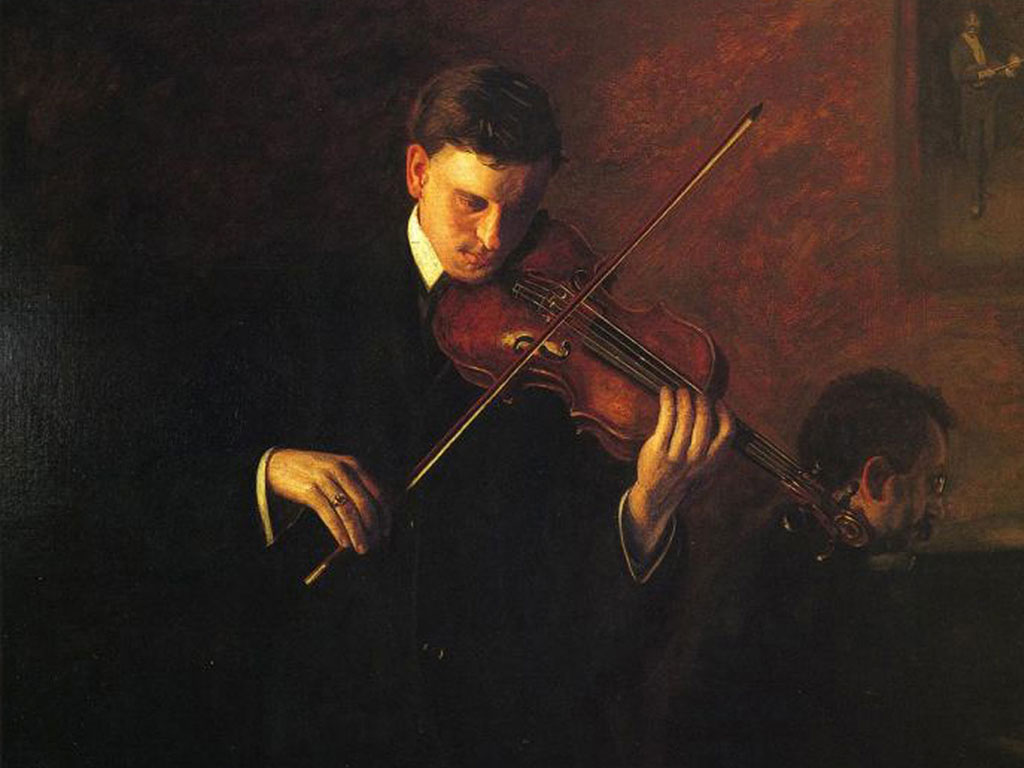
Watercolor "Fiddler on the Roof" is by my father Naum Katsenelson
I just finished an article in which I compare QE to GMOs, and it will appear in the next issue of Institutional Investor in a few days. I’ve also had a lot of random thoughts bottled up that I wanted to get out, so my apologies as this email has A.D.D. written all over it.
▪ By Bronislaw Huberman – I was shocked when I stumbled on this performance (recorded in NY in 1944). According to the movie, Brahm’s himself cried when he heard then-nine-year-old Huberman perform this concerto in 1891.
Over the weekend I watched the documentary The Return of the Violin, and it had a tremendous impact on me. Watch it, even if you don’t care for classical music – this movie is so much more than its title implies.
I was going to write a synopsis of the film, saying that “truth is stranger than fiction,” but then I stumbled on this summary of the movie in The Jewish Chronicle, which made the same point:
No movie director could make up a story like this.
A little Jewish boy [Bronislaw Huberman] from Czestochowa, Poland, plays the violin with such virtuosity that a nobleman makes him a gift of a priceless Stradivarius, which he uses to bedazzle the composer Johannes Brahms.
But when he grows up, becoming one of the great classical musicians of his day, the violin that has come to bear his name is stolen. He never sees it again.
Unbroken, the man flees to Palestine before World War II, founds the national orchestra, rescues hundreds of Jewish musicians from certain death in Nazi Europe and is hailed as a hero before he dies.
Fifty years later, his beloved violin surfaces when the man who stole it makes a deathbed confession. The instrument is sold twice and finally acquired by superstar Jewish performer for a jaw-dropping $4 million.
That same man returns to Czestochowa, where it all began, to perform the previous owner’s favorite concerto by — you guessed it — Brahms.
Truth is stranger than fiction.
This documentary prominently features Brahm’s Violin Concerto in D major, op. 77. As the movie makes clear, the violin part in this concerto is very technical and difficult to play. Someone described it as written not for violin and orchestra but against violin and orchestra. Here are three performances:
* By Joshua Bell (he also performs it in the movie)
▪ By Itzak Perlman – this is the performance I am most familiar with. He was not mentioned in the movie, but I would not be surprised if we find that he owes his life to Mr. Huberman – both of his parents were Jews from Poland who immigrated to Israel (then Palestine) in the 1930s. The performance is in three parts:
According to McKinsey, global debt has increased by $57 trillion since the financial crisis. Their report points out that debt in China has gone up fourfold. Here is what the report said about China:
"Fueled by real estate and shadow banking, China’s total debt has nearly quadrupled, rising to $28 trillion by mid-2014, from $7 trillion in 2007. At 282 percent of GDP, China’s debt as a share of GDP, while manageable, is larger than that of the United States or Germany. Three developments are potentially worrisome: half of all loans are linked, directly or indirectly, to China’s overheated real-estate market; unregulated shadow banking accounts for nearly half of new lending; and the debt of many local governments is probably unsustainable."
One of the most hated (by the market, not by us) stocks in our portfolio is Tesco (TESO). I made a case for Tesco a few months ago in this article. Here is what I wrote in our latest letter to clients about this position:
We also increased our position in Tesco. Though its fourth-quarter same-store sales in the UK were down 4%, its December same-store sales were down only 1% – a significant improvement. It announced that it will be selling its Dunhumby loyalty card business (though it didn’t announce the price, we estimate it to be north of $2 billion), and therefore it will probably not need any external capital.
Most importantly, Tesco announced that it will be hiring Matt Davies to run its UK retail business. We have a very high regard for Mr. Davies, who did a terrific turnaround of another UK retailer, Halfords. In fact, on the day Tesco announced Mr. Davies’ hire, Halfords reported same-store sales numbers: they were up 10% for the fourth quarter (they averaged 5-10% down when Mr. Davies was hired by Halfords a few years back).
We cannot kill Tesco’s stock, so let us summarize the investment case in a sentence. If Tesco were to sells its businesses in East Asia (it is the second largest retailer in Korea) and Eastern Europe, along with Tesco Bank in the UK for a reasonable (not extraordinary) valuation, we’d be getting the UK business (which has an almost 30% brick and mortar and 50% online market share) for free.
A few weeks ago Kantar reported that for the 12 weeks ending February 1st Tesco grew its sales in the UK by 0.3%.
According to the WSJ, Apple (AAPL) is China’s most desirable brand, and its products are the gifts of choice for both men and women. Apple ranks above Tiffany, Gucci, Cartier, etc., with Samsung in the number 10 spot. This is very important, as Apple is entering into the jewelry space by introducing the Apple Watch. In other words, in a few months a Rolex will not the bribe of choice anymore, having been replaced by an Apple Watch in gold.

Comments
Log in or sign up to join the conversation.