

Greetings from New York City… home of the $68 Bolognese… and 5-mile $60 Uber ride…
This morning, I attended a small conference event centered around Quantum Computing stocks.
There’s a lot of optimism around these names.
The argument is that we’re sitting in a world that is comparable to AI back five years ago. One of the names brought up… IonQ Inc (IONQ).
I couldn’t help but look at this chart… and couldn’t help but notice how badly this stock did on January 28 through March 27… when our momentum signal went negative…
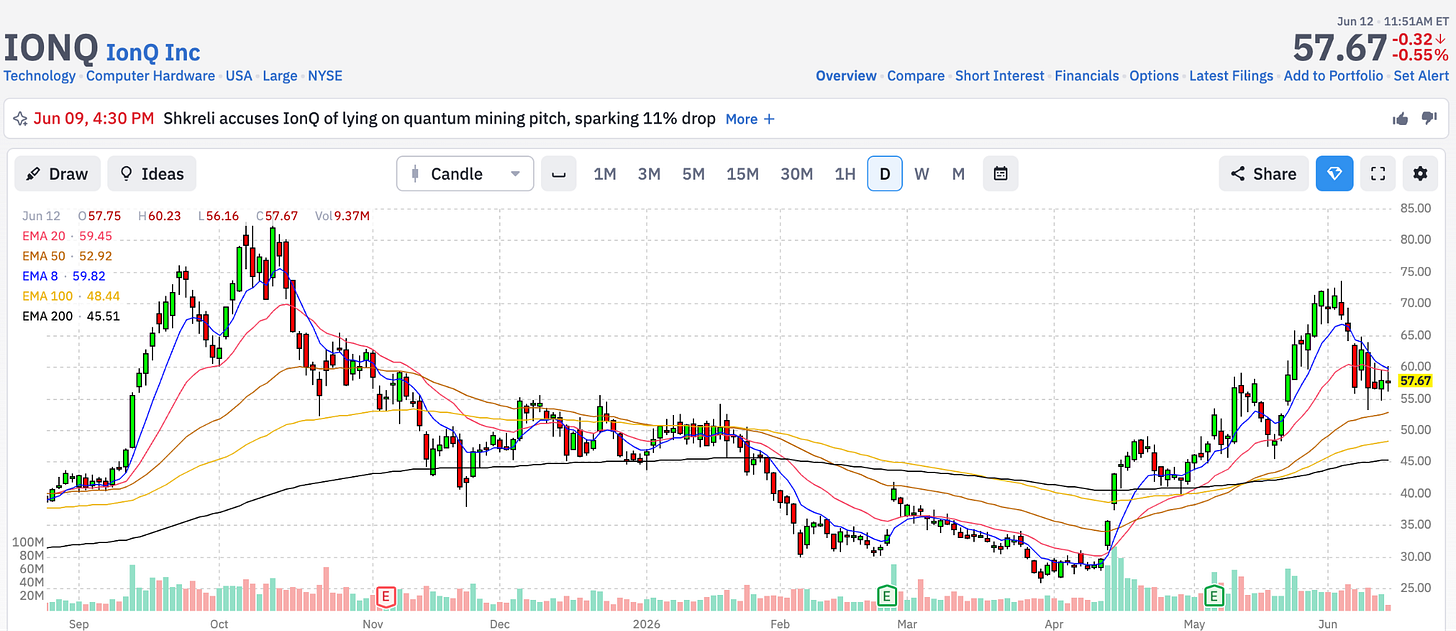
And then… went ballistic when momentum returned on April 7…
I can’t look at a stock with a PE Ratio of 983 and think… “What a great investment” unless you’re really convinced that you’re going to buy and hold this stuff forever…
This is going to whipsaw around momentum… pure, hardcore capital flows…
And it’s going to take a significant amount of confidence on one specific name…
Flows and liquidity matter… everything else is downstream…
For the rest of the day, I visited the New York Stock Exchange, caught up with a few analysts at nearby banks down on Stone Street, and popped in to talk to a few people running a few desks with a lot of money on the line…
So, here’s what seems to be the general overview of my conversations today…
Let’s Go Fed!
This morning, I woke up and did the usual things I do… I made some phone calls, shot both morning videos, and then had to hop in a car. That was the $60 Uber ride…
Along the way, I read a piece that was sent out by the New York Fed. Effectively, it’s just an updated FAQ around its Reserve Management Purchases and Reinvestment Purchases.
Some people assumed this was new… or that the Fed quietly restarted the printer.
But this goes back to the directive by the New York Fed on December 10, 2025.
The Federal Reserve’s Open Market Desk in New York has been buying Treasury bills under this program for six months.
The only substantive change in March was the upgrade of the auction execution platform from FedTrade to FedTrade Plus. I couldn’t tell you what the difference is…
The story from the post on the site isn’t the announcement.
It’s that a bunch of people in New York are heading home this weekend for what seems like a calm before the storm. It comes down to the things that new Federal Reserve Chairman Kevin Warsh has inherited…
Former Fed Chair Jerome Powell was behind the action in December as part of a macro setup that expected rate cuts and a softening dollar.
Six months later, the world the program operates inside is unrecognizable.
The rate market has flipped from pricing cuts to pricing a possible hike by early 2027.
The Bank of Japan is also days away from its highest policy rate since 1995.
And Kevin Warsh, who’s been publicly hawkish and signaled an interest in shrinking the Federal Reserve’s footprint.
Warsh now inherits an active QE-mechanism program at his first FOMC meeting next Wednesday.
The Fed’s buying Treasury bills to top up reserves while the rate market is repricing toward tightening.
Those two motions are pulling against each other in slow motion… and it’s creating this dislocation of opinion… I’ll just keep focusing on our signal…
The question that now matters next week isn’t whether the Fed maintains this QE-like push. We know they’ve been active since December.
The question is whether Warsh keeps the program running into an oil-shock inflation backdrop, tapers it, or signals a hawkish reset at his first meeting.
That’s the story…
The Bull Case
We head into the Fed meeting next week with a bull case still standing, but a risk profile that remains pretty… well… risky.
The buzzword around here remains “corporate earnings,” which are genuinely strong and live downstream for the loose economic conditions that we’ve witnessed.
The bullish argument is toward the 8,000 level… that is based on earnings-revision breadth at a fresh cycle high, manufacturing surveys at their best level since 2022, and private payrolls running at their strongest pace since 2023.
The thing that is odd is how direction and risk have come apart right now.
The most profitable path - say the analysts I’ve talked with today - is higher earnings strength…
However, the distribution around that path is skewed.
Today’s market structure amplifies declines far more than advances.
An investor can be correct about the year ahead and still be carried out in a bag on the way there. It’s quite an unusual world to be in right now…
The Plumbing Matters Most
Despite all the bullishness on earnings numbers… the financial plumbing is facing a more stressful path.
Recent numbers showed that the top-of-book depth in equity index futures heading into next week’s Third Friday has dropped to its lowest levels since April 2025…
This means that orders in the market will move prices a lot more in one direction than what’s usual.
Trend-following strategies (which I’ve been explaining- the ones that are buying and selling based on what they have to buy - fell under a key selling threshold. Everyone is currently glued to this 7,400 level on the S&P 500.
The asymmetry in this market shows that selling would compound at a much greater rate than what would be expected out of buyers in the weeks ahead.
All the while, we have this massive pool of leveraged ETFs that have to rebalance every single day… And we’re going to get the SPCM (the double SpaceX ETF) - aka “Spaceman” launching out of Tradr ETFs on Monday. It’s a trader’s market…
These assets lead to even more mechanical buying and selling strength… and create a new set of risks like we saw last Friday.
Things can and will destabilize if the S&P 500 drops another 4% from here.
That’s the next big level. So.
Just be aware of it… Selling would be orderly… until it starts being chaotic.
Inflation is Really Divergent
The CPI this week came in at 4.2%, the highest level in three years…
But it was softer on the month-to-month numbers… Core goods prices fell for the first time of the year… going back to what I said a year ago when so much of this started. They start as “inflation” and then start to become… deflationary.
Hot takes!
All that said, remember that I’ve explained that all of this stock market run… specifically around AI is creating a feedback loop that is adding to consumer purchasing… and helping to support… inflation.
Next week, we’ll have Kevin Warsh’s first meeting, and deeper conversations around their preferred measure of inflation moving forward.
Watch Liquidity Flows…
The ECB hiked this week…
The Bank of Japan will do the same next week... all while facing a leadership vacancy heading into a meeting where a hike is fully expected.
We’re seeing central banks tightening into difficult conditions… they’re not easing.
But… now the geopolitical premium that dominated the first half of the week reversed sharply. After threatening to strike a key oil-exporting region very hard, the administration abruptly de-escalated, claiming the strikes had been cancelled and that a framework agreement might be signed within days, even as the other side continued to dispute that any deal was final.
The debate is no longer how high prices climb if the strait stays closed, but rather where they find a floor, with reasonable arguments ranging from $80s if inventories remain tight, to a deeper decline if supply discipline breaks down.
Oil remains the swing variable for the inflation and rate outlook, but the risk around it is now genuinely two-sided.
Finally, Gold is the Real Warning
Gold was dropping for three months, despite a war, volatility and increased macro uncertainty…
This is where gold is supposed to thrive…
Its behavior moving forward is a critical signal for the markets….
As liquidity tightens, the metal has been acting less like a safe-haven asset and more like a funding source. Money continues to chase technology stocks and leveraged products at the expense of the safe-haven thesis.
We’re at a place where I’m hearing different things…
I’m seeing one group that sees gold as a broken hedge…
And another that frames this weakness as a fall before a rise… largely due to higher real yields. But the world is structurally still focused on debt, geopolitics, and the prospect of rate cuts over the next 12-18 months.
Gold will act as a barometer moving forward… Any continued declines alongside wobbling equities would confirm that the market is in a funding-stress regime rather than an orderly one.
And that’s why we keep our eyes so locked on what’s happening upstream.



Comments
Log in or sign up to join the conversation.