


The Week in Geopolitics
Geopolitical risk remained concentrated around energy, strategic endurance and great-power optionality. The Iran conflict entered its sixth month with Washington shifting toward intensified economic pressure, Hormuz traffic still severely impaired, and China's energy adaptation increasingly visible. At the same time, Russia and Ukraine escalated attacks on economic infrastructure, while U.S.-China strategic competition remained active across the Taiwan Strait and critical supply chains.
TMI WEEKLY READ
Development | Why It Matters | Transmission |
U.S.-Iran pressure intensifies | Washington is emphasizing sanctions while military objectives remain unresolved. | Oil -> inflation -> yields -> growth / policy |
Hormuz remains impaired | Very low shipping traffic keeps a major global energy chokepoint economically relevant. | Freight + crude + refined products -> global costs |
China adapts its oil logistics | Alternative loading, ship-to-ship transfers and non-Gulf sourcing demonstrate resilience - but at higher cost. | Energy security -> margins -> strategic endurance |
Russia-Ukraine economic targeting expands | Drone and infrastructure attacks increasingly target the opponent's economic capacity, not only battlefield assets. | Energy + grain + logistics -> fiscal / social endurance |
Taiwan Strait signaling continues | A U.S. Navy P-8A transit ahead of a planned Xi-Trump meeting underscores persistent security competition. | Deterrence -> defense allocation -> U.S.-China relations |
TMI INSIGHT
This week's common thread is endurance. Iran is testing whether geographic leverage can outlast economic pressure. The United States is testing whether sanctions can substitute for additional military escalation. China is testing whether logistics, inventories and supplier diversification can absorb an energy shock. Russia and Ukraine are increasingly attacking each other's capacity to sustain war.
01 | MIDDLE EAST
Iran: Pressure Shifts Toward the Economic Battlefield
Washington announced plans for exceptionally severe new sanctions on Iran and threatened consequences for countries providing Tehran an economic lifeline. The shift matters because it suggests an effort to increase coercive pressure without immediately expanding major military operations.
The China connection is direct but should not be overstated. China buys the great majority of Iran's shipped oil, so tighter enforcement can reduce Iran's revenue while simultaneously raising costs for Chinese refiners. Reuters reported this week that offers of Iranian crude to Chinese buyers had fallen and prices had risen as the U.S. blockade constrained shipments.
Implication: Iran policy is simultaneously a Middle East security policy and a transmission mechanism into Chinese energy security. Whether that makes China a principal objective or a consequential secondary target remains an analytical question rather than an established fact.
02 | ENERGY CHOKEPOINTS
Hormuz: Geography Continues to Create Disproportionate Power
Ship-tracking data cited by Reuters showed commodity-vessel crossings through Hormuz in the single digits late this week. Before the conflict, the strait carried close to one-fifth of global crude oil and LNG shipments. Iraq received permission for some tankers to transit, illustrating how access itself has become a bargaining instrument.
Implication: Iran demonstrates that national power is not adequately measured by GDP or military spending. Control or disruption of a critical node can give a smaller state systemic influence far beyond its economic size.
03 | CHINA
Adaptation Is Not Immunity
Chinese state shippers have avoided the highest-risk Gulf chokepoints, using ship-to-ship transfers and alternative loading points. Saudi Aramco also sold crude loading outside Hormuz to Chinese refiners. These adaptations reduce immediate vulnerability but introduce higher freight, complexity and cost.
Implication: The relevant question is not whether China is hurt by the energy shock; it is whether the shock exceeds China's capacity to adapt. Strategic pain and strategic defeat are not the same thing.
04 | RUSSIA - UKRAINE
The War Moves Deeper Into Economic Infrastructure
Ukraine intensified drone attacks on Russian industrial and energy targets, while Moscow threatened retaliation against Ukraine's most sensitive economic sectors. Russian attacks also struck Ukrainian grain infrastructure, adding food-export capacity to the list of economic pressure points.
Implication: The conflict increasingly resembles a contest in national endurance. Refining capacity, logistics, agriculture, air defense inventories and industrial replacement rates matter alongside territorial control.
05 | U.S. - CHINA
Strategic Competition Continues Beneath the Crisis Cycle
A U.S. Navy P-8A Poseidon transited the Taiwan Strait on Friday, with Chinese forces tracking the aircraft. The transit occurred ahead of a planned Xi-Trump meeting and serves as a reminder that Indo-Pacific deterrence continues while Washington remains heavily engaged in the Middle East and Europe.
Implication: This is the opportunity-cost problem. Resources committed to one theater cannot be assumed to have zero effect on readiness, inventories or political attention elsewhere.
WHAT WE ARE WATCHING NEXT
1. Whether new U.S. sanctions materially reduce Iranian oil flows to China.
2. Whether Hormuz traffic begins a sustained normalization rather than episodic exceptions.
3. Whether economic-infrastructure attacks in Russia and Ukraine produce measurable energy, export or industrial constraints.
STRATEGIC FOCUS
The New Economics of Geopolitical Power
Dependency, leverage, endurance - and the price of strategic overreach
For much of the post-Cold War era, globalization was organized around a straightforward proposition: produce where production is most efficient, source from the lowest-cost supplier, and allow trade and capital to connect the system.
That proposition has not disappeared. But another consideration increasingly competes with it: what happens when economic efficiency creates strategic vulnerability?
Energy, critical minerals, semiconductors, manufacturing capacity, shipping routes and financial systems are no longer merely components of commerce. They are potential sources of leverage. The emerging contest is therefore increasingly about reducing one's own strategic dependencies while preserving - or exploiting - the dependencies of competitors.
Power increasingly belongs to the actor that can preserve the greatest strategic optionality and absorb the consequences of confrontation longer than its competitors.
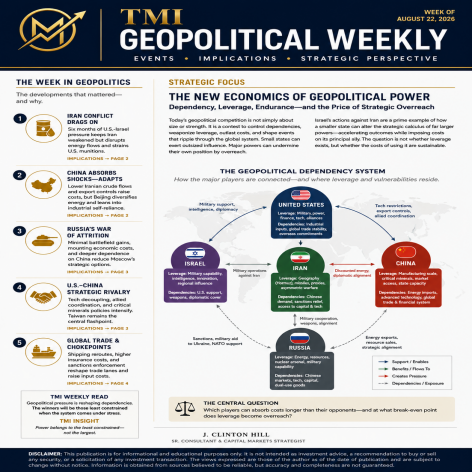
FIGURE 1. Strategic-dependency map. The graphic is designed as an analytical map rather than decoration: it highlights the principal flows of support, pressure, benefit and exposure linking the United States, China, Russia, Iran and Israel.
Russia: From Leverage to Dependency
Before invading Ukraine, Russia possessed energy resources, European trading relationships, geographic reach and multiple markets. War and sanctions narrowed those alternatives. Russia retained enormous resources, but became more reliant on China as a buyer, supplier and economic partner.
The strategic error was not simply incurring costs. It was converting diversified leverage into concentrated dependency. Resources create power only when their owner retains sufficient alternatives for selling, transporting and monetizing them.
China: The Long Game Is Dependency Management
China's position differs. Its rise depends heavily on the international economic system - manufacturing, exports, foreign markets, technology and energy imports. Beijing therefore has incentives to change its vulnerability within that system rather than destroy the system outright.
China's challenge is to make the world dependent on Chinese industrial capacity faster than China remains dependent on foreign energy, technology, finance and markets.
Iran: Geographic Leverage
Iran illustrates how geography can compensate for economic weakness. Its position beside Hormuz gives it potential influence over an energy artery vastly larger than the Iranian economy. That does not make Iran unconstrained; it makes Iran systemically important.
Israel: Strategic Accelerant
Israel changes the framework because it demonstrates another form of disproportionate influence. Its military, intelligence and technological capabilities allow decisions taken by a comparatively small country to transmit through Iran, Gulf energy, U.S. military deployments, inflation and ultimately the broader U.S.-China strategic balance.
Israel can therefore be both an American strategic asset and a strategic obligation. The balance is not fixed. It changes with the intensity and duration of conflict.
The American Endurance Question
The question is not simply whether the United States can sustain pressure. A country with America's economic and military scale can sustain enormous burdens. The relevant question is at what marginal cost, for how long, and compared with what alternative use of the same resources?
A strategy can weaken Iran and constrain Chinese energy access while also consuming munitions, naval capacity, fiscal resources and political attention that may be relevant to deterring China elsewhere. Both effects can exist simultaneously.
This is the strategic break-even problem: at what point does the additional leverage generated by continued confrontation become smaller than the resources and optionality consumed by sustaining it?
A Four-Part Framework
How TMI Can Measure Strategic Power
Variable | Core Question | Illustrative Relevance |
Dependency | What must the country obtain from others? | China: imported energy; U.S.: selected critical-mineral processing |
Leverage | What can others be denied, priced or pressured through? | China: industrial supply chains; Iran: Hormuz; Russia: resources |
Endurance | How long can economic, military and political costs be absorbed? | Inventories, fiscal space, industrial replacement, public tolerance |
Systemic Importance | How widely can the actor's decisions transmit? | Israel: regional security; Taiwan: semiconductors; Gulf: energy |
The framework explains why national size alone is insufficient. A smaller actor positioned at a critical node can wield extraordinary systemic influence. Conversely, a large power can possess enormous resources yet become strategically constrained if it loses alternatives.
THE CENTRAL THESIS
The world is not simply deglobalizing. It is repricing dependency.
For decades, corporations and governments asked: Where can we obtain this most cheaply? Increasingly they must also ask: What happens if we cannot obtain it at all?
That changes capital allocation. It increases the value of redundancy, domestic energy, mining and processing capacity, defense production, alternative shipping routes, inventories and geographically diversified supply chains.
Efficiency remains valuable. But resilience now has a price - and states are increasingly willing to pay it.
The defining geopolitical competition may therefore be decided not by which country possesses the most resources, but by which retains the greatest freedom of action when the system comes under stress.
SOURCES & METHODOLOGY
Research Notes
This inaugural weekly is an analytical publication, not a news digest. Events are selected for their potential to alter strategic relationships, economic transmission channels or market-relevant risks. Facts were checked against Reuters reporting available through August 22, 2026. Interpretations and forward-looking judgments are TMI analysis.
Editorial note: Statements concerning motives - including whether U.S. policy toward Iran is intended partly to constrain China - are treated as hypotheses unless supported by direct evidence. The analysis distinguishes demonstrated transmission effects from inferred strategic intent.
Comments
Log in or sign up to join the conversation.