


“This collapse in economic growth is the most important fact about British economics and politics. It has been made worse by the pressures of ageing and a succession of big shocks, from the global financial crisis to today’s closure of the Strait of Hormuz. It has, in turn, made politics a nightmare of fiscal pressures and “affordability crises”, without end.” Martin Wolf, FT.Com
Although Martin Wolf was speaking only about life in the U.K., the very same basic conditions exist throughout North America and with the EU members. Putting aside the dramatic decline related directly to COVID, all countries have never really regained any serious economic momentum since the 2008 financial crisis. Collectively, the major North American and European nations’ growth rates have steadily declined over the past seventeen years. While Europe has suffered the worst slowdown, the US and Canada have not distinguished themselves in any enviable way.
Deviation from Growth Rates in the 1970-2007 Period (%)
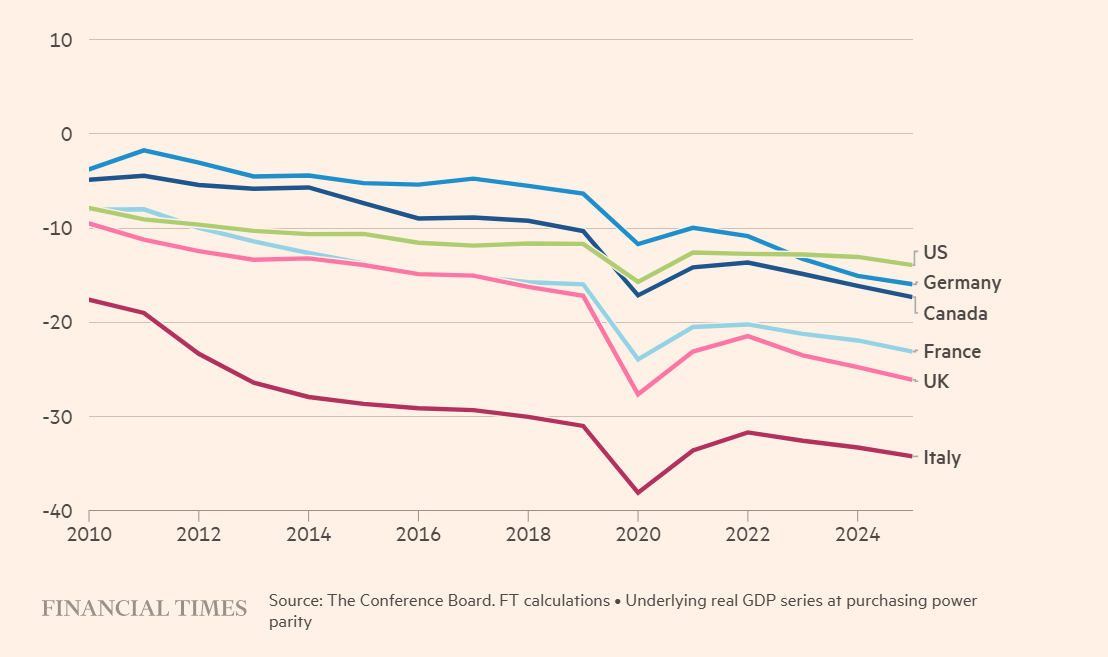
The Trump Administration attributes this decline to “bad” policies of previous Presidents. Wolf refers to the “ rise of infantile populism— the view that if you want something badly enough, it has to be available.” So, in the UK, Brexit was the response towards infantile populism, now regretted by the majority who voted for the breakup. In the US, the infantile wish gave rise to the MAGA philosophy, employing America First policies on trade and foreign investment. Now, tariffs are both declared illegal and have proven to be ineffective in promoting a re-industrialization at home. US trade deficits have worsened and lessened GDP expansion. The “affordability” issue looms large in the US, especially regarding housing and basic food products. No instant gratification is possible at the cost of shelter. Now, the US, along with the rest of the developed world, is experiencing stagflation resulting from disruptions in the oil markets while Trump negotiates with Iran.
Canadians face a similar set of slow-growth conditions. Conservative critics point to the decade-long policies under Justin Trudeau as harmful to productivity growth. A slew of policies in the fields of energy development, immigration, and social policies have been trotted out as evidence that the Trudeau era is responsible for such poor economic performance. Whether this is an accurate assessment is beside the point. Prime Minister Carney's government has shifted gears from its predecessor and now looks to generate growth from new energy and infrastructure projects over the longer term. Despite best efforts to speed up these projects, we cannot expect such huge developments to come on stream quickly. The slow growth patterns will still haunt Canadians. And, there are the emerging trade negotiations with the US and Mexico, creating considerable uncertainty in the Canadian business community. Finally, the World Bank anticipates very sluggish conditions in Europe and Central Asia because of the impact of the conflict in the Middle East.
These growth trends are like battleships… very slow to change course and need a huge effort to turn themselves around.



Comments
Log in or sign up to join the conversation.