

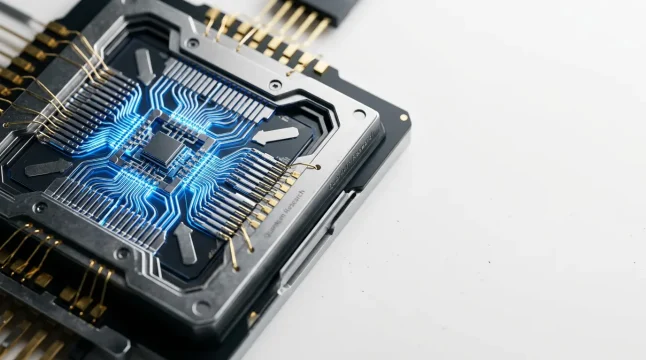
Microsoft Corporation (MSFT) introduced Majorana 2 at its Build conference, boasting a 1,000x improvement in qubit reliability, crucial for scalable quantum computing by 2029.
The chip achieves qubit lifetimes of 20 seconds, with some lasting up to a minute, marking a significant redesign rather than a mere software upgrade. This positions Azure Quantum as a key player in transitioning to fault-tolerant quantum systems for enterprise use.
The announcement comes amid increased activity in the quantum sector, including Google (GOOGL)’s Willow chip demonstrating significant reductions in error rates and Caltech research suggesting lower resource requirements for breaking elliptic-curve cryptography.
Project Eleven predicts Q-Day, when quantum computers can crack public-key cryptography, could arrive as early as 2030, a timeline supported by Citi analysts.
Microsoft Quantum Error Correction: What the 1,000x Improvement in Majorana 2 Actually Achieved
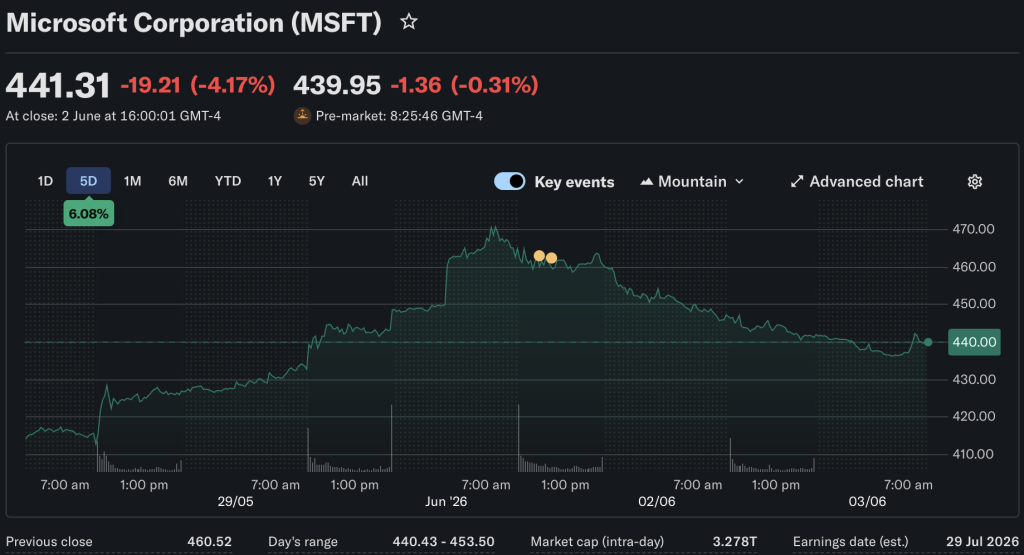
SOURCE: Yahoo Finance
Microsoft’s Majorana 2 replaces the aluminum-based topological superconductor from Majorana 1 with a lead-based design, improving qubit isolation from environmental interference.
This architectural change increased the parity lifetime from milliseconds to an average of 20 seconds, enhancing quantum error correction by allowing longer state retention.
Microsoft Technical Fellow Chetan Nayak highlighted a significant improvement, stating, “We’re 1,000 times better” than the previous year, marking progress toward a utility-scale quantum supercomputer.
The company attributes some of its success to its Microsoft Discovery platform, which aids in materials discovery and automates measurements, thereby streamlining the manufacturing process.
However, the Majorana 2 findings are still in preprint form and pending peer review, with critics noting that the current data do not confirm the existence of topological qubits or Majoranas. Independent validation and peer-reviewed results are needed before any commercial claims can be fully assessed.
Microsoft Azure Quantum as Future Enterprise Infrastructure: How the Breakthrough Reshapes the Competitive Stack
Microsoft has positioned Azure Quantum as the commercial hub for its hardware advancements. In September 2024, the company announced priority access to reliable quantum hardware following a milestone of scaling up to 12 entangled logical qubits.
This integration enables quantum workloads to run on the existing Azure cloud infrastructure, easing adoption for enterprise customers.
In the competitive landscape, Google aims for Q-Day by 2032 and has made progress in reducing error rates. IBM (IBM) focuses on increasing physical qubit counts, while Microsoft emphasizes logical qubit quality and reliability for commercial viability.
IonQ (IONQ) is also advancing trapped-ion architectures for enterprise cloud integration. However, none have yet achieved peer-reviewed, fault-tolerant logical qubit operations at scale, which is the target for the Microsoft 2029 roadmap.
MSFT Stock and the Quantum Variable: What Analysts Are Saying About Long-Term Value
The Majorana 2 announcement does not function as a near-term earnings catalyst; Microsoft has not disclosed quantum-specific revenue, and the 2029 utility-scale target places monetization well beyond the current fiscal horizon.
What it does provide is an option value on a compute paradigm that, if Azure Quantum reaches commercial scale, would layer on top of an existing cloud business that generated $42.4 billion in Intelligent Cloud revenue in fiscal Q3 2025 alone.
Wedbush analyst Dan Ives maintained an Outperform rating on MSFT with a $550 price target as recently as March 2026, citing durable AI and cloud growth as the primary valuation drivers – quantum represents an upside variable within that same infrastructure thesis.
The bull case runs through Azure Quantum, becoming the enterprise default for hybrid quantum-classical workloads, monetizable at hyperscaler margins and locked into the Azure ecosystem through existing enterprise agreements.
The bear and risk case is equally legible: the 2029 timeline carries execution risk, peer-review validation remains outstanding, capital intensity for quantum hardware is substantial, and competitors, including Google and IBM, are advancing parallel architectures.



Comments
Log in or sign up to join the conversation.