The Margin Math Finally Works For Vestas

Vestas hiked its margin guidance and launched a €400 million buyback as wind energy profitability rebounds.

For years the wind energy sector felt like a value trap. Supply chain snarls and brutal inflation crushed project economics, making investors wonder if the business model was broken. Today the puzzle looks different. Vestas (VWDRY) is generating stronger profits and using a healthy capital structure to launch another buyback while raising its margin outlook. The question now is whether the core business is truly fixed, or if offshore losses and lingering warranty costs will eventually eat into these new profits.

Main Note

The Margin Math Finally Works For Wind Energy

Vestas Wind Systems (VWDRY) Quote

Verdict: The margin reset appears real, but the buyback is being supported by trailing cash generation and a healthier capital structure rather than one clean half of cash flow. Management is signaling that the worst of the inflation and supply chain squeeze may be over, even though offshore execution and warranty costs remain open risks.

What happened

Vestas lifted its full year EBIT margin before special items guidance to a range of 7% to 9% from 6% to 8%, while leaving revenue guidance unchanged at €20 billion to €22 billion. It also announced a €400 million share buyback. The company reported €4.7 billion of second quarter revenue, a 9.4% EBIT margin before special items and a 67% increase in turbine order intake, although every new turbine order in the quarter was onshore.

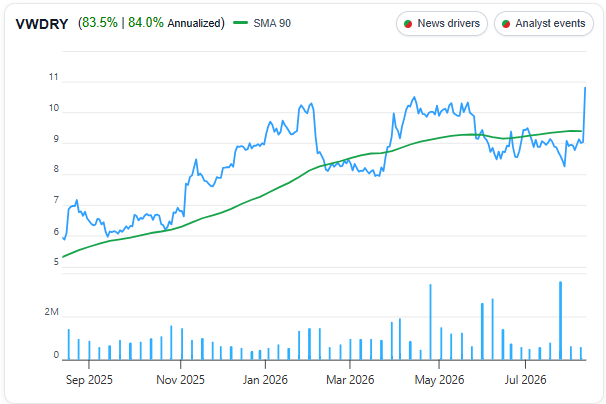
The market reacted violently yesterday, sending shares up nearly 20% before some mild profit taking this morning. This is not just another earnings beat. The size of the buyback is a meaningful signal of financial health, but it is also the third repurchase program Vestas has announced this calendar year rather than a sudden change in capital policy.

Vestas Wind Systems (VWDRY) 1 Year Chart

Vestas Wind Systems (VWDRY) 1 Year Chart

Why it matters

Wind turbine manufacturing has been structurally difficult for the past few years. Rising material costs and rigid contract structures destroyed profitability. The margin upgrade shows that Vestas is getting more operating leverage from higher deliveries while executing projects at lower costs than expected. That is stronger evidence of an operational recovery than a broad return of pricing power, especially because management described the pricing environment on new orders as stable.

What changed in the thesis

Investors previously viewed Vestas as highly risky because weak project economics kept margins thin and cash flow unreliable. Now they must digest a scenario where the turbine business can earn a normal industrial margin again. If management is right about the recovery, the valuation debate shifts away from a turnaround discount and toward whether the new 7% to 9% margin range can hold and eventually move toward management’s long term goal of at least 10%.

What the market may be missing

Investors might be overlooking the warranty burden that is still sitting on the balance sheet. Vestas recorded €141 million of warranty costs this quarter, equal to 3% of revenue, while €218 million of existing warranty provisions were consumed. The positive sign is that Vestas consumed more provisions than it added during the first half and its Lost Production Factor improved slightly, but the company still carried €1.82 billion of warranty provisions at the end of June.

Valuation and expectations

Analysts will likely revise earnings and cash flow estimates higher after the guidance increase, but the buyback does not create a guaranteed floor under the stock. Multiple expansion will depend on whether the strong second quarter project execution can repeat, whether the offshore ramp up can move toward profitability by the end of 2027, and whether warranty costs continue to trend down.

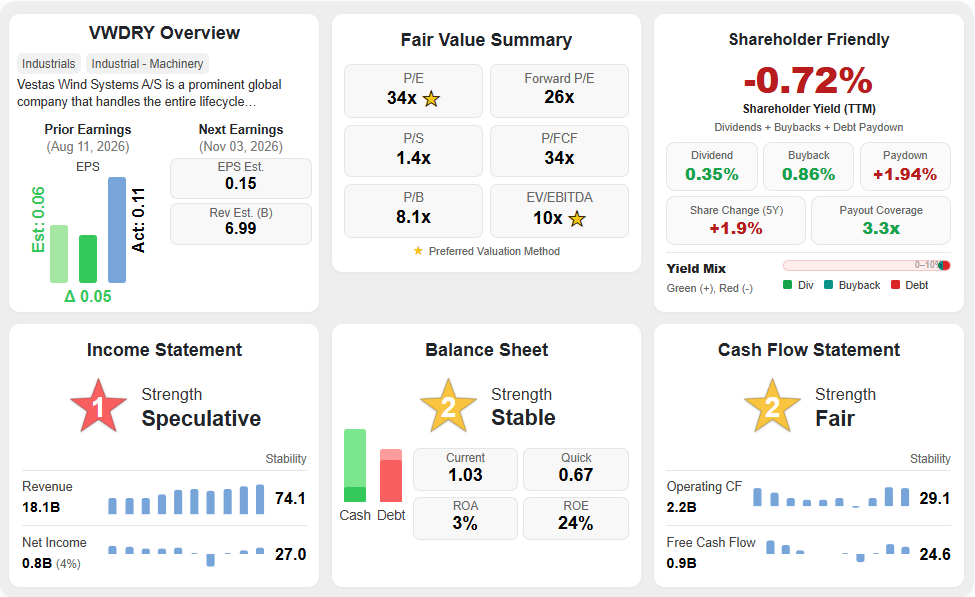
Vestas Wind Systems (VWDRY) Summary Scores

Vestas Wind Systems (VWDRY) Summary Scores

Bottom line

Vestas is proving it can sell turbines profitably again. The capital return is a strong signal of confidence. The catch is that investors need to ensure those hidden warranty costs do not spiral out of control and erase the newly found margin gains.

Pre Market Pulse

  • European equities opened slightly higher this morning, with the Euro Stoxx 50 gaining roughly 0.4% and holding onto recent industrial gains.

  • Vestas shares saw minor profit taking in early European trading today after a massive 19% surge yesterday.

Why it matters this morning

The early trading action shows normal digestion after a major gap up. Investors are pausing to evaluate whether the fundamental improvement in wind project economics can justify a sustained rally across the broader renewable energy sector.

Peer Read Through

Siemens Energy (SMNIY)

Siemens Gamesa already delivered its first profitable quarter since fiscal 2022, although full year guidance still calls for roughly break even. That supports the idea that wind equipment economics are improving, but it does not prove the recovery is complete.

GE Vernova (GEV)

The read through is much weaker. Its Wind segment lost $275 million of EBITDA in the second quarter, with orders down 40% organically, and management still expects about $400 million of Wind segment losses for 2026. Vestas may be improving faster than the peer group rather than proving the whole group is fixed.

Group takeaway

Vestas and Siemens Gamesa are showing real progress, but GE Vernova is a reminder that the wind manufacturing recovery is uneven. The strongest conclusion is that better execution and improved project economics can restore margins, not that every turbine maker has escaped unprofitable contracts.

What to Watch

  • Full year cash conversion to see whether stronger profitability turns into enough cash to support the larger buyback.

  • Offshore execution and order flow, especially after Vestas booked no offshore turbine orders in the second quarter.

  • Service EBIT margins against the 15.5% to 17.5% full year outlook and the longer term 25% ambition.

  • Warranty costs and whether existing provisions continue to be used faster than new ones are added.

Bottom line

The thesis depends on clean execution, but one negative cash flow quarter would not break it because project timing makes cash conversion lumpy. The real warning signs would be a renewed rise in warranty provisions, weaker full year cash conversion, or another delay in the path to offshore profitability.

STOCKS IN THIS ARTICLE

Also Mentions:

Comments