

Hormuz Shock Knocks the Tape Lower
UK equities traded lower on Wednesday as renewed Middle East escalation pushed investors back into a defensive posture, with the FTSE 100 down and the FTSE 250 also slipping in subdued trade. The move was not a disorderly selloff, but it was a clear risk-off session: oil surged, inflation concerns returned, and the market again had to price the possibility that the conflict around Iran and the Strait of Hormuz could become a longer and more damaging macro shock. The trigger was a further deterioration in the Gulf, including an Iranian missile strike that damaged Kuwait’s airport and renewed U.S. military operations near the Strait of Hormuz. Brent crude climbed toward $99 a barrel, up around 3%, as investors worried about supply disruption through one of the world’s most important energy corridors. U.S. Secretary of State Marco Rubio said Iran had mined “large segments” of the Strait of Hormuz and warned that peace talks could take several months to conclude. That combination left markets with little near-term confidence in a diplomatic resolution and pushed energy security back to the centre of the UK equity story.
The move in oil helped energy stocks stand out. UK energy names rose around 1.3%, with BP (BP) and Shell (SHEL) among the notable gainers, as crude strength provided direct support to the sector. Centrica also moved higher, while utilities and defensives found some demand. SSE, United Utilities, National Grid, Unilever, Tesco, Sainsbury’s, Vodafone (VOD), Kingfisher, Convatec, Airtel Africa and JD Sports Fashion were among the stocks that traded higher. Bunzl climbed 3.6%, while Howden Joinery, Whitbread and SSE gained roughly 2.6% to 2.8%, and United Utilities advanced 2.1%. But the broader index could not overcome weakness elsewhere. Healthcare was a major drag, with AstraZeneca (AZN) down 2.2%, and commodity stocks also came under pressure as precious metal and industrial metal miners fell more than 1%. Rio Tinto (RIO), Fresnillo, Anglo American, Antofagasta and Metlen Energy & Metals were all weaker as metal prices softened, reversing some of the previous session’s miner-led support. ICG fell more than 5%, while Melrose Industries, Burberry, Scottish Mortgage, Tritax Big Box, Croda International, Rolls-Royce, British American Tobacco, Prudential (PRU), BT, Segro and Rightmove also traded lower.
Among midcap and stock-specific moves, the tape was more dramatic. Ninety One dropped 6.4% after analysts pointed to lower-than-expected net inflows in the second half of 2026, while Bridgepoint Group fell 3.4% after Switzerland’s Partners Group said it would limit withdrawals from an $8.6 billion private equity fund. The read-across was negative for listed private-market and asset-management names, where investors remain sensitive to fund flows, redemption pressure and valuation risk. Retail delivered the day’s brighter spots. B&M surged 16.1% after the discount retailer reported a smaller-than-expected decline in annual pretax profit, reassuring investors that its value-led model remains resilient even as consumer confidence weakens. Debenhams Group jumped 22.3% after the online fashion retailer returned to growth, reporting a 0.5% rise in first-quarter gross merchandise value and a sharp improvement in core profits. Those moves showed that investors are still willing to reward credible recovery stories, especially when expectations have been reset low enough.
The macro data added to the cautious tone. S&P Global figures showed the UK Composite PMI fell to 49.7 in May from 52.6 in April, below the expansion threshold and weaker than the market had initially expected, though revised up from the preliminary reading of 48.5. The Services PMI fell to 49.3 from 52.7, pointing to contraction in the UK’s dominant sector, while the Manufacturing PMI edged up to 53.9 from 53.7. The data suggested that British service firms are feeling the squeeze from higher costs, weaker optimism and conflict-related disruption, even as manufacturing held up better.The OECD also revised its view on the UK outlook, acknowledging a more difficult near-term mix of growth and inflation linked to the Iran war and forecasting a slower recovery in 2027 than previously expected. That matters for the Bank of England because the market is once again facing the uncomfortable combination of weaker activity and higher energy-driven price pressure. Brent near $99 does not just lift oil majors; it also raises questions about household bills, transport costs, margins and whether the Bank can afford to look through another inflation shock.
Finish Line: The FTSE 100 slipped 0.35% as the market moved from relief to risk premium, with fresh Gulf escalation and Brent near $99 reviving inflation and rate-hike fears. Energy stocks were the natural winners, but gains in BP, Shell and defensives were not enough to offset weakness in healthcare, miners, asset managers and cyclicals. The day’s message was straightforward: when Hormuz risk rises, the FTSE can find shelter in oil and defensives, but the broader index struggles because the same crude spike that supports energy also tightens the macro noose around consumers, companies and the Bank of England.
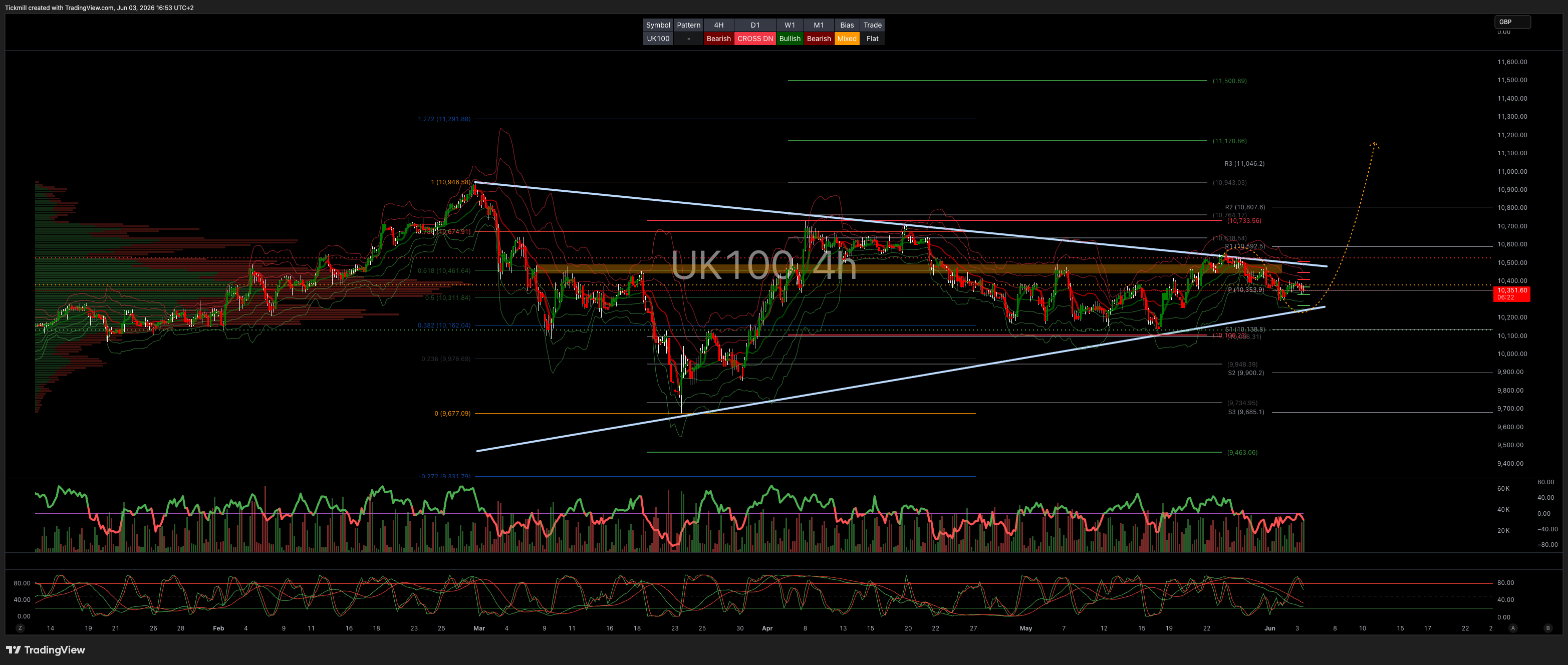
TECHNICAL & TRADE VIEW – FTSE100
Daily VWAP Bearish
Weekly VWAP Bullish
Above 10500 Target 11000
Below 10100 Target 9469
Comments
Log in or sign up to join the conversation.