

London ended July with another record-setting session, as the FTSE 100 hit an intraday high for the third session in a row and remained on course for both weekly and monthly gains. Robust corporate earnings, strength in miners and energy stocks, and a clearer interpretation of the Bank of England’s policy stance helped the market absorb a difficult backdrop of Middle East hostilities and central-bank uncertainty.
The week’s pattern was striking. The FTSE moved from a de-escalation rally on Monday to a Unilever-led defensive surge on Tuesday to record highs on Wednesday and Thursday and then another intraday record on Friday. By the end of the week, the index had shown that UK large caps could keep climbing even as investors rotated rapidly between consumer staples, banks, miners, energy and industrials.
Miners were the biggest support on Friday. Industrial metal miners rose 2.1%, tracking a rise in copper prices, while precious metal miners gained 0.9%. The move extended the recovery in the resources complex after a volatile month in which commodity stocks swung between fears of demand destruction, war-premium trades and company-specific earnings support.
Copper strength helped lift industrial miners because it points to more constructive expectations for global manufacturing, electrification demand and infrastructure-linked consumption. For the FTSE, the sector’s strength mattered because miners carry significant index weight and can offset weakness elsewhere when commodity momentum improves.
Energy stocks also supported the benchmark, gaining 1.4% despite oil prices slipping back below $90 a barrel. The sector’s resilience reflected the scale of its July advance. Energy shares have gained more than 15% this month and are set to outperform peers, as U.S.-Iran hostilities intensified and repeatedly threatened fuel supplies, shipping routes and broader regional stability.
The fact that energy stocks rose even as oil dipped suggested investors were not simply trading the day-to-day crude price. Instead, they were still assigning value to geopolitical risk, strong cash generation and the sector’s role as a hedge against renewed energy disruption. Shell (SHEL)’s strong profit update on Thursday and BP (BP)’s earlier strength also helped anchor sentiment toward the sector.
Corporate earnings remained central. NatWest (NWG) gained 4.3% after reporting better-than-expected first-half operating profit before tax of £4.3 billion, or about $5.8 billion, and raising its outlook for the year. The update followed Lloyds’ strong results and buyback announcement on Thursday, reinforcing the idea that UK banks are still benefiting from resilient margins, controlled credit stress and shareholder-return capacity.
NatWest’s results helped restore confidence in domestic lenders after Barclays had been hit earlier in the week by higher operating costs. The market’s message on banks has become more selective: investors are rewarding profit beats, cost control, buybacks and upgraded guidance, while punishing expense pressure or uncertainty around forward returns.
Sainsbury’s rose 2.5% after agreeing to sell Argos for at least £120 million, exiting the general retail business. The move was viewed as a strategic simplification, allowing the supermarket group to concentrate more fully on food retail and its core grocery operations. In a market rewarding discipline and focus, the disposal was taken positively.
IG Group was the major large-cap disappointment, sinking 10.2% to the bottom of the FTSE 100 after agreeing to acquire U.S. daily fantasy sports and prediction-markets operator Underdog for up to $1.3 billion. Investors appeared concerned about the price, strategic fit, execution risk and regulatory uncertainty attached to the move. At record index levels, the market is giving little benefit of the doubt to deals that appear to increase complexity.
In the mid-cap space, Greggs fell 6% to the bottom of the FTSE 250 after RBC (RY) downgraded the fast-food chain to “sector perform” from “outperform.” The downgrade hit sentiment toward a stock that has often been treated as a high-quality UK consumer compounder. It also underlined that consumer-facing companies remain vulnerable if investors believe growth expectations have become too demanding.
The central-bank backdrop remained important, but Friday brought a more nuanced interpretation of Thursday’s Bank of England decision. The BoE held Bank Rate at 3.75%, as expected, but the 6-3 vote split initially created concern because three MPC members voted for an immediate 25 basis point hike. That was more hawkish than expected and reflected worries about the inflationary impact of Middle East-driven energy shocks.
However, Governor Bailey made clear late in his press conference that investors should not interpret the decision as the Bank edging toward a hike. That clarification mattered. It helped markets separate the existence of hawkish dissent from the Committee’s central strategy, which remains based on the view that domestic disinflation is offsetting external inflation pressure from the energy shock.
In other words, the core MPC position has not changed. The Bank sees signs that domestic inflationary pressure is easing and believes the current restrictive stance, combined with tighter financial conditions implied by higher market rates, gives it time to assess whether second-round effects are emerging. The three dissenters are important, but they do not currently define the policy centre of gravity.
The Monetary Policy Report reinforced that message. The Bank acknowledged upside risks to inflation from energy commodities and Middle East uncertainty, but its central CPI projection at the two-year horizon is 1.8%, conditioned on a market-implied Bank Rate path of around 4.1% to 4.2% over much of that period. The simple interpretation is that if rates actually rose to that level, the MPC’s own forecast suggests inflation would undershoot target.
That is why the market increasingly sees higher rates as a risk scenario rather than the base case. Deputy Governor Lombardelli also said her vote to hold was “not a close judgement.” Since she may have been viewed as the next most hawkish member after the three dissenters, that comment reduced the perceived likelihood that a majority for a hike is close to forming.
The focus now shifts to second-round effects. The BoE has highlighted indicators such as the breadth of price changes across the inflation basket and wage-setting behaviour. Policymakers need more time to judge whether the energy shock is becoming embedded, but the tone so far remains relatively calm. That supports the default expectation that Bank Rate will remain at 3.75% in September and beyond, unless energy volatility or wage data deteriorate materially.
The Federal Reserve offered less clarity. Chair Kevin Warsh said policymakers remain committed to combating inflation after a divided Fed kept rates unchanged. The lack of guidance on the Fed’s next move kept global rate uncertainty alive, but the UK market appeared more focused on the BoE’s reassurance that a near-term hike is not the central case.
Middle East risk still matters. U.S.-Iran hostilities have been the dominant geopolitical theme of the month, driving energy stocks higher and forcing central banks to reassess inflation risks. Even with oil below $90 on Friday, the region remains unstable, and investors are still pricing the possibility that conflict could disrupt supply routes or trigger another commodity spike.
That is the main caveat to the FTSE’s record run. The index is benefiting from energy and mining exposure, strong corporate cash flows, buybacks and better-than-feared domestic data. But if the energy shock becomes persistent enough to influence inflation expectations and wage settlements, the BoE’s patient stance could come under pressure. For now, the market is betting that the shock remains manageable.
The domestic macro backdrop has helped that confidence. Recent UK CPI data surprised to the downside, shop-price inflation slowed to its weakest pace since December 2025, retail indicators improved from depressed levels, and the labour market has not deteriorated sharply. That gives investors a narrative of cooling inflation without an abrupt growth break — a favourable combination for equities.
Prime Minister Andy Burnham’s early policy agenda remains in the background. Measures aimed at easing household energy bills and supporting consumer-facing businesses may gain more room if inflation keeps easing and energy prices stabilise. But the gilt market will continue to watch whether fiscal support remains targeted and credible, especially if Middle East volatility renews pressure on energy costs.
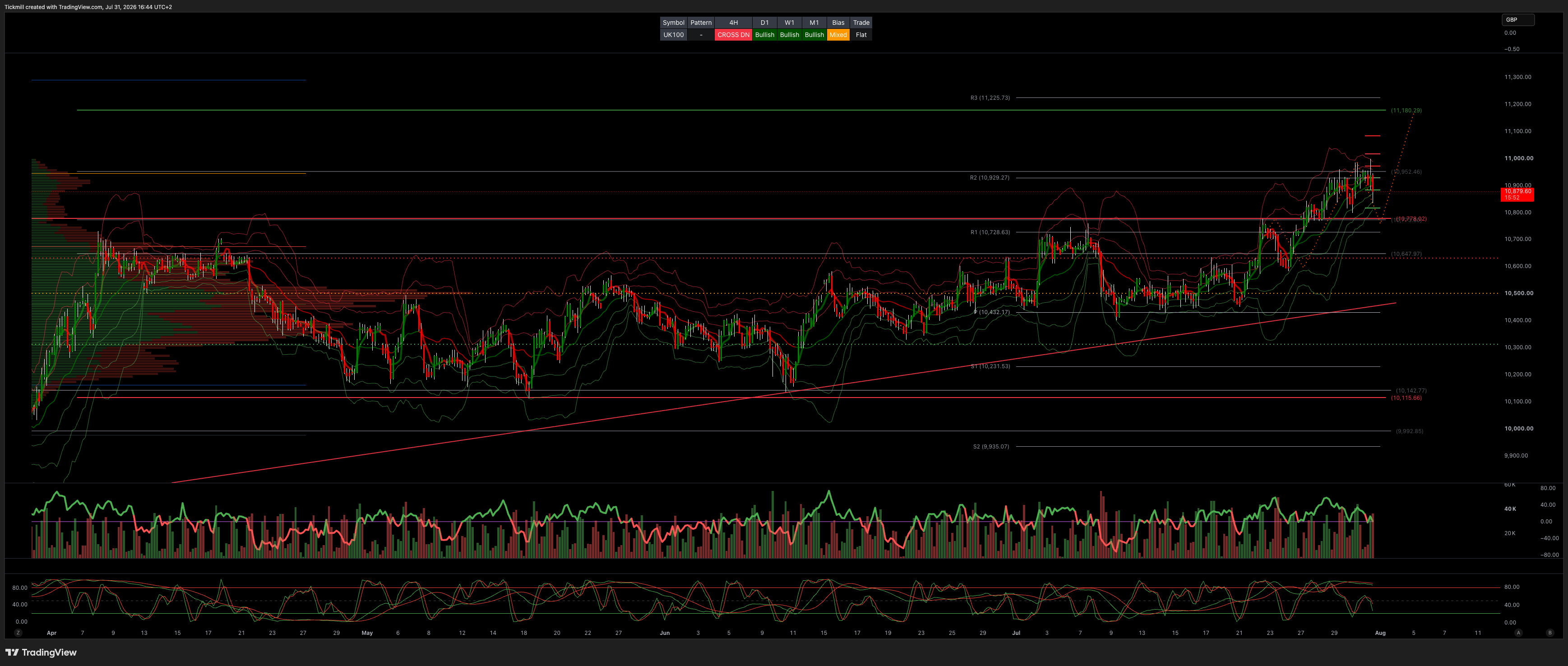
TECHNICAL & TRADE VIEW – FTSE100
Daily VWAP Bullish
Weekly VWAP Bullish
Above 10700 Target 11180
Below 10400 Target 9500

Comments
Log in or sign up to join the conversation.