


Flat Index, Property Surge, Fiscal Illusions Matter
London traded in a tight range on Wednesday, with the FTSE 100 roughly flat around midday as investors balanced takeover excitement in real estate against weakness in miners, energy and financials. The broader tone was cautious, with markets still trying to read conflicting reports around U.S.-Iran peace negotiations and the domestic political implications of a likely post-Starmer transition.
The standout move was in property. Segro soared more than 18% after rejecting a £12.6 billion takeover proposal from larger U.S. rival Prologis (PLD). The bid lit a fire under the listed real estate complex, with Tritax Big Box REIT up more than 6%, British Land rising 3.2%–3.4%, Land Securities, LondonMetric Property and Primary Health Properties also moving sharply higher. Primary Health Properties rallied nearly 3.5% after saying it is in advanced discussions over contributing its private hospital portfolio to a new joint venture. The message from the property sector was clear: UK assets remain cheap enough to attract strategic interest, especially from overseas buyers with stronger balance sheets and a longer-term view. In a market weighed down by high gilt yields and political risk, corporate activity can still force a re-rating where valuations are too depressed. Housebuilders also joined the rally. Berkeley Group jumped 4.5% after annual results came in line with guidance reiterated on April 1. Persimmon and Howden Joinery gained between 2% and 3%, helped by the same logic supporting real estate: if a fiscally disciplined Andy Burnham-led government can steady gilts, rate-sensitive domestic sectors may have room to recover.
That is the optimistic interpretation. Barclays argues that if Burnham becomes prime minister without a bruising leadership contest and commits to the current fiscal framework, pressure could ease on homebuilders, real estate and retail. The market reaction in property and housing names today suggests investors are willing to test that thesis selectively. But the gilt issue is not solved. The important nuance is that sticking to the fiscal rules does not necessarily mean limiting gilt issuance. The Guardian reports that a Burnham adviser has called for billions of pounds of infrastructure borrowing, pointing to what could be described as a “fiscal illusions” strategy: using the structure of the fiscal framework to boost investment while still claiming formal rule compliance. That matters for bondholders. There may be room to increase public investment within the existing rules, but if the result is higher gilt supply, the market still has to absorb it. In other words, “fiscal discipline” and “more bonds” can coexist. For equities, that may support infrastructure, housing and domestic demand. For gilts, it could keep term premia elevated.
That tension helps explain why the FTSE itself struggled to break higher despite big gains in property names. Miners and commodity-linked stocks were weak. Fresnillo, Glencore, Endeavour Mining and Anglo American fell, while Airtel Africa dropped about 3.5%. LSEG, Prudential (PRU), Lion Finance, Convatec, BP, Babcock, Halma and Centrica also lost between 1.2% and 2.7%. The commodity complex remains vulnerable to mixed global growth signals, lower oil and uncertainty around the U.S.-Iran talks. Elsewhere, Games Workshop climbed 4.3%, while Croda International and St. James’s Place gained 3.2%–3.4%. Haleon (HLN), Whitbread, Marks & Spencer, Associated British Foods, Pershing Square Holdings and Weir rose between 2% and 3%. B&M European Value Retail added 1.5% after appointing Atheeq Akbar as its next chief financial officer.
The bigger market question remains whether UK domestic equities can finally catch a bid. Barclays is still underweight UK equities, citing structural weaknesses: low IPO activity, declining domestic ownership, weak retail participation, limited tech exposure and a market whose earnings growth is still too dependent on energy and commodities. The FTSE 250 is up only about 2% this year and continues to lag the FTSE 100, with real estate, household goods, home construction and retail all under pressure. Still, the UK’s cheap valuation is becoming harder to ignore. If global AI and mega-cap tech trades wobble, the UK’s defensive, low-tech profile may become useful as a diversification hedge. The catch is that this diversification appeal works best if gilt yields are stable. If infrastructure ambitions translate into higher borrowing and more gilt supply, the rate-sensitive rebound can only go so far.
Finish Line: The FTSE 100 was flat, but the action underneath was anything but. Segro’s rejected £12.6 billion Prologis bid sparked a major property rally, lifting REITs, landlords and housebuilders. Yet miners, energy and financials capped the index, while political-fiscal risk remains unresolved. Burnham’s commitment to the fiscal rules may reassure markets, but investors should not confuse rule compliance with lower gilt supply. The autumn test is no longer just who leads the government — it is whether “fiscal discipline” still means restraint in the bond market.
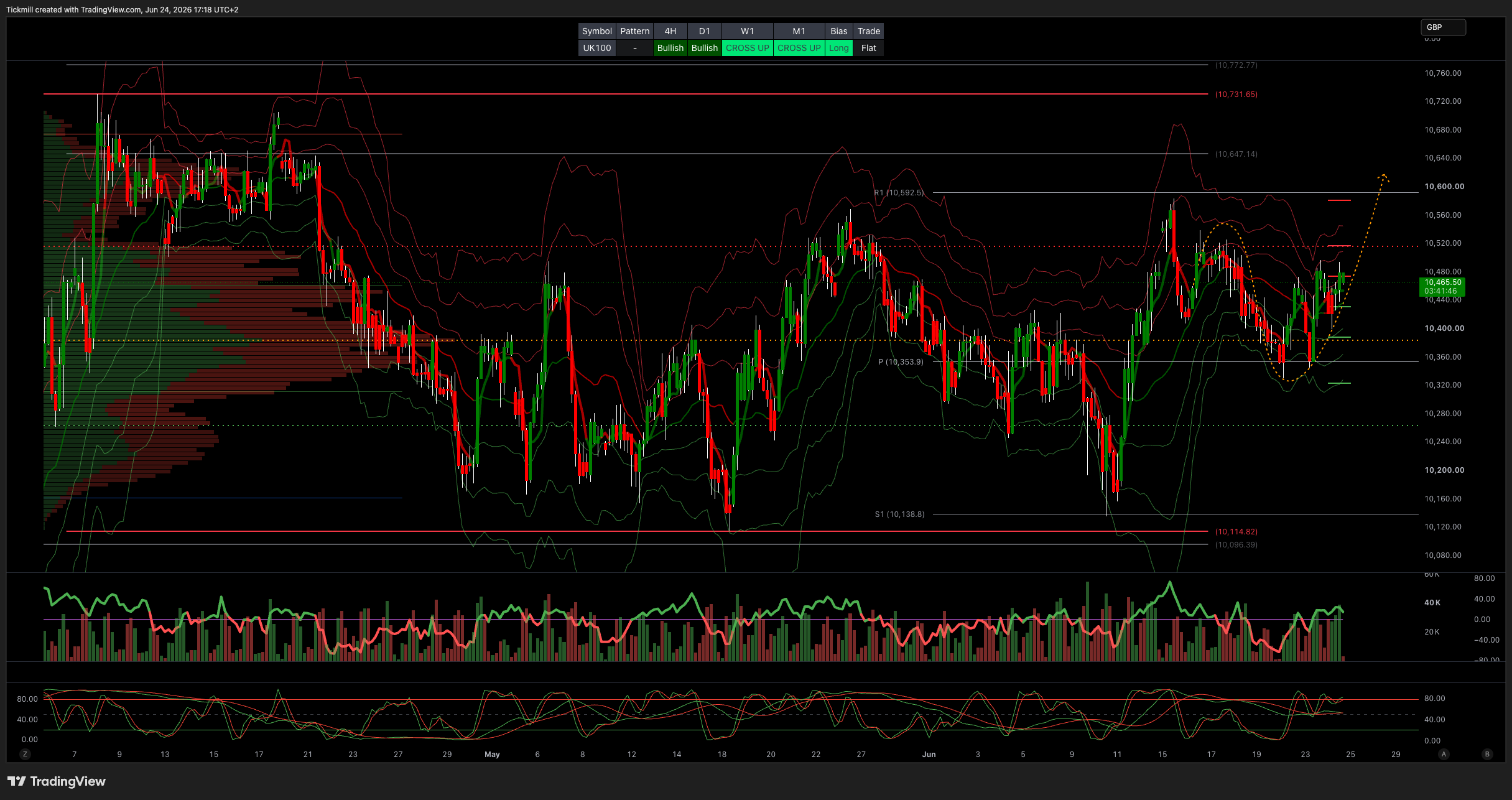
TECHNICAL & TRADE VIEW – FTSE100
Daily VWAP Bullish
Weekly VWAP Bearish>Bullish
Above 10350 Target 11000
Below 10100 Target 9469


Comments
Log in or sign up to join the conversation.