

Trump Reopens Iran Risk, Oil and Yields Jump, London Sells Off
London sold off sharply on Wednesday after President Donald Trump said the initial agreement to end the war on Iran was over, reigniting fears of a fresh escalation in the Middle East. The FTSE 100 fell more than 1%, dropping to its lowest level in nearly a week, while the FTSE 250 touched its lowest level in more than a week as rising oil prices and higher bond yields revived concerns about inflation and central-bank tightening. The move was broad and risk-off. Most sectors traded in the red, with defence stocks among the biggest drags, while energy was the only clear area of strength. The market reaction showed how quickly the post-truce relief trade can reverse when geopolitical headlines shift. Investors had only recently started to price a lower probability of disruption around the Strait of Hormuz. Trump’s comments forced the market to rebuild that risk premium.
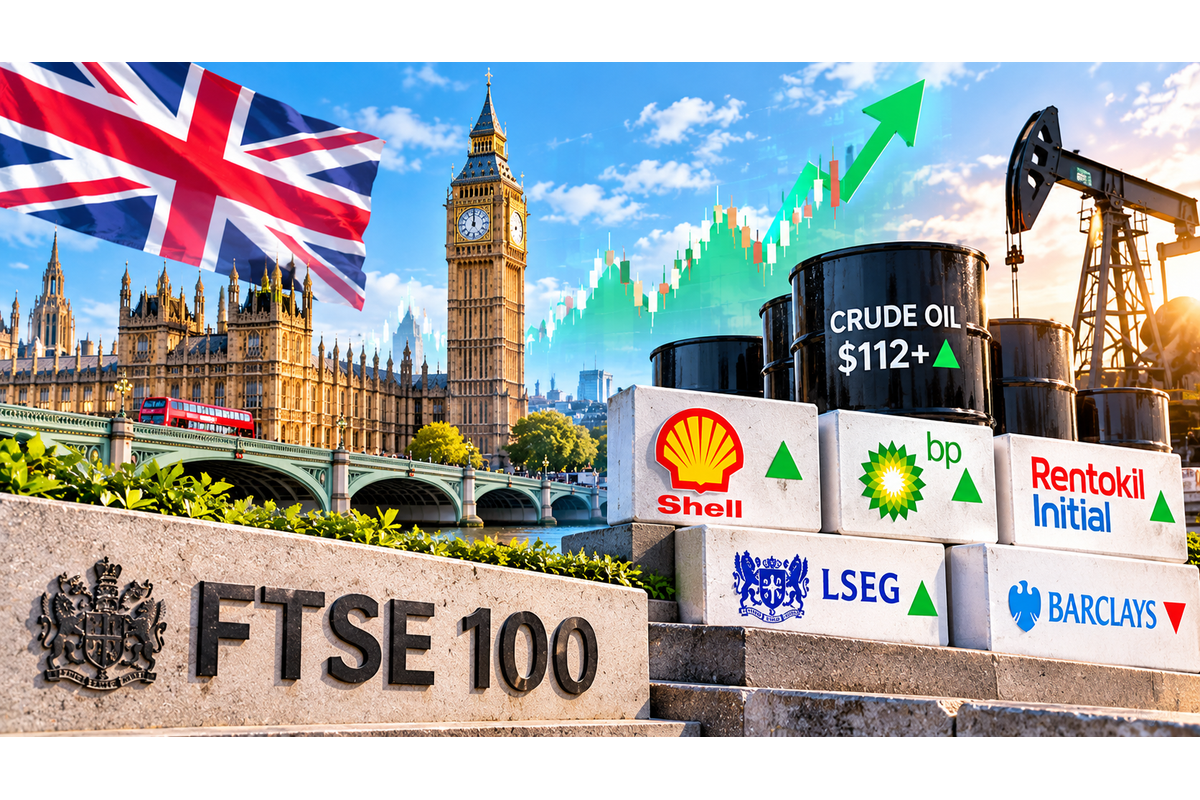
Oil was the immediate transmission channel. Brent crude rose to $79.26 a barrel before easing to $78.10, still nearly 4% above the previous close. That move lifted the FTSE’s energy heavyweights, with BP (BP) rising 3% and Shell (SHEL) gaining 1.8%. The energy index was the only sector in positive territory, helped by renewed fears that Middle East oil supplies and shipping routes could be disrupted. But the broader implication of higher oil was negative. A renewed energy shock would complicate the inflation outlook just as the Bank of England is already reluctant to discuss cuts. Governor Andrew Bailey has said rate cuts remain off the table for now because of delayed energy-price pass-through, while Catherine Mann has warned that inflation persistence may require a longer hold or even a need to lean against inflation risk. Wednesday’s jump in crude prices reinforced exactly the scenario policymakers are worried about. Bond yields also moved higher, adding pressure to equities. Rising yields hurt rate-sensitive sectors, increase discount rates and tighten financial conditions. For the UK, this is particularly important because domestic data have already weakened across services, construction, mortgages and business confidence. The market is therefore being hit by a difficult combination: softer activity but renewed inflation risk.
Precious metals miners were among the worst performers, with the sector falling 3.6% as gold prices dropped more than 1%. The decline reflected a stronger inflation and rates narrative rather than a classic haven bid. If investors believe higher oil will keep central banks tighter for longer, gold can struggle despite geopolitical stress, especially when real yields and the dollar move higher. The sell-off also hit the mid-cap space, where domestic exposure is greater. The FTSE 250 touching its lowest level in more than a week underlined that investors were not simply rotating within the FTSE 100; they were reducing exposure to UK cyclicals and rate-sensitive assets more broadly.
There were still individual stock stories. Jet2 climbed 9.9% after the travel firm said tourists were more willing to commit to travel plans following the earlier easing of Middle East tensions. The timing was awkward given the renewed escalation headlines, but the update suggested underlying travel demand remains resilient when consumers feel geopolitical risk is contained. Vistry fell 6.4% after Britain’s largest affordable housing builder warned of a first-half pre-tax loss of £30 million. That added to recent evidence of stress in housing and construction. The sector is still dealing with high financing costs, weak demand, slower project activity and fragile confidence. Earlier this week, the construction PMI remained deeply contractionary at 38.4, while recent mortgage and house-price data have shown only limited stabilisation. IG Group rose 2.5% after the online trading platform proposed creating a new holding company in Jersey as part of a strategic overhaul aimed at unlocking shareholder value. The move added to the ongoing theme of UK-listed firms exploring structural changes to improve valuation, capital flexibility or investor appeal. The labour-market signal was slightly less negative. A survey of recruitment companies showed that Britain’s jobs-market downturn eased somewhat last month, helped by an upturn in temporary hiring and starting salaries. That is helpful for household income and services demand, but it is not an unambiguously dovish signal for the Bank of England. Firmer starting salaries could keep wage-growth concerns alive, especially if energy prices rise again.
A major fiscal detail also entered the debate. HMRC published its latest estimate of the UK tax gap for 2024/25, showing that the gap between tax owed and tax collected rose to £59.2 billion, or 6.4% of theoretical tax liability. That is the highest cash level since records began in 2005/06, with the percentage gap at a decade high. The largest sources of unpaid tax were corporation tax at £21 billion and income tax, capital gains tax and National Insurance contributions at £20.9 billion. Importantly, this is not mainly a story of wealthy individuals avoiding tax. Businesses account for most of the gap, with small businesses responsible for £17.1 billion and medium and large businesses accounting for another £3.8 billion. Together, businesses make up almost three-quarters of the estimated shortfall. Much of the remainder comes from underpaid tax through self-assessment. This matters because the next Chancellor will face pressure to fund defence, public services, infrastructure and broader investment while respecting fiscal rules. With tax-rise speculation likely to intensify under an incoming Burnham government, the tax gap offers a potentially important alternative source of revenue. Even recovering around half of the missing receipts would raise roughly £22 billion.
The political implication is significant. Closing the tax gap may be easier to sell than raising headline tax rates. It is revenue that is already owed, and collecting it should be less damaging to growth than increasing the tax burden on compliant households and firms. The most obvious areas for focus are VAT, self-assessment income and small-business corporation tax payments. HMRC is already investing in AI and advanced data analytics to improve compliance, detect fraud and identify non-payment more effectively. That fits the broader UK policy debate around AI: while the Bank of England has warned about leveraged AI valuations and operational risks in finance, the public sector could still use AI productively to improve tax collection and reduce fiscal pressure. For markets, this connects directly to gilts. If an incoming Chancellor can credibly raise revenue through better compliance rather than large tax hikes or extra borrowing, it could support fiscal credibility and reduce pressure on gilt supply. That would matter for equities too, because elevated gilt yields have been a persistent headwind for domestically exposed sectors. The Bank of England’s Financial Stability Report remains relevant in this context. The BoE has warned that leveraged equity exposure, especially in AI-related companies, could amplify any asset-market correction. It has also flagged energy shocks, elevated sovereign yields and cyber risks from frontier AI models as growing vulnerabilities. Wednesday’s sell-off was a live example of how energy and rates can transmit quickly through UK assets.
Finish Line: The FTSE 100 fell more than 1% after Trump declared the initial Iran peace agreement over, sending oil and bond yields higher and pulling London into risk-off mode. BP and Shell gained as crude jumped, but most sectors fell, with precious metals miners hit by lower gold and higher-rate fears. Vistry’s warning reinforced housing stress, while Jet2 and IG Group provided isolated bright spots. The bigger message was macro: renewed Middle East escalation risks keeping inflation sticky just as UK activity weakens. At the same time, HMRC’s record £59.2 billion tax gap gives the next Chancellor a potential funding route that may be less damaging than broad tax rises. For UK markets, the key question is whether policymakers can close fiscal gaps and maintain gilt credibility while energy shocks, higher yields and geopolitical risk keep tightening the screws.
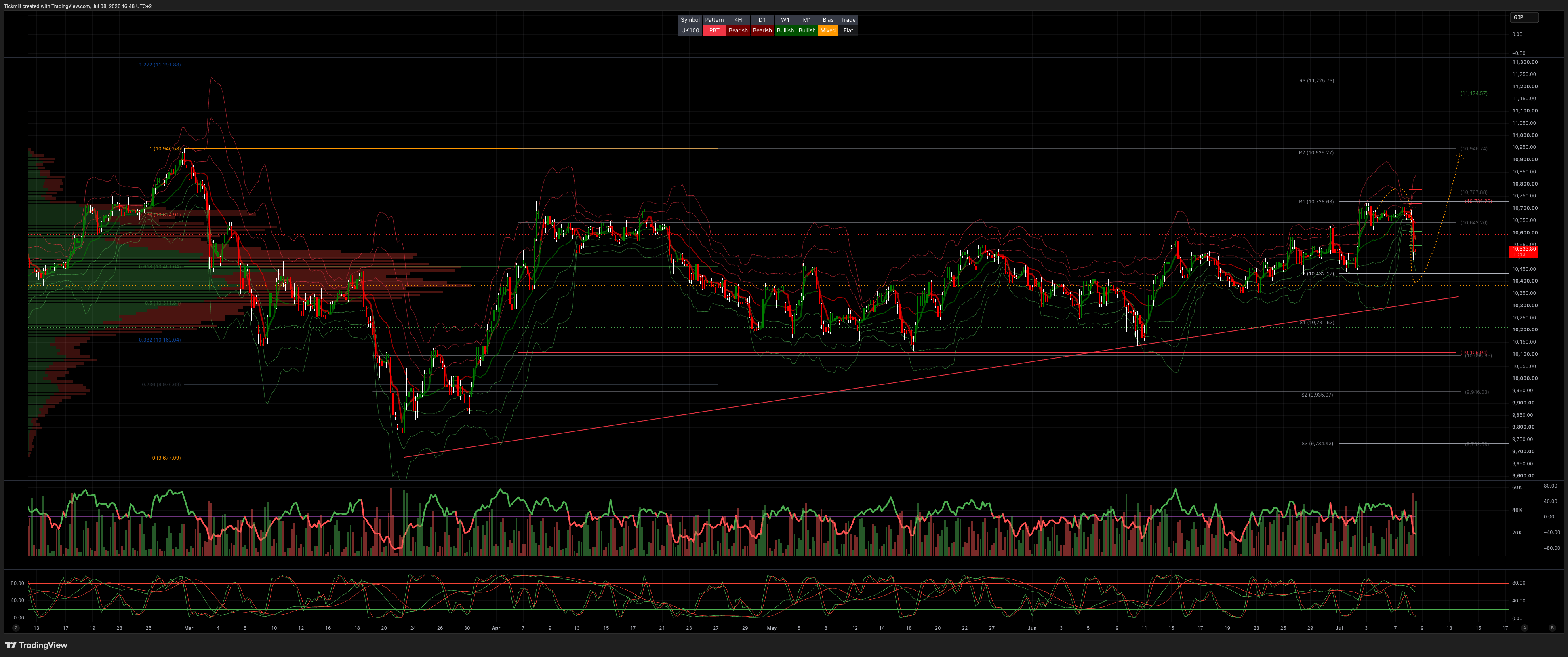
TECHNICAL & TRADE VIEW – FTSE100
Daily VWAP Bullish
Weekly VWAP Bullish
Above 10300 Target 11000
Below 10100 Target 9469

Comments
Log in or sign up to join the conversation.