

Miners Lift London to Fresh Highs Before Rebalancing Flows Fade the Rally
London traded firmly higher for much of Tuesday, supported by a strong rebound in miners, renewed optimism around artificial intelligence and hopes that diplomacy can contain the Middle East crisis. But the early rally faded into the close, with the FTSE 100 sliding back toward the flatline as month-end, quarter-end and half-year rebalancing flows muddied the picture. The benchmark briefly printed its highest level since April 2026 before reversing sharply. Even with the late fade, the broader trend remains strong: over the past 12 months, the FTSE 100 is up 20.36%. That resilience continues to reflect the index’s mix of global earnings, defensive cash flows, financials, energy exposure and still-cheap UK valuations. The strongest leadership came from mining. Antofagasta gained 3.6%, Anglo American rose 3.5%, Glencore climbed 2.5% and Rio Tinto (RIO) added 2.2%, while Endeavour Mining advanced 0.6%. The sector benefited from better risk appetite, a softer tone around Middle East escalation and renewed optimism that AI-related infrastructure demand can support metals consumption. That AI angle matters. While the FTSE 100 is not a technology-heavy index, it has indirect exposure through miners, industrials, electrification supply chains and global capital expenditure. If investors are again willing to price stronger AI infrastructure demand, copper, power, equipment and engineering-linked names can all benefit.
The rally was broader than miners' early in the day. St. James’s Place, Polar Capital Technology Trust, Scottish Mortgage, Lion Finance, Babcock International, J Sainsbury, Spirax, Lloyds Banking Group, Melrose Industries, Rolls-Royce, Diploma, Halma, NatWest (NWG), Croda, Abrdn and BAE Systems all moved sharply higher. That mix pointed to a healthier risk tone across financials, industrials, defence, technology-linked trusts and selected consumer names. But the closing action was less convincing. The FTSE’s reversal back toward the flatline suggests investors were unwilling to fully chase strength at quarter-end, especially after a 20% gain over the past year. Rebalancing flows likely amplified the late move, with winners trimmed and sector weights adjusted at month, quarter and half-year close. On the downside, Burberry, Persimmon, Barratt Redrow, Vodafone (VOD), Entain, Diageo and BT Group (BT.A) fell between 1% and 1.7%. Weakness in housebuilders was notable given the earlier mortgage data showing a sharp fall in approvals and borrowing. Rate-sensitive domestic exposure remains fragile, even if gilts have behaved more calmly since Andy Burnham’s fiscal address.
The macro data were supportive on the surface. Final figures from the Office for National Statistics confirmed that the UK economy grew 0.6% quarter-on-quarter in the first quarter, in line with the initial estimate and stronger than the revised 0.1% expansion in the fourth quarter. The detail showed growth across all three production sectors, with services making the largest contribution. Services output rose 0.8%, industrial production increased 0.2% and construction grew 0.2%. On the expenditure side, household spending rose 0.6% and government spending increased 1.3%. That paints a picture of a solid start to the year, with domestic demand and services activity still contributing despite pressure from high borrowing costs.However, the historical revision was less helpful. GDP growth for 2025 was revised down to 1.3% from 1.4%, following unrevised growth of 1% in 2024. That keeps the medium-term UK growth story modest. The first-quarter expansion was welcome, but investors remain cautious about whether the momentum can survive weaker mortgage activity, soft retail surveys, elevated gilt yields and lingering inflation risk.
Politics stayed in the background but remains important. Markets have so far treated Andy Burnham’s likely move into Downing Street as manageable, especially after his commitment to fiscal discipline calmed sterling and gilts. But the real test is still ahead: the choice of Chancellor, the Autumn Budget and whether any infrastructure push can be delivered without unsettling gilt supply expectations. Geopolitics also remained central to sentiment. Hopes for progress on U.S.-Iran talks helped reduce immediate risk premia, supporting miners and broader cyclicals. But after several sharp reversals in Middle East headlines over recent weeks, investors are unlikely to price a durable peace dividend until shipping security, energy flows, and regional proxy risks look more settled.
Finish Line: The FTSE 100 rose strongly early on Tuesday, powered by miners, AI-linked optimism and hopes of a Middle East de-escalation, briefly reaching its highest level since April 2026. But the rally faded sharply into the close as month-end, quarter-end, and half-year rebalancing flows pulled the benchmark back toward flat. The UK’s confirmed 0.6% first-quarter GDP expansion helped the backdrop, but weak housing signals and lingering fiscal, inflation and geopolitical risks kept investors from chasing the breakout.
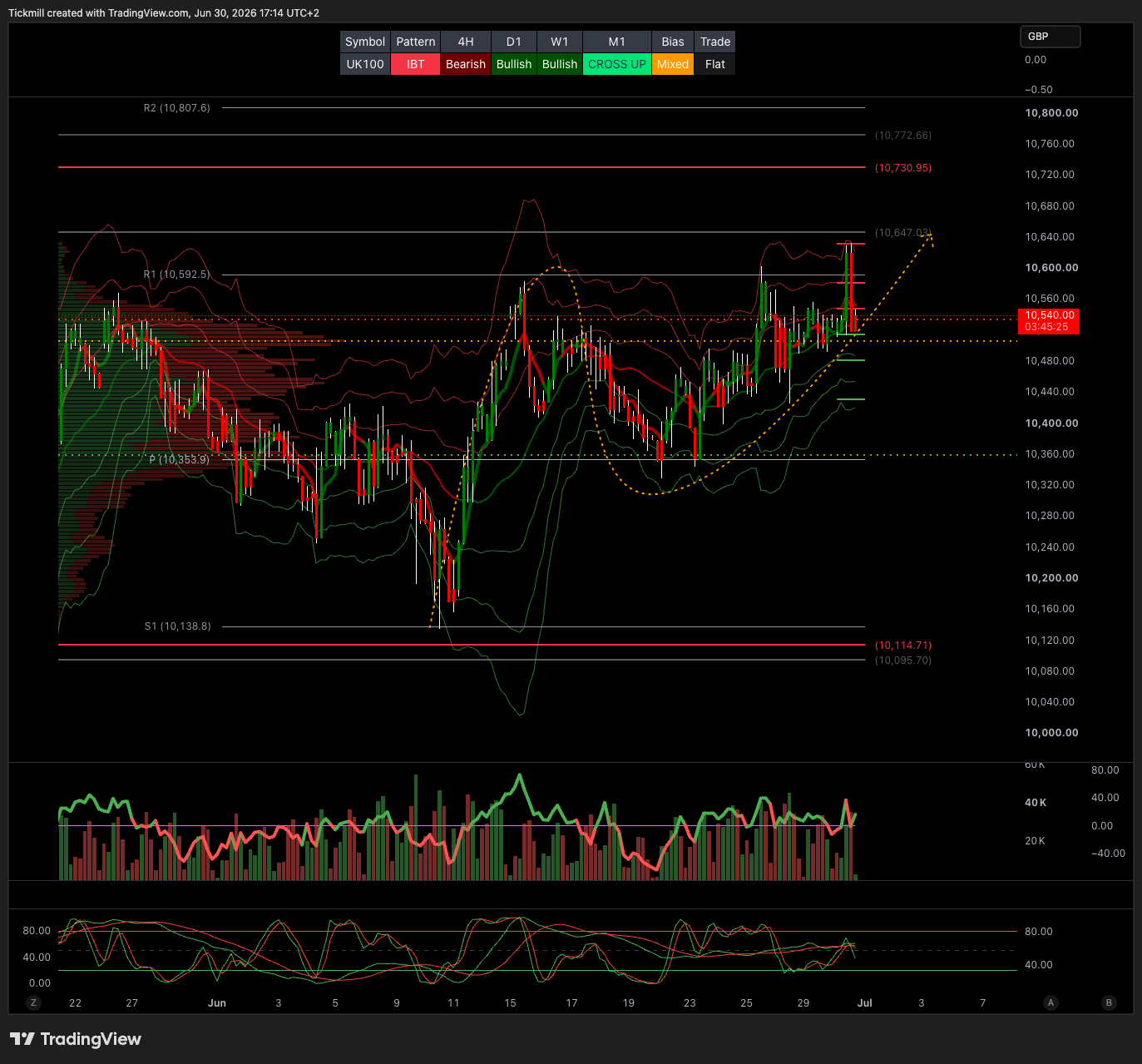
TECHNICAL & TRADE VIEW – FTSE100
Daily VWAP Bullish
Weekly VWAP Bullish
Above 10350 Target 11000
Below 10100 Target 9469


Comments
Log in or sign up to join the conversation.