

London finished in positive territory on Tuesday, with the FTSE 100 now up 0.42%, reversing the earlier softer tone as gains in defensives, staples, healthcare and selected quality names outweighed heavy losses across miners and growth-sensitive stocks. The session still carried a cautious macro message. The flash S&P Global UK Composite PMI fell to 49.4 in June from 49.7 in May, missing expectations for 50.6 and marking a second straight month of contraction after 11 months of expansion. The weakness concentrated in services, with the PMI dropping to 48.7 from 49.3. Manufacturing was the only sector to improve, rising to 53.6 from 52.2.
That mix left investors with an awkward interpretation. UK activity is weakening, especially in the dominant services sector, but the slowdown also strengthens the case that the Bank of England may not need to tighten further — and may eventually resume cutting if slack opens up. That helped the broader index recover even as cyclical leadership remained poor.
Miners were the main drag. Antofagasta fell 6.6%, Anglo American dropped 5.5%, Fresnillo lost 5%, Glencore declined 4.2%, Rio Tinto (RIO) fell 3.7% and Endeavour Mining slipped 2.4%. The sector was hit by weaker commodity sentiment, concern over global demand and renewed uncertainty around the durability of the U.S.-Iran truce. Technology and long-duration growth names also remained under pressure. Scottish Mortgage, Polar Capital Technology Trust, Computacenter, Spirax, Halma, IMI, Pershing Square, Persimmon, Howden Joinery, Weir and Tesco lost between 1.7% and 4.5%. Fed rate-hike fears and uncertainty around global central-bank policy kept discount-rate-sensitive names on the back foot. But the FTSE’s heavyweight defensive base did the work. Bunzl, Babcock International, British American Tobacco, RELX, AstraZeneca (AZN), Sage, Marks & Spencer and Coca-Cola HBC rose between 1.3% and 3%, enough to pull the benchmark into the green. The move was less a broad risk-on rally than a rotation into earnings visibility, pricing power and lower-beta balance sheets.
The most important policy signal came from BoE’s Taylor, who framed the current backdrop as one where geopolitics is driving economic outcomes and monetary policy — an uncomfortable place for central bankers. His remarks were deliberately two-sided, but the dovish tail mattered. Taylor said that if more slack opens up and inflation looks likely to undershoot, the Bank may have to cut quickly. In a more benign scenario, he said rates can and should resume their downward path to neutral. He also noted that firms expect an uptick in inflation over the coming year but do not expect wages to follow, with labour-market weakness likely to restrain second-round effects. That is crucial. If wages do not validate the inflation pickup, the BoE has more room to look through externally driven price shocks rather than tighten into a slowdown.
Finish Line: The FTSE 100 rose 0.42%, but the gain was defensive rather than euphoric. Weak PMI data hurt miners, tech trusts and housing-linked cyclicals, while Taylor’s remarks strengthened the case that the BoE may ultimately return to cuts if slack deepens. The index closed higher because defensives and quality compounders carried it — not because investors suddenly embraced the growth outlook.
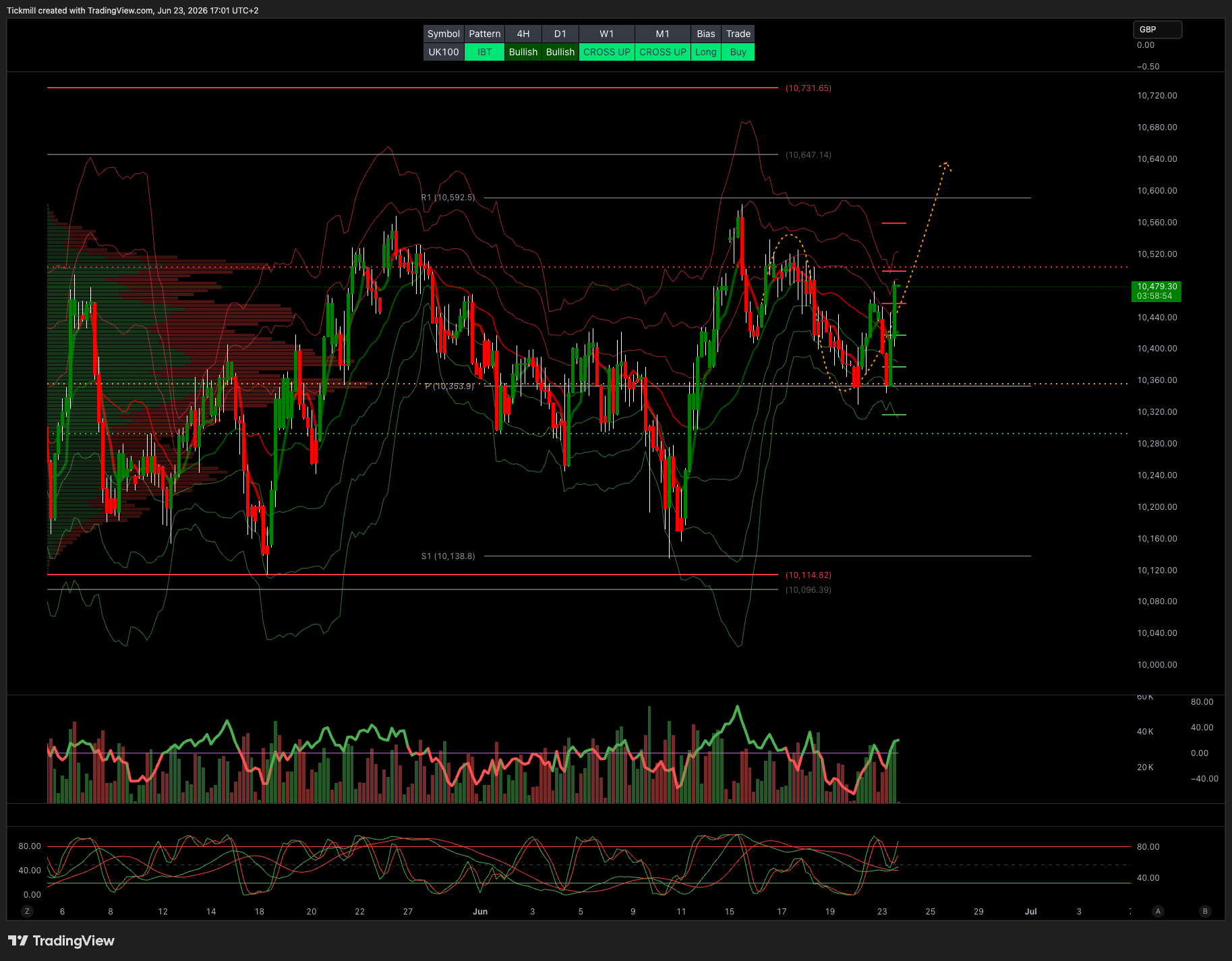
TECHNICAL & TRADE VIEW – FTSE100
Daily VWAP Bullish
Weekly VWAP Bearish>Bullish
Above 10350 Target 11000
Below 10100 Target 9469

Comments
Log in or sign up to join the conversation.