

Miners Lift the Tape as Bailey Keeps the Inflation Line
UK equities moved higher on Tuesday, as strength in mining stocks and domestic housing names helped the benchmark recover from three straight losing sessions. The FTSE 250 outperformed, supported by broader buying interest in midcaps and rate-sensitive domestic shares. The tone was constructive but still carried a clear inflation warning. Bank of England Governor Andrew Bailey told the House of Lords Economic Affairs Committee that the central bank’s priority remains returning inflation to its 2% target, not redefining it after repeated overshoots. Asked whether the persistence of above-target inflation through much of the 2020s meant the BoE should rethink its framework, Bailey pushed back, saying the focus must be on managing the journey back to target and ensuring the public believes in the legitimacy of the Bank’s objective. He also rejected the idea that raising the target to 3% would be an appropriate response to missed targets.
Bailey confirmed that he voted to keep rates steady at 3.75% in April, part of an 8-1 majority. He also noted that rising market interest rates had given the Bank some breathing room to assess whether another rate increase is needed in response to inflationary pressures linked to the conflict in Iran. For investors, the message was balanced but firm: the BoE is not rushing into another hike, but it is also not ready to declare victory on inflation.
Fresh lending data helped domestically focused shares. British lenders approved 65,945 mortgages for house purchases in April, the highest level in 15 months, up from 63,979 in March and comfortably above the 62,000 consensus forecast. Net unsecured consumer lending rose by £1.859 billion, ahead of expectations for £1.7 billion, though slightly below March’s £1.904 billion increase. The figures suggested that household credit demand remained more resilient than feared, despite weaker consumer sentiment and rising mortgage rates since the start of the Iran war in late February.
Housebuilders responded positively, with the sector rising 1.5% during the session. Still, the housing picture remains uneven. Nationwide has reported the first monthly fall in house prices since December in May, while the Royal Institution of Chartered Surveyors has pointed to weaker prices and buyer demand in April. So while the mortgage approvals data offered support, it did not fully remove concerns around affordability, higher rates and the durability of demand.
The strongest support for the FTSE came from mining stocks, as base metal prices strengthened. Industrial metal miners rallied after copper prices climbed to a more than two-week high, with Glencore, Anglo American and Rio Tinto (RIO) each rising by around 2%. Precious metal miners also gained, with the segment up 1.8% as gold prices increased by around 1%. That combination of copper strength and gold support gave commodity-linked equities the main upward push and helped offset weakness elsewhere.
Energy stocks lagged, with the oil and gas sector down 0.8% as crude prices came under pressure. The decline followed comments from US President Donald Trump suggesting that discussions with Iran were ongoing, raising hopes of diplomatic progress and reducing some of the immediate supply-risk premium in oil. The Middle East backdrop also showed tentative signs of cooling, with Lebanon announcing a partial ceasefire between Hezbollah and Israel. For the FTSE, lower oil remains a double-edged development: it eases inflation concerns and can help rate-sensitive areas, but it also weighs on energy heavyweights with significant index weight.
Among individual stocks, British American Tobacco fell 2.9% despite raising its forecast for revenue from smoking alternatives such as vapes. Investors focused instead on the company keeping its overall guidance unchanged. GB Group slid 9.9% after reporting an annual loss driven by a £73.1 million impairment charge, reinforcing the market’s low tolerance for balance-sheet disappointments and earnings pressure.
In fixed income, UK government bond yields edged slightly lower across the curve, offering some support to rate-sensitive shares. In currency markets, the pound was little changed but slightly firmer, edging up 0.1% against the US dollar in subdued trading.
Finish Line: The FTSE 100 climbed 0.4%, putting it on track to break a three-day losing streak, as miners rallied on stronger copper and gold prices while housing stocks drew support from better-than-expected mortgage approvals. But Bailey’s message kept the macro guardrails firmly in place: the BoE will maintain its inflation target and treat the latest price pressures as significant. For today, metals strength and resilient credit data carried the tape; the next test is whether lower oil and softer gilt yields can keep supporting domestic equities without forcing the Bank of England back into a more hawkish lane.
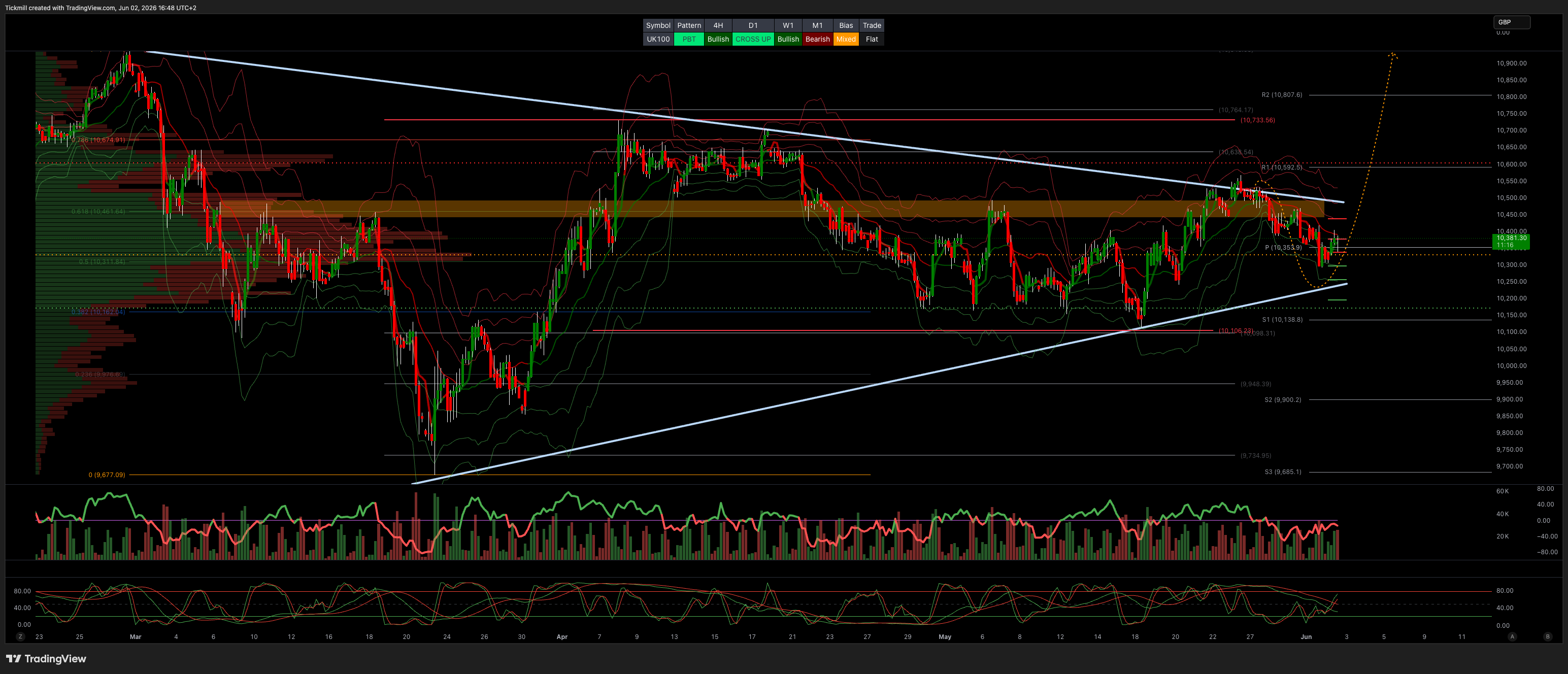
TECHNICAL & TRADE VIEW – FTSE100
Daily VWAP Bearish
Weekly VWAP Bullish
Above 10500 Target 11000
Below 10100 Target 9469


Comments
Log in or sign up to join the conversation.