

Unilever Powers FTSE Higher as Defensives Lead and Oil Relief Lingers
London advanced again on Tuesday, with the FTSE 100 rising 0.5%, as a surge in Unilever lifted the consumer staples complex and easing concerns over U.S.-Iran tensions continued to support risk appetite. The move extended Monday’s de-escalation rally and pushed the benchmark further into near five-month-high territory. The day’s leadership came from FMCG and defensives rather than energy or miners. That made Tuesday’s rally different from many recent sessions. Instead of being driven by crude prices, banks or resource stocks, the market was lifted by a strong company-specific earnings beat from one of the FTSE’s largest defensive growth names. Unilever’s update gave investors evidence that consumer staples can still deliver volume growth and pricing resilience in a difficult macro environment.
Unilever jumped nearly 8% after reporting better-than-expected earnings and upgrading its full-year underlying sales growth guidance. The company now expects underlying sales growth in the 4% to 6% range, compared with its previous expectation for growth at the bottom end of that range. The upgrade was supported by around 3% underlying volume growth, and the company reported its best quarter of sales volume growth in 16 years. The quality of the Unilever beat mattered. In the first half, operating profit rose 2.6% to €4.885 billion from €4.762 billion a year earlier, while underlying operating profit grew 0.9% to €5.2 billion. The stronger volume performance suggested that the company is no longer relying solely on price increases to drive top-line growth. For investors worried about stretched household budgets, that was an important signal.Unilever’s rally spread across the broader consumer staples and defensive space. Compass Group, Diageo, Imperial Brands, Reckitt Benckiser, Coca-Cola HBC, British American Tobacco, Haleon (HLN), Sainsbury, Associated British Foods, Tesco and Marks & Spencer all gained. The breadth of the move showed that investors were rotating into companies with pricing power, steady cash flows and exposure to improving real-income conditions as inflation pressure eases.
The shop-price data reinforced that theme. British Retail Consortium figures showed UK shop price inflation rose 0.9% year-on-year in July, below market expectations for a 1.2% increase and slower than June’s 1.2% rise. It was the slowest increase since December 2025. On a monthly basis, shop prices fell 0.1%. That added to the recent evidence that goods inflation and retail price pressure are cooling. For the Bank of England, the data are helpful. June CPI already delivered a third consecutive downside surprise relative to the MPC’s expected path, easing to 2.6% year-on-year. Now, softer shop-price inflation suggests that some of the pressure facing households is continuing to fade, particularly in goods and retail channels. This supports the case for holding rates at 3.75% while the Bank waits for more evidence on services inflation, wages and energy pass-through. However, the inflation story is not completely settled. The earlier drop in oil prices was driven by the U.S. and Iran pausing strikes and opening the door to renewed peace negotiations. Brent’s sharp fall helped ease inflation fears, but Middle East tensions remain fragile and energy prices could still rebound if talks fail. For now, though, the de-escalation has created a better backdrop for consumer names and rate-sensitive equities.
Admiral rose a little over 4%, while RELX gained 3.6%. Compass, Diageo, Imperial Brands, Croda, Babcock, Reckitt, Sage and Experian climbed between 2.5% and 3%. 3i Group, Haleon, BAE Systems, Auto Trader, British American Tobacco, Coca-Cola HBC, BT (BT.A), Whitbread, Sainsbury, Associated British Foods, Tesco, Metlen Energy & Metals, Marks & Spencer and Land Securities gained between 1.5% and 2.5%. The gains in Land Securities and other domestic or rate-sensitive names reflected the softer inflation backdrop. Lower shop-price inflation and reduced oil pressure support the idea that the peak in monetary tightness is behind the UK economy. Property and consumer-facing names tend to benefit when investors see less risk of renewed rate hikes and more potential for real incomes to stabilise. Defence names also remained well supported. Babcock gained and BAE Systems rose, reflecting continued geopolitical uncertainty even as the immediate U.S.-Iran escalation cooled. The market is no longer treating the situation as an outright war shock, but it is not assuming a clean peace either. That leaves defence spending and security-linked demand as continuing themes.
Banks were the major drag. Barclays fell more than 5% after reporting increased operating costs in the second quarter. The decline overshadowed the broader strength in the index and weighed on the financial sector. Cost discipline is becoming increasingly important for banks because investors are no longer focused only on net interest income. As rate expectations stabilise and margin upside becomes less powerful, expenses, credit quality and capital returns matter more.
NatWest (NWG) and Lloyds also eased by about 1.3%, reflecting some read-across from Barclays and a more cautious tone toward domestic lenders. The pullback came after recent gains in banks, which had benefited from stable labour data, better retail sales and signs that the economy was holding up. Tuesday’s action showed that financials remain vulnerable to earnings quality and cost inflation even when the macro backdrop is improving. Other fallers included Lion Finance, down 3.6%, as well as Games Workshop, Polar Capital Technology Trust, Centrica, Prudential (PRU), Glencore, Anglo American, Weir and Halma. The weakness in miners such as Glencore and Anglo American reflected a continued rotation away from commodity and war-premium trades after the sharp decline in oil and the easing of geopolitical risk. Centrica also softened as lower energy prices reduced support for energy-linked names.
The broader market tone remained constructive despite the weakness in banks and resources. The FTSE’s gain was driven by large-cap defensives, consumer staples, selected insurers, data names and domestic retailers. That suggests investors are increasingly willing to buy into a disinflation-and-resilience narrative: inflation is cooling, the consumer is not collapsing, and corporate earnings are still capable of surprising positively. Prime Minister Andy Burnham’s early cost-of-living measures also sit in the background. His government has already promised to cut household energy bills by scrapping the Digital ID Programme and reduce business rates for pubs, clubs and live music venues by 20% from April. Softer shop-price inflation gives the government some breathing room, but fiscal credibility remains essential. Markets will tolerate targeted support more easily if inflation keeps easing and borrowing remains contained.
Finish Line: The FTSE 100 rose, lifted by an almost 8% jump in Unilever after the consumer goods group beat expectations, delivered its best quarterly volume growth in 16 years and raised full-year sales guidance. Softer UK shop-price inflation added to the disinflation narrative, with prices up just 0.9% year-on-year in July and down 0.1% month-on-month. Defensives, staples and consumer names led, while Barclays dropped more than 5% on higher costs and dragged NatWest and Lloyds lower. Miners and energy-linked names also weakened as investors rotated away from war-premium trades after the U.S.-Iran pause. The market’s message was clear: lower inflation pressure, better consumer-staples earnings and reduced geopolitical stress are enough to keep the FTSE pushing higher, even with banks and commodities acting as a drag.
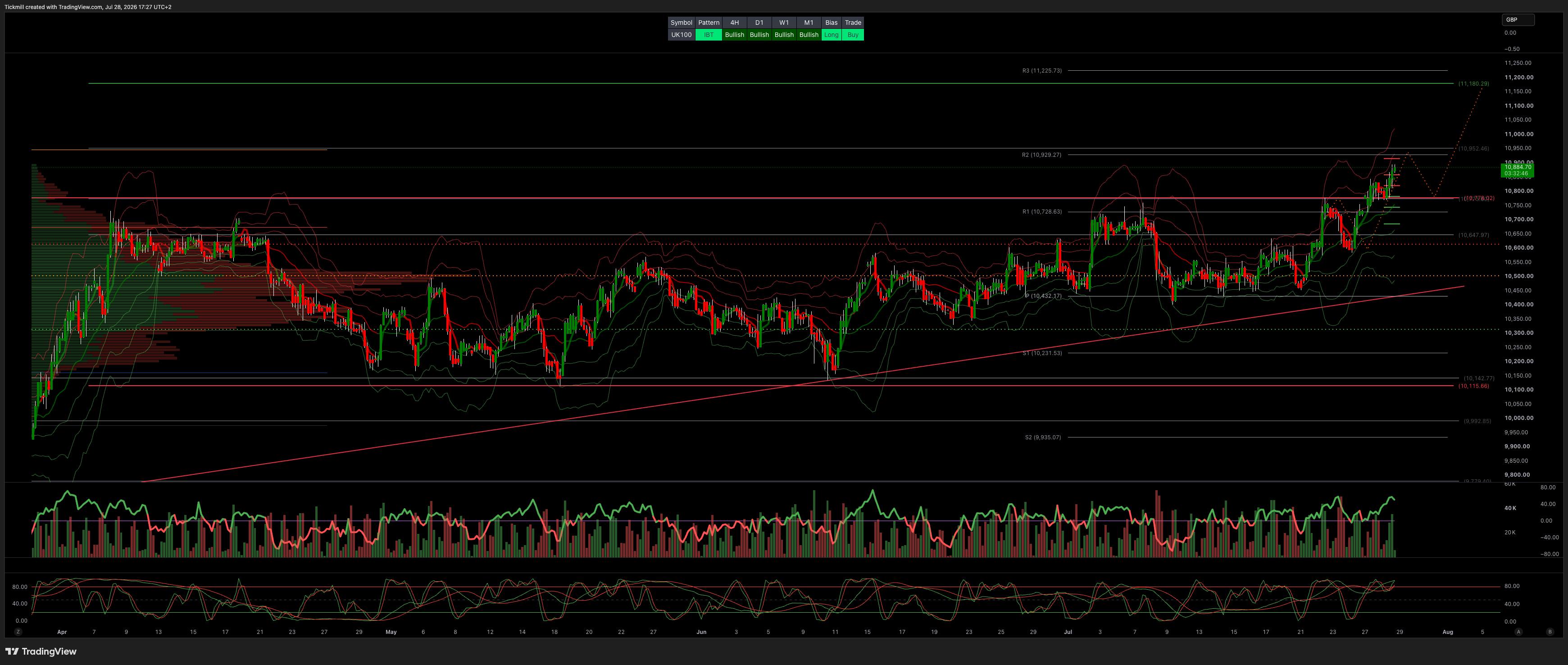
TECHNICAL & TRADE VIEW – FTSE100
Daily VWAP Bullish
Weekly VWAP Bullish
Above 10500 Target 11000
Below 10400 Target 9500

Comments
Log in or sign up to join the conversation.