

BoE Holds, Fed Haunts, Miners Break
London rolled over on Thursday as the Bank of England delivered the expected hold but global rates anxiety kept risk appetite under pressure. The BoE left Bank Rate unchanged at 3.75%, with only two of nine MPC members voting for a hike. That split was not as hawkish as feared, but it was not enough to rescue the tape after the Federal Reserve struck a tougher tone overnight. The Fed kept rates unchanged on Wednesday, but the dot plot did the damage: nine policymakers now project a rate hike this year. That was enough to tighten global financial conditions and push investors out of rate-sensitive and commodity-linked risk. The UK market was not trading the BoE in isolation; it was trading the Fed’s warning that the inflation fight is not finished. The BoE’s message was more balanced. Persistent inflation remains a concern, but the Committee does not appear ready to follow the ECB into renewed tightening or match the Fed’s hawkish guidance. The conditions for sustained UK inflation pressure still do not look firmly in place: activity is cooling, hiring is softening, and recent oil weakness reduces one major upside risk. That gives the BoE room to stay on hold, even if inflation remains above target.
Still, equity investors were not in a forgiving mood. The policy takeaway is important. The BoE’s 7–2 hold supports the view that Bailey’s centre still controls the Committee. Pill and Greene may be pushing for insurance against inflation persistence, but they have not pulled the majority with them. A 6–3 would have looked materially more hawkish; a 7–2 gives the market some comfort that an imminent UK hike is not the base case. But the Fed has made that comfort conditional. If global yields remain elevated and the dollar stays firm, UK risk assets will struggle even without extra BoE tightening. The FTSE’s problem today was not just domestic policy. It was the interaction of a hawkish Fed, weaker commodities, lower oil and fragile domestic cyclicals.
Miners led the decline as precious metals softened. Hochschild Mining fell 8%, while Fresnillo dropped 6% as gold and silver prices eased. The move was a classic positioning squeeze: miners had benefited from geopolitical stress, inflation concern and haven demand, but the combination of lower oil, softer metals and firmer global rates took the shine off the trade. Rate-sensitive housing names were also hit hard. The homebuilders' index fell 2.4%, with Persimmon down 6.2% and among the weakest FTSE 100 performers. The move underlined the problem for the sector: the BoE may not be hiking today, but mortgage affordability remains tight and global yields are still being pulled around by the Fed. For builders, “no hike” is not the same thing as relief. Financials were mixed but broadly heavy. 3i Group fell 4%, while LSEG dropped 5.8% after Rothschild Redburn downgraded the stock to neutral. Heavyweight banks were relatively resilient, with HSBC (HSBC) and Barclays down only 0.2% each, helped by the fact that higher-for-longer rates can still support net interest margins. But the broader financial complex remained under pressure as equity beta was cut. Energy also weighed. BP (BP) and Shell (SHEL) fell 1.6% each as oil prices slipped to their lowest levels since the start of the Iran war. The peace premium has become an earnings headwind for the oil majors. Lower crude is helpful for inflation and consumers, but it removes a major support pillar for the FTSE’s heavyweight energy names. Corporate news added another layer. Tesco (TSCO) slipped 1.6% after reporting slower first-quarter sales growth. That reinforced the sense that the UK consumer is not breaking, but momentum is fading. In a market already worried about growth and rates, slower sales growth was enough to trigger selling. There were bright spots. Informa rose 2.5%, making it the top FTSE 100 performer after the exhibitions group forecast stronger growth in 2027. Intertek gained 1.5% after the testing and certification firm agreed to a takeover by Swedish private equity firm EQT. Those gains showed investors are still willing to reward clear corporate catalysts, even in a weaker macro tape.
Finish Line: The BoE held at 3.75% with a manageable 7–2 split, but the FTSE still fell as the Fed’s hawkish dots tightened the global backdrop. Miners broke, housebuilders sank, oil majors fell with crude, and LSEG was hit by a downgrade. The BoE is not the immediate threat. The bigger problem for UK equities is that global rates are still being set in Washington, while lower oil is now hurting the FTSE’s energy ballast.
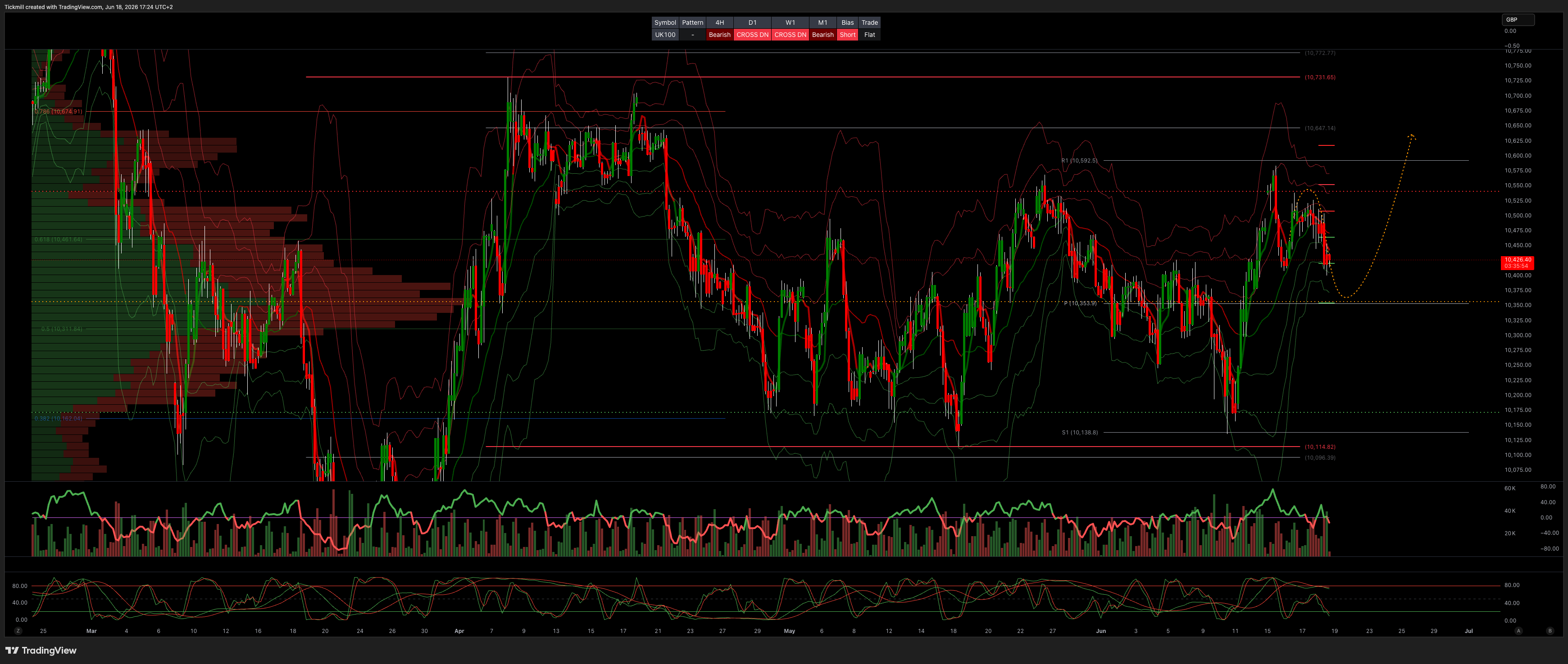
TECHNICAL & TRADE VIEW – FTSE100
Daily VWAP Bullish>Bearish
Weekly VWAP Bullish>Bearish
Above 10350 Target 11000
Below 10100 Target 9469
Comments
Log in or sign up to join the conversation.